Health officials participate in Global Summit on Traditional Medicine
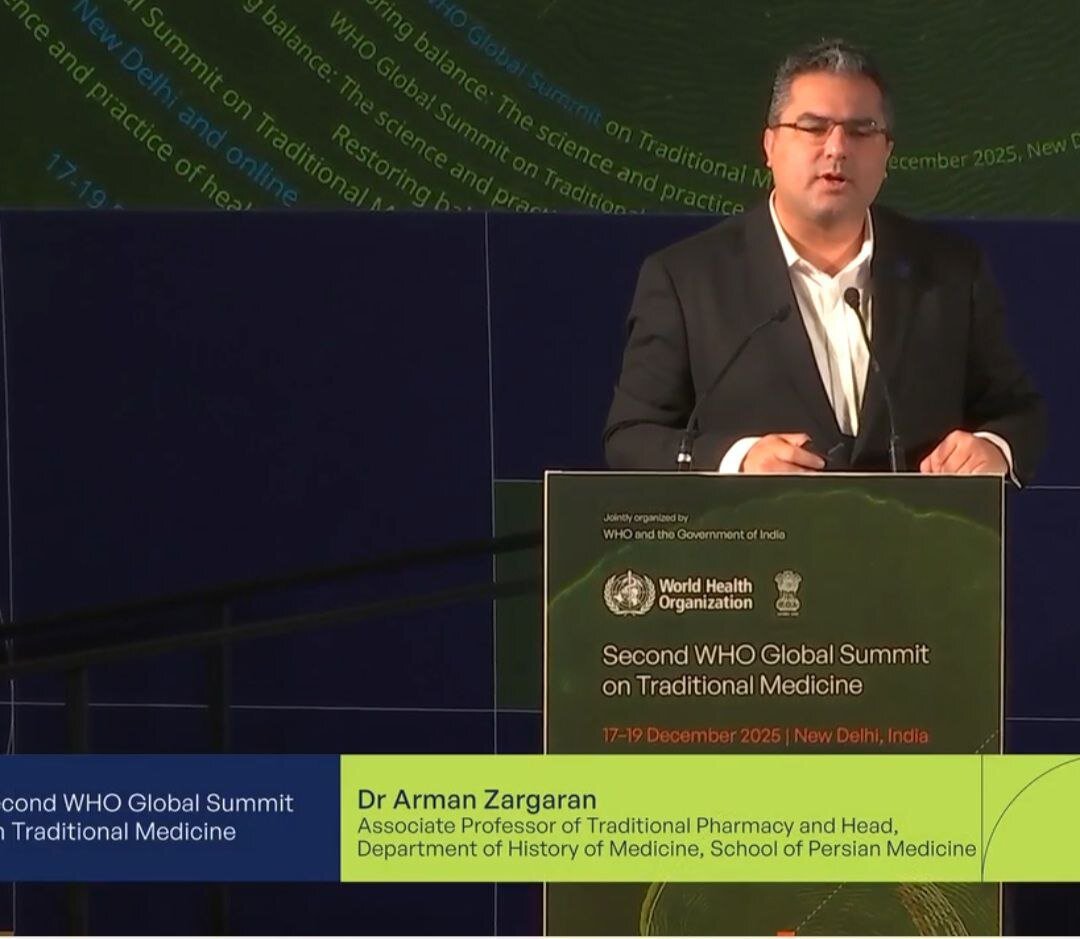
TEHRAN – The head of the health ministry’s traditional medicine office, Hossein Rezaeizadeh, the advisor to the health ministry’s traditional medicine office, Arman Zargaran, along with the ambassador to India, Mohammad Fathali, have attended the second World Health Organization (WHO) Global Summit on Traditional Medicine.
Co-organized by the WHO and the Government of India, the event was held from December 17 to 19, in New Delhi, under the theme ‘Restoring Balance: The science and practice of health and well-being’.
It brought together ministers, country representatives, policy-makers, researchers, innovators, indigenous Peoples, traditional medicine practitioners, and civil society from more than 100 countries.
During the summit, Iranian officials took part in specialized discussions on traditional medicine. Zargaran was the first speaker to deliver a speech, titled ‘Codifying complexities: standardization in traditional medicine research’, at the parallel session 2A themed ‘Translating the WHO Traditional Medicine Research Roadmap into Global Action’.
On the sidelines of the event, they conducted meetings with representatives from other countries to discuss the expansion of scientific interactions, with a focus on traditional medicine.
The second WHO Global Summit on Traditional Medicine aimed to advance a global movement to restore balance for people and the planet, grounded in the science and practice of Traditional Medicine.
Guided by the Global Traditional Medicine Strategy 2025–2034, the Summit highlighted the latest evidence and innovations, addressing critical issues including health systems regulation and integration, respectful information exchange with Indigenous Peoples and across knowledge paradigms, biodiversity preservation, and intellectual property rights, as well as the transformative potential of frontier technologies.
The participants committed to strengthening the evidence base for traditional medicine, supporting equitable access to safe and effective traditional medicine through appropriate regulatory mechanisms, integrating safe and effective traditional medicine into health systems, and optimizing cross-sector value through data, collaboration, and empowered communities.
Iranian traditional medicine
A recent survey has shown that 83.8 percent of people in the country tend to benefit from Iranian traditional medicine.
The survey’s findings have confirmed people’s positive attitude towards Persian traditional medicine. However, only 10 out of 83.8 percent use traditional medicine and supplements for the treatment of their illnesses, IRNA quoted Nafiseh Hosseini-Yekta, the director of the health ministry’s Persian medicine office, as saying.
Like many ancient medical systems, Persian medicine takes a holistic approach to health, emphasising lifestyle factors such as adhering to a proper diet, moderate exercise, sufficient sleep, and mental/emotional balance.
According to Roshanak Ghods, an associate professor of Persian medicine at Iran University of Medical Sciences, many treatments in Persian medicine focus on restoring balance and boosting the body’s natural healing capacities.
“The knowledge accumulated over centuries of practice and research provides clinical insights and therapeutic approaches complementary to modern medicine”, she said. “Preserving this medical tradition and making it accessible ensures that people today can benefit from this time-tested system of natural healing and its unique principles, but of course, we also need the evidence on the effectiveness and safety of traditional and complementary medicine, based on suitable research methods for personalised medicine.”
Ghods’ vision is for a health-care system that combines traditional and conventional medicine, without prejudice. “Our goal for the future should be to provide personalised, patient-centred care that addresses the person’s mind, body, and spirit”, she said.
Ghods encourages policymakers to work out the most responsible way to integrate traditional and conventional medicine and to ensure providers are knowledgeable about different treatment options and how they might interact with or complement each other. “Our ultimate aim should be to have a comprehensive health-care system focused on the patient’s needs and preferences, not proving the superiority of one medical discipline over the other”, she concluded.
MT/MG
Leave a Comment