Fractured fortress: Israel crumbling from within
TEHRAN – Israel often presents itself as a regional fortress, with its military active from Gaza to Lebanon, Syria, and Yemen, and in confrontations linked to Iran. From the outside, it seems untouchable, disciplined, and in control. But a closer look reveals that the walls are cracking. Every strike, every campaign is like a hammer blow against the world, yet the same blows reverberate inside, shaking Israel itself. The more Israel relies on force, the more the foundations beneath it weaken.
The war on Gaza has made this contradiction impossible to ignore. Israel has poured extraordinary military power into the enclave, convinced that overwhelming force would break Hamas and restore deterrence. Yet after more than two years of bombardment and ground operations, the strategic picture remains stubbornly unchanged. Hamas’s core structure survives. Captives were not recovered through military means. And Gaza’s political future is being shaped not in Tel Aviv, but in Cairo, Doha, Ankara, and Washington.
The same pattern extends across Israel’s other fronts. In Lebanon, Israel strikes Hezbollah with regularity, but the balance of deterrence remains frozen. In Syria, Israel can disrupt but not dictate outcomes. Even actions linked to Yemen or Iran reveal the same paradox: Israel can project force, but it cannot convert that force into lasting influence. Israel acts constantly, yet achieves little. Israel is an entity in perpetual motion, but without a destination.
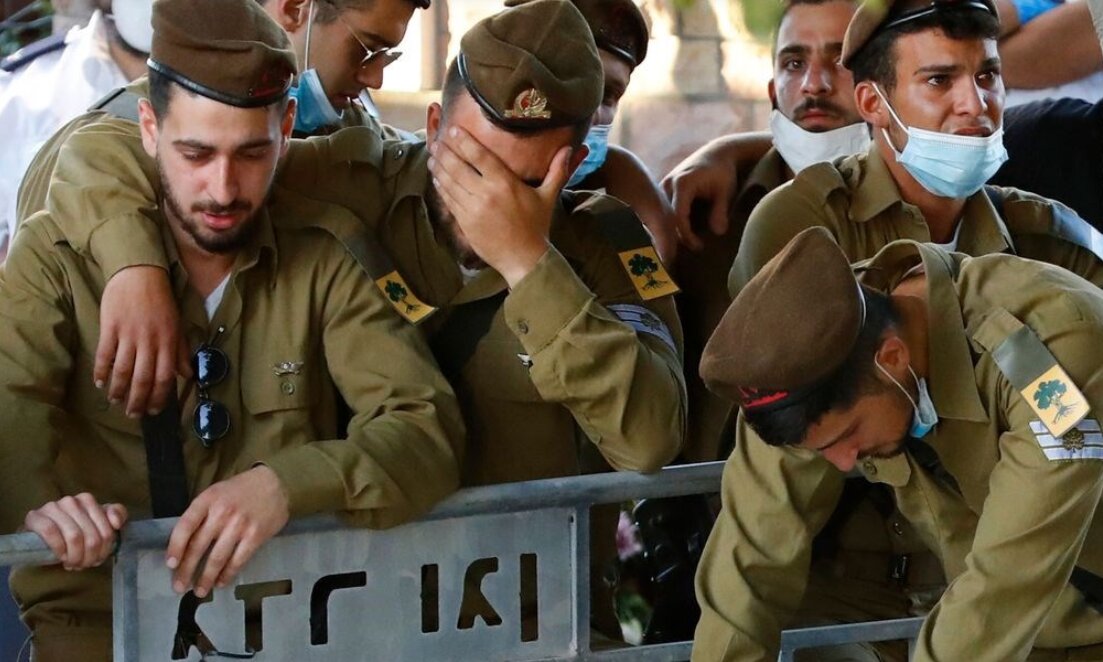
Inside Israel, the cost of this endless militarization is becoming increasingly visible. The army — long portrayed as Israel’s most disciplined institution — is showing signs of deep psychological strain. According to the Knesset Research and Information Center, roughly 280 soldiers attempted suicide between early 2024 and July 2025, with dozens of deaths confirmed by the army since the Gaza war began. These tragedies reflect a military pushed beyond its limits, asked to carry the weight of political failures it cannot solve.
Civilian institutions are no better. Hospitals operate at the edge of collapse. Mental health services are overwhelmed. Schools struggle to function. Courts sit half empty. Government ministries lose experienced staff faster than they can replace them. Israel’s political class has spent years feeding the military while starving the state. The result is an Israel that can launch airstrikes across the region but cannot keep its own institutions standing upright.
Politics, instead of offering solutions, deepens the crisis. Coalitions fracture and reform without producing direction. Ideological battles consume the energy needed for governance. Decision-making narrows to a handful of actors, not because the system is strong, but because the system beneath them is eroding. Israel increasingly governs through emergency, not policy, and an emergency cannot sustain a state indefinitely.
Demography adds another warning sign. More than 80,000 Israelis left Israel in 2024, while far fewer arrived, resulting in a net migration loss of nearly 59,000 people. A state once defined by immigration now watches its citizens depart. People do not abandon somewhere they believe in. They leave when they sense that the future is shrinking. The exodus reflects a deeper truth: Israel’s internal cohesion is eroding faster than its leaders admit.
Diplomatically, Israel’s room to maneuver is narrowing. Western support is more conditional. Regional actors increasingly shape events in Gaza and beyond. International scrutiny limits Israel’s freedom of action. The fortress still stands, but its foundations are no longer firm.
Israel’s crisis is not driven primarily by external enemies. It is driven by the accumulated weight of internal strain: endless conflict, political paralysis, institutional decay, social fragmentation, and demographic loss. War has become both a symptom of this decline and a shield that hides it. Israel remains armed and active, yet increasingly unable to sustain the cohesion and confidence that once defined it.
A fortress can withstand many sieges. But when the cracks run through its own foundations, collapse does not arrive with a dramatic blow — it arrives quietly, steadily, and from within. Israel’s greatest threat is not the enemies it names, but the structural unraveling it refuses to confront.
Leave a Comment