Commodities worth $1.2b exported from East Azarbaijan in 8 months
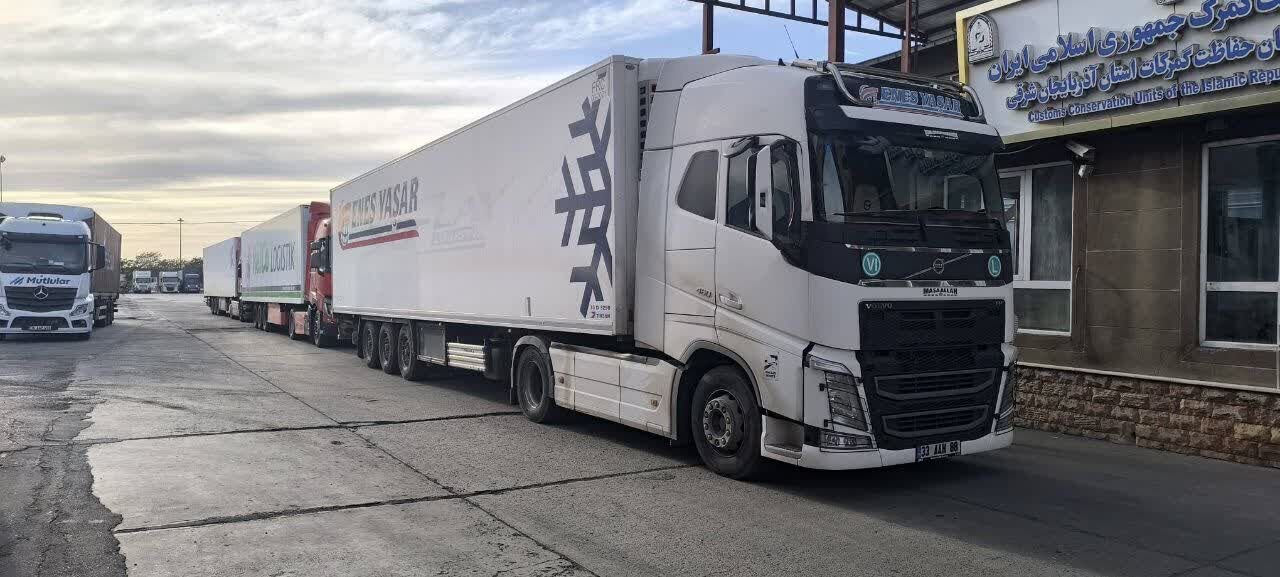
TEHRAN- Ali Asghar Abbaszadeh, the supervisor of Customs for East Azarbaijan Province, reported that 2.366 million tons of non-oil goods worth $1.244 billion were exported from the province in the first eight months of the current Iranian calendar year (March 21-Novemebr 21).
He added that among the total eight-month goods exports from the province's customs, Tabriz Customs, with exports worth $712 million and weighing 862,000 tons, accounted for the largest share.
Abbaszadeh stated: “The main items of exports from the province's customs during this period were cast iron, iron, and steel worth 224.6 million dollars; edible fruits, citrus peels, and melons worth 147.6 million dollars; petrochemical products and plastic articles worth 144.1 million dollars; copper and articles of copper worth 82.5 million dollars; and locomotives and railway signals worth 72 million dollars. These items were mainly exported to Turkey, Armenia, Iraq, Afghanistan, and Georgia.”
The supervisor of Customs for East Azarbaijan Province and the director-general of Tabriz Customs also announced that during the first eight months of this year, non-oil goods worth $941.516 million were imported to the province.
He said that the main imported items to the province included: machinery and mechanical appliances worth 144.6 million dollars; land vehicles and their parts and components worth 115.2 million dollars; tobacco worth 107.2 million dollars; meat worth 56.5 million dollars; and gold bullion worth 55.4 million dollars, along with some other permitted items. These items were mainly imported from Turkey, China, the United Arab Emirates, Germany, and Japan.
East Azarbaijan province, with its strategic capital of Tabriz, is a pivotal economic and industrial hub in northwestern Iran. Its economy is diversified, anchored by a strong industrial base that contributes significantly to Iran's non-oil exports. The province is renowned for its machinery, vehicle manufacturing (including Iran's largest tractor factory), petrochemicals, cement production, and food processing. Agriculture and animal husbandry also remain vital, with the province being a leading producer of crops, dairy, and honey.
Trade and transit are central to its economic identity due to its unique geopolitical position. East Azarbaijan shares borders with the Republic of Azerbaijan, Armenia, and Nakhchivan, making it Iran's primary gateway to the Caucasus, Russia, and Europe. Key border crossings like Bazargan (with Turkey) and Jolfa/Astara (with Azerbaijan) facilitate substantial overland trade. The province is a critical link in the International North-South Transport Corridor (INSTC), a major multimodal route connecting India, Iran, and Russia, enhancing its role as a regional transit powerhouse.
Tabriz hosts several special economic zones (SEZs) and industrial towns, such as the Tabriz and Sahand SEZs, which attract foreign investment and boost export-oriented production. Despite challenges like international sanctions and regional instability, the province leverages its skilled workforce, established infrastructure, and logistical advantages to maintain robust commercial links.
In summary, East Azarbaijan is a dynamic economic engine driven by heavy industry, diversified agriculture, and, most critically, its strategic position as Iran's premier transit corridor for Eurasian trade.
Beyond its heavy industries, East Azarbaijan possesses a rich heritage in traditional and handicraft industries, most notably the world-famous Tabriz carpet, a UNESCO-listed intangible cultural heritage and a major export commodity. The province is also a center for leather production, confectionery, and dried nuts, with its high-quality dried fruits being shipped globally. The historic Tabriz Bazaar, another UNESCO World Heritage site, continues to function as a vital commercial and social nexus for regional trade.
The province's agricultural sector is increasingly modernizing, with a focus on horticulture, greenhouse cultivation, and medicinal plants, adding value and diversity to its export basket. Furthermore, East Azarbaijan is emerging as a knowledge-based and technology hub, with the presence of advanced research centers and universities fostering innovation in fields like nanotechnology and biotechnology, particularly within the Sahand Science and Technology Park.
Looking ahead, the province's economic future is tightly linked to the expansion of cross-border cooperation and transit infrastructure. Major projects like the development of the Aras Free Trade-Industrial Zone and enhanced rail links through the INSTC are pivotal. These initiatives aim to solidify its position not just as a passageway, but as a value-adding logistical and industrial center where goods are processed, packaged, and manufactured for re-export. However, realizing this full potential requires navigating geopolitical complexities and attracting sustained foreign and domestic investment to upgrade ports, customs facilities, and supporting services, ensuring it can compete effectively on the international stage.
As the capital of East Azerbaijan province, Tabriz is not only the administrative heart of northwestern Iran but also its undisputed commercial and industrial powerhouse. The city's economy is a dynamic mix of heavy industry, traditional craftsmanship, and modern services, solidifying its position as a primary engine for Iran's non-oil GDP.
Tabriz is a major center for automotive and machinery production. It houses Iran's largest vehicle and tractor manufacturing complexes (Iran Khodro Diesel and Tractor Sazi Tabriz), which serve both domestic and export markets. The city's industrial base is diversified into petrochemicals, refinery operations, cement, electrical equipment, and pharmaceuticals. This manufacturing strength is anchored by well-established industrial towns and the sprawling Tabriz Special Economic Zone (SEZ), designed to attract investment and boost export-oriented production.
Tabriz's historic role as a Silk Road caravanserai continues through the iconic Tabriz Historic Bazaar Complex, a UNESCO World Heritage site. While still a vital center for commerce—particularly in hand-woven carpets (a key export commodity), leather goods, dried nuts, and spices—the city's modern trade flows through its official customs infrastructure. Tabriz Customs consistently handles the largest volume and value of trade in the province, processing the majority of exports to neighboring countries and imports of machinery, raw materials, and consumer goods.
Tabriz's economic significance is amplified by its strategic location as the key node in Iran's northwestern trade corridor. It is the principal logistical and distribution center for goods moving to and from Turkey, the Caucasus (Azerbaijan, Armenia, Georgia), Russia, and Europe via land borders. This role is further enhanced by its connection to the International North-South Transport Corridor (INSTC), positioning Tabriz as a critical inland hub for multimodal Eurasian freight.
Beyond traditional industries, Tabriz is fostering growth in knowledge-based economies. With prestigious universities and research centers, it is developing capacities in nanotechnology, biotechnology, and advanced materials within tech parks like Sahand. This, combined with its established industrial muscle and transit advantages, makes Tabriz a resilient and multifaceted economic center, crucial for Iran's regional trade integration and domestic production goals.
MA
Leave a Comment