Tehran, Moscow holding workshops on drug abuse prevention, rehabilitation
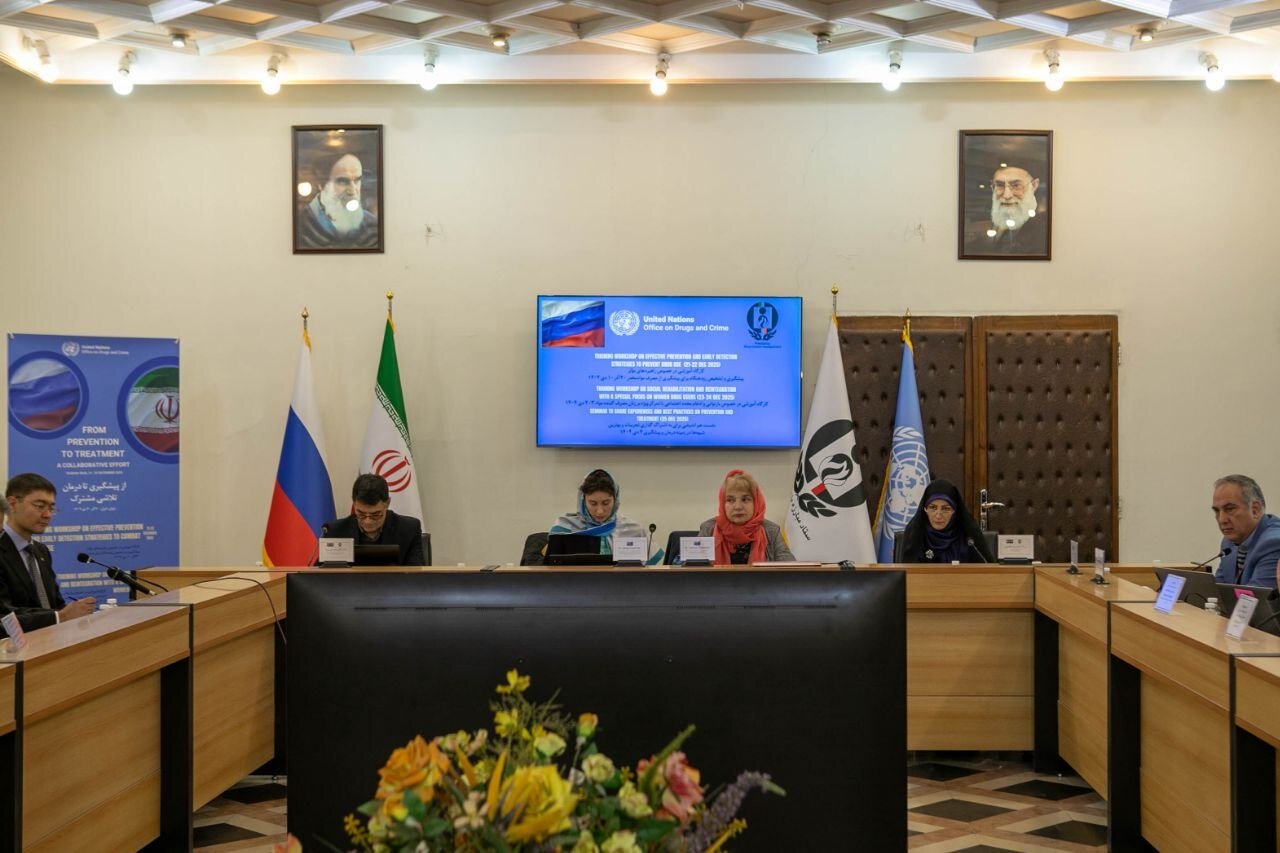
TEHRAN – The Drug Control Headquarters (DCHQ) of the country, in cooperation with the Russian Federation, is conducting workshops that provide effective strategies for the early detection and prevention of drug abuse in Tehran and eight other provinces of the country.
A group of senior police officers of the Iranian Anti-Narcotics Police, representatives of 15 executive bodies and ministries working in the field of drug prevention, and 10 non-governmental organizations (NGOs), are participating in the four-day workshops.
The event includes ‘Training workshop on effective prevention and early detection strategies to prevent drug use’ (December 22 -23), and ‘Training workshop on social rehabilitation and reintegration with a special focus on women drug abuse’ (December 23-24),
During the opening ceremony of the workshop, Alexander Fedulov, Deputy Regional Representative of UNODC for Afghanistan, Central Asia, Iran, and Pakistan, said, “Our presence here today demonstrates a shared understanding that drug-related problems know no border. Illicit drug markets, emerging patterns of consumption, health, and social consequences are turning into a global trend. Therefore, no single country can address these challenges.”
Effective responses require international collaborations, mutual learning, and ongoing exchange of scientific knowledge and expertise.
The agenda is an example of joint efforts bringing together leading experts from the Russian Federation and Iranian experts in fields of prevention, treatment, rehabilitation, and policymaking, providing a platform for comparative learning, rethinking ideology, and sharing successful experiences, the official added.
Substance use disorders are complex, multifactorial conditions that require coordinated, evidence-based, and interdisciplinary responses across health, social, educational, and law enforcement systems, Fedulov noted.
The official went on to say that early health-centered and community-based prevention is one of the most cost-effective and sustainable investments for communities. Moreover, access to proper treatment and social reintegration, along with maintaining human dignity, play a fundamental role in reducing harm, preventing relapse, and restoring individual and social health.
For her part, Tatiana Klimenko, Deputy Head of the Russian Medical Research Center on Psychiatry and Narcology, said drug abuse is a global, not national problem. All the countries are grappling with drug abuse and its consequences.
“Drug prevention structure in Russia is different from that of other countries. In our country, drug substitution is more important. Our main focus is on prevention and treatment, followed by rehabilitation. Prevention includes comprehensive and scientific programs in combating drugs, medical rehabilitation, and various scientific programs,” Klimenko added.
She considered the family a key factor in combating addiction, saying that in Russia, special attention is paid to strengthening families, traditions, and customs for the prevention of addiction.
Lauding UNODC supports, Zahra Abedini, an official with DCHQ, for her part, said that drug prevention, particularly non-medical use of illicit drugs, is one of the most important social challenges worldwide. However, utilizing the experiences of other countries and international cooperation will make it more feasible.
There is a growing international consensus on preventive interventions in drug demand reduction and counter-narcotics. The current workshop “aims at boosting drug prevention approaches and sharing experiences; the goal is not to merely share models, but to localize shared experiences in accordance with Iran’s culture and traditions,” Abedini added.
According to the official, drug prevention policies in Iran are centered on several key issues, including empowering children and adolescents, strengthening family foundations, providing life skills training, developing early interventions, and focusing on students, adolescents, and youth.
The official expressed hope that the workshop would lay the ground for the expansion of collaborative efforts in conducting scientific, educational, and research projects between DCHQ and the Russian Federation.
UNODC, Russia strengthen anti-narcotics capacities in Iran
In November, the UNODC in Iran, in coordination with the DCHQ of the Islamic Republic of Iran, successfully organized the fourth specialized training course on “Combating Drug Trafficking” for senior officers of the Anti-Narcotics Police of the Islamic Republic of Iran, under generous funding received from the Russian Federation.
This five-day capacity-building program, held in Tehran from 09 to 13 November 2025, was conducted by two senior instructors from the Siberian Law Institute of the Ministry of Internal Affairs of the Russian Federation. The training covered a wide range of topics, including modern investigative techniques, the use of information technology in law enforcement, identification of new psychoactive substances, and methods of detecting and investigating online drug trafficking and money laundering crimes.
In addition to theoretical lectures, the training included interactive workshops and group exercises, allowing participants to apply their newly gained knowledge in simulated operational scenarios. These team-based sessions provided practical experience in coordination, intelligence gathering, and case analysis — enhancing participants’ readiness for real-life law enforcement operations.
During the opening session, Fedulov expressed his appreciation to all national counterparts and participants, highlighting UNODC’s continued commitment to supporting Iran’s anti-narcotic efforts through technical assistance and capacity-building programs under the Country Partnership Program (2023–2026).
The training sessions were designed based on feedback from Iranian authorities and focused on strengthening operational and analytical skills in combating transnational drug trafficking. The participants highly appreciated the relevance, practical orientation, and interactive nature of the training materials.
As part of the program, the Russian instructors also visited the Anti-Narcotics Police Exhibition in Tehran, where they became acquainted with the advanced operational capacities, technical capabilities, and achievements of Iran in the field of counter-narcotics.
The course concluded with a certificate presentation ceremony, where UNODC expressed gratitude to the Government of the Russian Federation for its generous financial contribution and to the Drug Control Headquarters for its valuable support and coordination in organizing the event.
This initiative was implemented under Sub-Program 1: Border Management and Illicit Trafficking of the UNODC Country Partnership Program (2023–2026) for the Islamic Republic of Iran, funded by the Russian Federation.
MT/MG
Leave a Comment