‘Board of Peace’: A new tool for American control
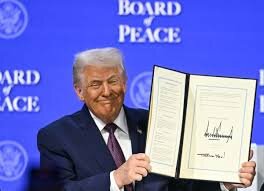
TEHRAN – U.S. President Donald Trump officially unveiled the so-called “Board of Peace” for Gaza at a signing ceremony in Davos on Thursday.
When the proposal was first announced several months ago, the White House framed it as an initiative aimed solely at supporting a Gaza ceasefire plan.
Since then, it has evolved into a much broader institution, supposedly with authority to address flashpoints in other regions around the world.
“It can do pretty much whatever we want it to do,” Trump said. True to that claim, Trump, who will serve as chair of the board, moved swiftly to remove U.S. ally Canada after Prime Minister Mark Carney spoke out against U.S. tariffs.
Trump has indicated the board could take over some UN functions and potentially render the organization obsolete. He stated that the UN “hasn’t been very helpful” and “has never lived up to its potential.”
Ironically, Washington convened a UN Security Council session for its “Board of Peace” to garner global support for Gaza, which allowed the resolution to pass.
Now, the eleven-page charter of the board does not refer to the Gaza Strip. The UN says its mandate will be limited to Gaza alone.
The U.S. expansion has raised concerns internationally. Despite the Security Council’s well-known structural flaws and its urgent need for comprehensive reform to make it more representative and effective, it remains the only international body grounded in widely recognized legal legitimacy.
Trump’s new committee is taking shape in the aftermath of U.S. aggression against Venezuela and his threats to take control of Greenland.
In reality, the establishment of a “Board of Peace” has nothing to do with peace. It represents a deliberate attempt by the U.S to bypass international law, neutralize the UN, and impose political outcomes that serve American and Zionist interests.
Nowhere has this behavior been more visible than in the UN Security Council, where Washington has repeatedly abused its veto power to shield the Zionist regime from accountability, even in the face of overwhelming evidence of war crimes and mass civilian suffering.
Throughout the Gaza genocide, the U.S. veto was used to block ceasefire resolutions and prevent any binding measures aimed at protecting Palestinian civilians.
This diplomatic cover enabled the Zionist regime to continue its daily massacres of Palestinian women and children.
At the same time, the United States has a long record of launching military interventions without Security Council authorization, or by distorting concepts such as “self-defense” and “humanitarian intervention.”
These practices have hollowed out international law and reduced the Security Council to a forum where power, not justice, determines outcomes.
Against this background, the idea of a “Board of Peace” emerged after military solutions were exhausted in Gaza. Washington and Tel Aviv began searching for a political mechanism to manage the strip without granting Palestinians real sovereignty.
Critics say Trump’s new board would function as an alternative to the UN Security Council, one free from vetoes by China or Russia, and firmly under American control.
This is precisely why Washington prefers bypassing the Security Council rather than reforming it. Genuine reform, such as limiting veto power or expanding permanent membership to include the Global South, would weaken U.S. dominance.
Rather than accept a more democratic international system, the U.S. is attempting to build parallel institutions where it sets the rules and dictates outcomes.
Such a body would not challenge American aggression or the Israeli regime’s violations of international law.
On the contrary, it would legitimize them under the language of “peacebuilding,” just as previous U.S.-led initiatives have done in Iraq, Afghanistan, and elsewhere, with catastrophic results.
Leave a Comment