Jihad Square mural depicting Ferdowsi’s line on love of homeland
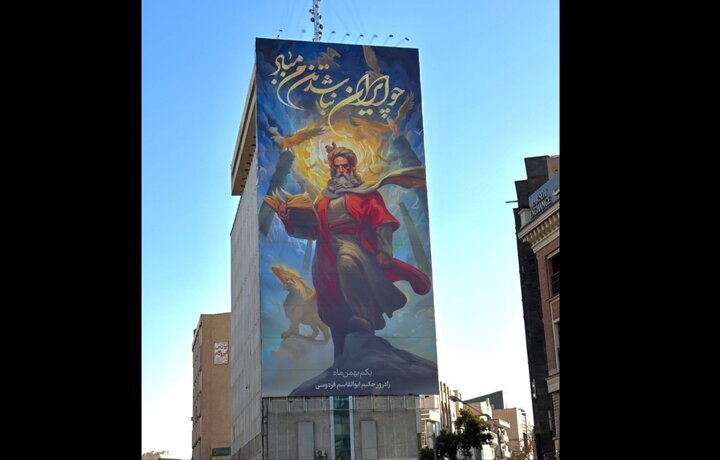
TEHRAN – A new mural at Jihad Square in Tehran was unveiled on Thursday, showing the great Persian poet Ferdowsi along with one of his most famous verses in the legendary Persian epic “Shahnameh” (Book of Kings).
Designed by Mikail Barati, the mural has decorated the city on the occasion of the birthday of Ferdowsi, who has always been associated with patriotism and love of the homeland, and includes the verse “If there is no Iran, may my body not remain,” referring to the recent unrest in the country, Mehr reported.
Ferdowsi's “Shahnameh” frequently portrays Iran's battles against external enemies, particularly the Turanians, as a central theme. However, the epic also delves into internal conflicts and the consequences of division within Iran. It emphasizes the importance of national unity and the dangers of internal strife, portraying it as a threat to Iran's strength and well-being. While the epic celebrates Iranian heroism and victories, it also highlights the ethical considerations of warfare and the importance of justice and compassion, even towards enemies.
“Shahnameh” is a unique literary masterpiece filled with epic, romantic, and mythical stories. Its storytelling style aligns perfectly with narrative traditions worldwide and offers deep insights into Iranian culture, art, and even the governance, and political traditions of ancient Persia.
The book is a cornerstone of Persian literature and identity, chronicling the mythical and historical past of Iran from the creation of the world until the Arab conquest in the 7th century. Through poetic storytelling, it promotes themes of justice, heroism, and resistance against oppression.
Hakim Abul-Qasem Ferdows (940-1020) was a Persian poet and the author of “Shahnameh,” which is one of the world's longest epic poems created by a single poet, and the greatest epic of Persian-speaking countries.
He is celebrated as one of the most influential figures of Persian literature and one of the greatest in the history of literature.
Ferdowsi's patriotism is prominently displayed in his epic poem “Shahnameh”, where he celebrates Iranian history, culture, and language, and champions the values of courage, wisdom, and national pride. His work is seen as a powerful assertion of Iranian identity.
The verse line accompanied by the image of Ferdowsi on the mural is a tribute to Iran's rich history and culture, expressing deep affection of Iranians for their homeland.
The recent unrest in the country, which started with protests over currency market volatility among Iran’s bazaaris, was exploited by the U.S. and Israel and, supported by the foreign regimes, devolved into systemic urban terrorism in an effort to overthrow the Islamic Republic.
The atrocities of the U.S. are deeply rooted in decades of geopolitical conflict, ideological opposition, and historical trauma.
The U.S. has imposed multiple rounds of economic sanctions on Iran, targeting banking, oil, trade, and even medicine. These sanctions are seen by many Iranians as acts of economic warfare, harming ordinary people and undermining national development. The Trump administration’s withdrawal from the 2015 Iran nuclear deal (JCPOA) and the “maximum pressure” campaign intensified this perception of hostility.
The U.S. military presence in the Middle East (especially in Iraq, Syria, and the Persian Gulf), its close alliance with Israel, and the targeted killing of General Qasem Soleimani in 2020 all reinforce the Iranian view of the U.S. as a direct and dangerous adversary.
Moreover, on June 22, the United States bombed Iranian nuclear facilities during the 12-day Iran-Israel war.
In the early hours of June 13, 2025, the Israeli regime launched an unprovoked act of military aggression against the sovereign territory of the Islamic Republic of Iran, martyring revered commanders of the Islamic Revolution Guard Corps (IRGC) and prominent nuclear scientists, alongside civilians.
The strikes continued for 12 days, targeting civilian nuclear facilities and residential areas, violating all international norms and threatening to ignite a regional conflagration.
Responding to Israel’s aggression, the Islamic Revolution Guards Corps (IRGC) launched Operation True Promise III and unleashed coordinated missile and drone strikes deep inside the occupied territories, targeting military and intelligence command centers. On 24 June, Israel and Iran agreed to a ceasefire.
Throughout the 12 days of hostilities, the fighting caused widespread destruction. Reports indicated that at least one-third of Tel Aviv was heavily damaged or destroyed by Iranian strikes. Tehran and other Iranian cities also suffered significant damage, underscoring the severity of the conflict. Civilian casualties and infrastructure damage increased the humanitarian toll and heightened regional instability.
International reactions to the conflict were significant. U.S. President Donald Trump reportedly demanded the evacuation of Tehran and threatened to take lethal action against Iran's leadership, further complicating diplomatic efforts to de-escalate the situation. The international community closely watched the escalation, with many nations urging restraint and calling for peace talks to prevent further loss of life.
In the aftermath of the war, Iran has embarked on various initiatives to commemorate the conflict and honor those affected. Cultural and artistic events, including exhibitions, festivals, and literary gatherings, have been organized to remember the martyrs and celebrate Iran's resilience in the face of adversity. These efforts aim to foster national unity and reflect on the sacrifices made during the days of intense fighting and unrest.
SS/SAB
Leave a Comment