Tehran’s City Theater hosting “Rostam and Esfandiyar”
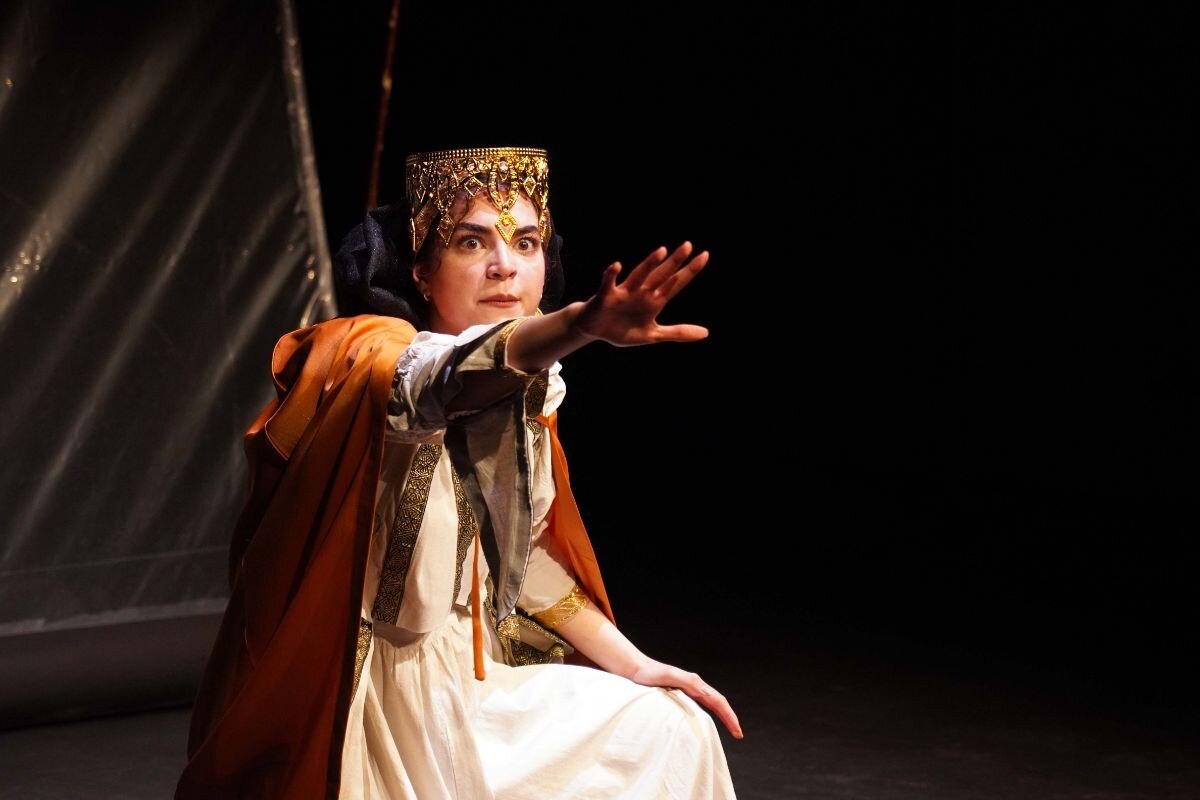
TEHRAN – The play “Rostam and Esfandiyar” directed by Dariush Nassiri and Reza Hassankhani is on stage at the City Theater in Tehran.
Negin Zeynivand is the only performer in this 60-minute play, which will be staged through February 20, Honaronline reported.
The central focus of the story is why and how Rostam guarded defended Iran and the Iranian people. This theme is narrated and performed by Katayoun, the mother of Esfandiyar, in the form of a monodrama (solo performance), using a modern theatrical approach.
The production is a fully research-based, academic work, born of the integration of theory and practice. It has been developed through the collaboration of university professors and students of dramatic arts, resulting in a performance that embodies a distinct Iranian identity and sense of cultural authority.
Katayoun is a female figure in Ferdowsi’s epic book “Shahnameh” (The Book of Kings) and Iranian mythology. She is married to Goshtasb and the mother of Esfandiyar.
Battle of Rostam and Esfandiyar is a story in “Shahnameh”. It narrates a war between two Iranian governments. The difference from the other wars is that only the warlords are engaged in duels and the division is both observers. The reason for the war is Rostam's disobedience to Esfandiyar's father, Goshtasp, the king of Iran.
When Goshtasp seized power in Iran, all countries were loyal except Zabol. Esfandiyar was commissioned to invade that country and capture Rostam, the leader of the Zabolians.
Esfandiyar departed with a small number of troops and camped near a river near the city of Zabol. He sent his son, Bahman to convey the message of the Shah of Iran to the leaders of Zabol. There was no profit in the chatter and the talks, and the duel between the two gladiators began.
The battle lasted for several days but neither one was defeated. Rostam complained to his father Zal of the difficult battle and Zal took help from Simorgh (a benevolent bird in Persian mythology and literature) for Rostam to win the battle.
According to the “Shahnameh,” Esfandiyar was the Crown Prince and a Divine Warrior of ancient Iran who supported the prophet Zarathustra, enabling him to spread the religion of Zoroastrianism.
He also fought against many apostates and enemies of Zarathustra. In return, Zarathustra gave him a chain and armor from Heaven. The armor made him invulnerable and the chain had the power to bind anyone, even a demon or evil magician, making them unable to escape.
Esfandiyar is best known for the tragic story of a battle with Rostam. It is one of the longest episodes in Shahnameh and is one of its literary highlights.
Rostam is a legendary hero in Iranian mythology and historical tradition. In the “Shahnameh,” Rostam and his predecessors are guardians of Sistan (present-day Iran and Afghanistan).
Rostam is best known for his tragic fight with Esfandiyar, the other legendary Iranian hero, for his expedition to Mazandaran (not to be confused with the modern Mazandaran Province), and for the story of his Seven Labors.
Rostam was always represented as the mightiest of Iranian paladins (holy warriors), and the atmosphere of the episodes in which he features is strongly reminiscent of the Parthian Empire.
The “Shahnameh” is a long epic poem written by the Persian poet Ferdowsi between 977 and 1010 CE. Consisting of some 50,000 couplets (two-line verses), the “Shahnameh” is one of the world's longest epic poems, and the longest epic poem created by a single author.
It tells mainly the mythical and to some extent the historical past of Iran from the creation of the world until the Muslim conquest in the seventh century. Iran, Azerbaijan, Afghanistan, Tajikistan and the greater region influenced by Persian culture such as Armenia, Dagestan, Georgia, Turkey, Turkmenistan, and Uzbekistan celebrate this national epic.
The work is of central importance in Persian culture and Persian language. It is regarded as a literary masterpiece, and definitive of the ethno-national cultural identity of Iran.
SS/SAB
Leave a Comment