IAF to show “The Duchess of Malfi”
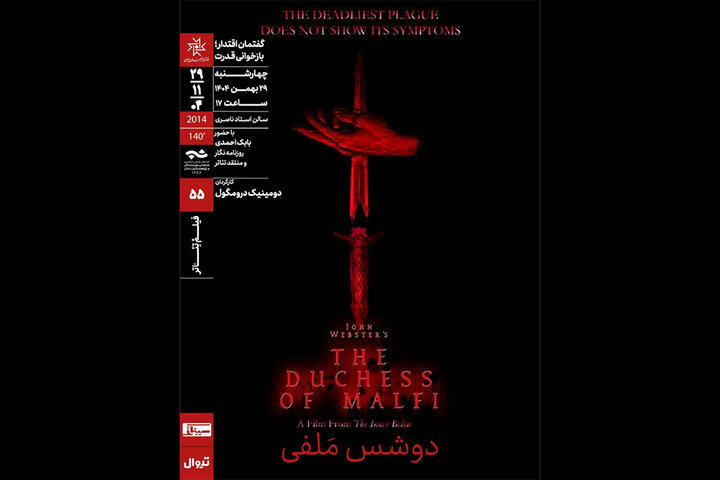
TEHRAN – The Iranian Artists Forum (IAF) in Tehran will screen and review the filmed theater “The Duchess of Malfi” directed by Dominic Dromgoole on Wednesday.
The 55th program in the series of screening of prominent filmed theaters will be dedicated to the 2014 movie, a Jacobean revenge tragedy written by English dramatist John Webster in 1612–1613, IRNA reported.
The movie will be screened at the Nasseri Hall of the IAF at 5 p.m. and will be followed by a review session in the presence of the journalist and film critic Babak Ahmadi.
Published in 1623, the play is loosely based on events that occurred between 1508 and 1513 surrounding Giovanna d'Aragona, Duchess of Amalfi (d. 1511), whose father, Enrico d'Aragona, Marquis of Gerace, was an illegitimate son of Ferdinand I of Naples. As in the play, she secretly married Antonio Beccadelli di Bologna after the death of her first husband Alfonso I Piccolomini, Duke of Amalfi.
The play begins as a love story when the Duchess marries beneath her class, and ends as a nightmarish tragedy as her two brothers undertake their revenge, destroying themselves in the process. Jacobean drama continued the trend of stage violence and horror set by Elizabethan tragedy, under the influence of Seneca.
The complexity of some of the play's characters, particularly Bosola and the Duchess, and Webster's poetic language, have led many critics to consider “The Duchess of Malfi” among the greatest tragedies of English renaissance drama.
In January 2014, Shakespeare's Globe staged a production directed by Dominic Dromgoole and starring Gemma Arterton as the Duchess, James Garnon as the Cardinal, David Dawson as Ferdinand, Alex Waldmann as Antonio, and Sean Gilder as Bosola.
John Webster was one of the best Jacobean playwrights of the early 17th Century. Mostly, he wrote dark and intricate tragedies. His writing explores the themes of power, corruption, and the complexity of human nature. This style of his has left an everlasting impact on English literature.
“The Duchess of Malfi” depicts gender and class conflict in the 17th century. It also shows the pathetic condition of women in the 17th century society. Girls and women had no rights in society. It was a patriarchal society. Women and girls were under the control of their fathers and brothers. They were not allowed to marry a man of their choice.
The play is a culmination of tragedy depicting the consequences of unchecked power, betrayal, and societal constraints. The death of the Duchess and her children symbolizes the strong grip of fate and the inevitable consequences of a character’s choices. It serves as a reminder of the tragic outcomes when individuals are trapped in a web of deceit, power struggles, and moral decay, ultimately leading to their downfall.
John Webster (c. 1578 – c. 1632) was an English Jacobean dramatist best known for his tragedies “The White Devil” and “The Duchess of Malfi,” which are often seen as masterpieces of the early 17th-century English stage. His life and career overlapped with Shakespeare's.
SS/
Leave a Comment