Persian calligraphy exhibition, master class held at Eurasian National University in Kazakhstan
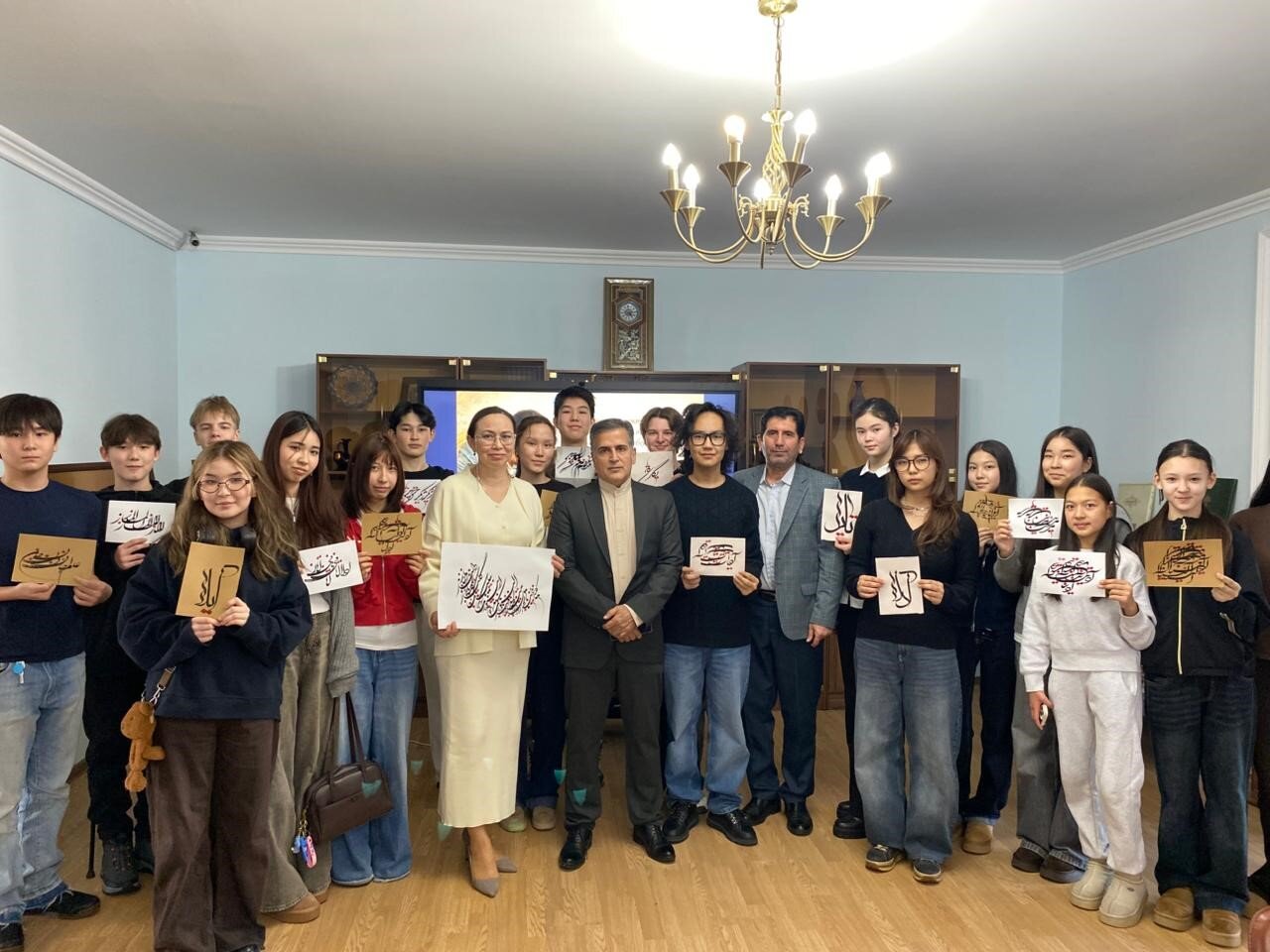
TEHRAN – An exhibition and master class on the art of Persian calligraphy was held at the L.N. Gumilyov Eurasian National University in Astana by the master Iranian calligrapher Hadi Ghasemi, with the support of the Cultural Attaché of the Islamic Republic of Iran in Kazakhstan, on the weekend.
At the event, Ghasemi spoke about the history, formation, and evolution of Persian calligraphy across different historical periods and the role of this art in Iranian–Islamic civilization. He also elaborated on the spiritual and aesthetic dimensions of calligraphy and the place of great calligraphers in the contemporary art scene, ILNA reported.
The connection between calligraphy and Qur’anic texts, classical Persian literature, and Iranian cultural identity was also highlighted. These discussions provided a deeper introduction to Iranian civilization, cultural values, and its role in the flourishing of Islamic art.
A significant portion of his remarks focused on traditional writing tools, the structural principles and composition of letters, and the rules of harmony in calligraphy.
Through a live demonstration, Ghasemi practically showcased various calligraphic styles for the participants. In addition, as a memento, he handwrote each participant’s name on special calligraphy paper and presented it to them.
Also speaking at the event, Gulnara Userbaevna, head of the Department of Oriental Studies at Eurasian National University, emphasized the scientific and cultural importance of the program in advancing Oriental studies and strengthening academic cooperation between the educational and cultural institutions of the two countries.
Some university officials also emphasized the importance of continuing such programs, including short-term calligraphy courses at Kazakh universities.
The Iranian calligraphy master presented one of his artworks as a commemorative gift to the management and members of the university’s Department of Oriental Studies.
Alongside the workshop, a collection of Persian calligraphy works, including examples of Nastaʿliq and Shekasteh-Nastaʿliq scripts, was displayed in an exhibition. These works not only introduced the beauty of Persian script but also demonstrated the connection between calligraphy, literature, poetry, and Islamic teachings.
Simultaneously with the workshop, a meeting was held between Majid Aligar, the cultural attaché of Iran in Kazakhstan and Ibrai Sayat, dean of the School of Arts and Humanities of the Astana International University.
The two sides exchanged views on prospects for bilateral cooperation and discussed practical measures such as organizing joint lectures, holding art exhibitions, supporting students of Oriental studies, and academic delegation exchanges.
Aligar emphasized the importance of linking authentic art with the academic environment and proposed elevating cooperation from exhibition-level activities to deeper scholarly engagement.
He also underscored the key role of academic exchanges in enabling scholars of both countries to better understand each other’s capabilities.
For his part, Sayat referred to the region’s shared civilizational roots and expressed readiness to organize joint academic sessions and create platforms for introducing Iranian art and history within curricular and extracurricular programs.
He noted that Astana International University could become a hub for cultural and civilizational dialogue between the two countries.
In another event, the Cultural Attaché of the Islamic Republic of Iran in Astana hosted students from the School-Gymnasium No. 91.
The first part of the program was dedicated to introducing the tangible heritage of Persian civilization. An exhibition of Iranian handicrafts and calligraphy works was held, among which exquisite examples of khatamkari (marquetry) and minakari (enamelwork) particularly attracted attention.
The exhibition guide provided detailed explanations of the historical and archaeological value of these works and the students established a direct and meaningful connection with Iranian culture through the artifacts.
The importance of such visits in deepening bilateral relations between Iran and Kazakhstan and familiarizing the younger generation with Iran’s rich cultural heritage was emphasized.
Zhantore Zakiyev, an intern at the Cultural Attaché Office, introduced Iran’s literary heritage in the local language. He presented outstanding works of Persian literature and made special reference to the timeless book “Golestan” by Saadi Shirazi.
The program continued with the screening of a documentary produced by the Cultural Attaché Office for the students. The film beautifully portrayed Iran’s tourism capacities—from the ancient ruins of Persepolis and the turquoise domes of Isfahan to the semi-tropical forests along the Caspian Sea and the vast deserts of Dasht-e Lut. It particularly highlighted Iran’s achievements in social development, scientific and technological progress, and contemporary cultural symbols.
At the event, Majid Aligar elaborated on the mission’s cultural, educational, scientific, artistic, and intercultural dialogue programs in Kazakhstan.
He added that the primary priority of Iran’s Cultural Attaché Office, beyond introducing the country’s civilizational heritage, is to establish lasting bonds of friendship and cooperation between the peoples of Iran and Kazakhstan.
Calligraphy master Hadi Ghasemi, spoke about various dimensions of traditional Iranian calligraphy, explaining the historical development of the six classical scripts, its philosophical aspects, and the role of the written word in Islamic culture.
Gulnar Ahmadova, Deputy Principal of the school, noted that such visits not only broaden students’ perspectives but also teach them respect for global cultural diversity and cultivate human values in them.
SS/SAB
Leave a Comment