Iran, Russia stress deeper strategic ties as joint economic committee meeting opens
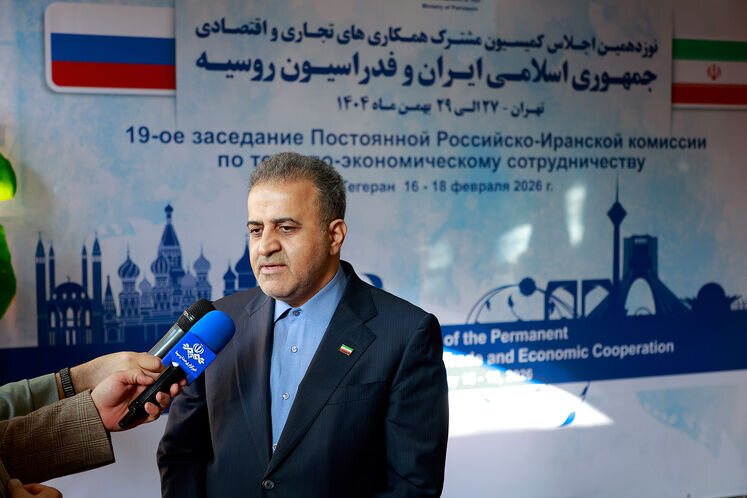
TEHRAN – Iran and Russia opened the 19th session of their Joint Economic Committee on Monday, underscoring efforts to convert bilateral understandings into executable projects and results-driven cooperation.
Seyed Ali-Mohammad Mousavi, Iran’s deputy oil minister for international affairs and commerce, said Tehran views the meeting as an opportunity to record progress made by expert delegations and to finalize a new joint document with defined timelines and clear responsibilities.
He said relations between the Islamic Republic of Iran and the Russian Federation are based on mutual respect, shared interests and aligned views on regional and international developments, adding that cooperation has expanded in recent years across energy, trade, transport, science and technology.
Khalimat Karimovna Budunova, the Russian secretary of the joint committee, described Iran as a friend, brotherly nation and strategic partner of Russia, and stressed both sides’ determination to deepen strategic cooperation and translate agreements into practical projects.
She said the committee provides an effective platform to register progress achieved by working groups and to pursue cooperation with an operational and outcome-oriented approach, backed by the political will of both countries’ leadership.
Mousavi said the Oil Ministry, which oversees the committee, is focused on expanding balanced economic ties, increasing private sector participation, removing trade barriers and advancing joint projects, including through greater use of transit and regional capacities.
He added that Iran is ready to work with Russia to implement previous agreements and define new initiatives.
Both officials said deeper ties require mutual trust, continued dialogue and close monitoring of commitments through specialized working groups.
At the 18th committee meeting, 193 clauses were agreed, of which more than 75 percent have been implemented, according to their assessments.
Sixteen expert-level working groups are meeting over two days, followed by a limited session of the commission heads and a plenary meeting on Wednesday. The final memorandum of understanding is due to be signed by Iran’s Oil Minister Mohsen Paknejad and Russia’s Energy Minister Sergey Tsivilyov.
For the first time, a monitoring system has been designed to track implementation of the committee’s resolutions and agreements.
The system is being launched on a pilot basis and will also facilitate drafting and finalizing the 19th memorandum.
The committee, which runs through Wednesday at Tehran’s International Conference Center, is reviewing a broad range of issues, including completion of the International North–South Transit Corridor (INSTC), gas transfers from Russia to Iran and expanded cooperation in space industries, nuclear energy, trade and investment, finance and banking, customs, industry and mining, agriculture, healthcare, culture, tourism, science and technology.
The 18th committee meeting was held in Moscow in May. Iranian and Russian officials say regular convening of the joint commission plays a key role in strengthening long-term strategic ties and advancing economic cooperation based on shared interests.
Iran’s Oil Minister Mohsen Paknejad has described the 19th meeting of the Iran–Russia Joint Economic Committee as a pivotal opportunity to deepen strategic ties between Tehran and Moscow and open a new chapter in bilateral economic relations.
Paknejad, who heads the Iranian side of the committee, said the session will provide a platform to advance cooperation across a broad range of sectors.
He noted that a preparatory coordination meeting was held earlier with deputy ministers and representatives of relevant executive bodies to review the latest status of joint projects, assess progress on previous agreements, and finalize priorities for the upcoming talks.
He stressed the importance of unified coordination among Iranian institutions to accelerate the implementation of priority projects and ensure tangible outcomes from the commission’s work.
According to the minister, expert-level discussions on February 16 and 17 will focus on priority projects and agreements in trade, energy, transport, financial and banking cooperation, peaceful nuclear energy, healthcare and other economic fields.
The finalized cooperation documents are expected to be signed on the final day of the meeting.
Paknejad also pointed to evolving regional and international conditions, emphasizing that stronger economic collaboration between Iran and Russia can enhance the economic resilience of both countries and contribute to shaping a framework of cooperation based on shared interests.
He expressed optimism that sustained coordination among executive agencies and the efforts of the commission’s secretariat would lead to the signing of significant agreements and the launch of a new phase in Tehran–Moscow economic relations.
EF/MA
Photo: Seyed Ali-Mohammad Mousavi, Iran’s deputy oil minister for international affairs and commerce
Leave a Comment