Israel’s renewed anxiety over Egypt’s strategic weight
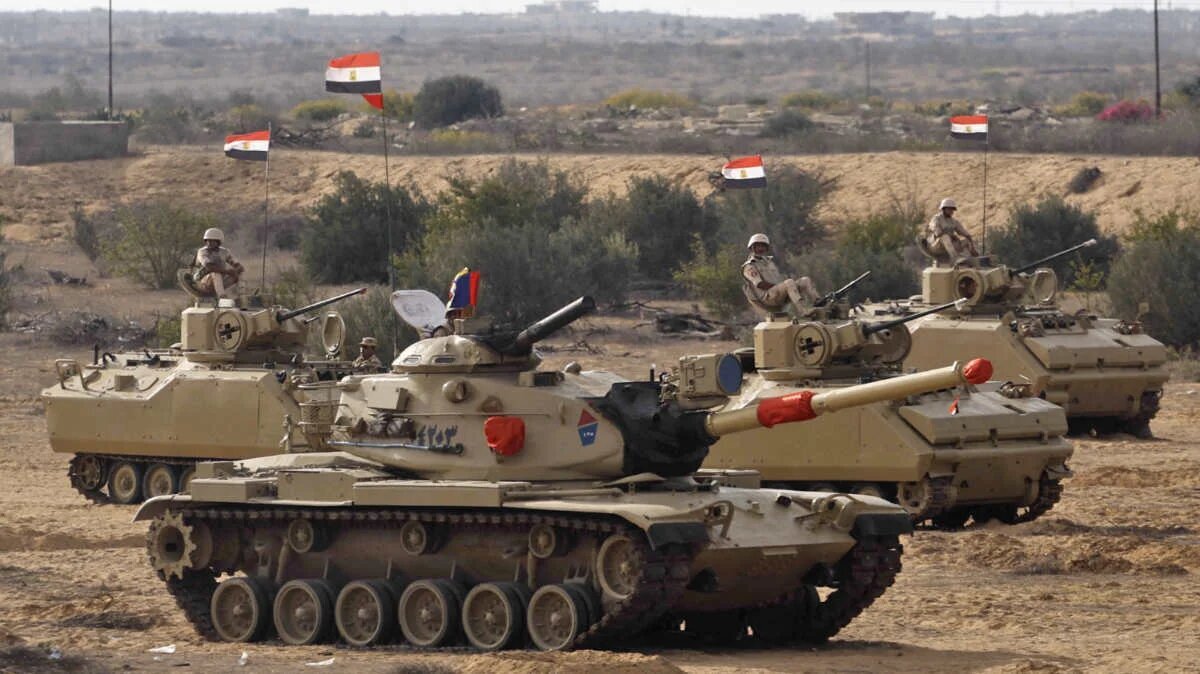
BEIRUT — Since the early confrontations of 1948, 1956, 1967, and 1973 to the uneasy decades that followed the Camp David Accords, Egypt and its army have remained central to the anti-Israel conflict equation.
Even after Cairo’s formal exit from direct military confrontation, Egypt remained a decisive player, either as an active force or as a latent power that could not be ignored.
For decades, the very potential of the Egyptian army has been a matter of calculation in Tel Aviv. On the other side of the divide, its stature has symbolized enduring Arab and Islamic hope: the possibility that, under the right conditions, Egypt could once again shift the strategic balance.
Today, security assessments emerging from Israeli strategic circles into Hebrew media reiterate a familiar refrain: the Egyptian army is strengthening as a source of risk to the Israeli enemy.
Recent reports speak openly of mounting concern over Egypt’s expanding military capabilities and the need to “contain this trajectory before it becomes a direct strategic threat.”
The anxiety is reportedly shared at the highest political levels, including Prime Minister Benjamin Netanyahu. Yet the timing is striking.
Why refocus on Egypt’s western frontier amid regional preoccupation with Iran, Syria, Lebanon, and the Palestinian arena?
To understand this shift, one must revisit a foundational premise: Israel’s strategic doctrine has long rested on preserving absolute regional superiority.
Maintaining qualitative military edge is treated as an existential requirement. Any significant enhancement in the capabilities of neighboring states, especially a heavyweight like Egypt, is therefore perceived not in isolation but in relation to this doctrine.
Egypt, for its part, faces a complex security environment. The post-2011 regional upheavals, instability in Libya and Sudan, tensions in the Red Sea, and uncertainty regarding Nile water security have all contributed to a recalibration of Cairo’s defense posture.
Over the past decade, Egypt has been ranked among the world’s largest arms importers, according to data from the Stockholm International Peace Research Institute (SIPRI).
Its arsenal includes thousands of main battle tanks, a vast air fleet with hundreds of combat aircraft—most notably around 200 F-16s forming the backbone of its air force—and a modern navy equipped with submarines, advanced frigates, and two Mistral-class helicopter carriers.
More significant than numbers, however, is diversification. Egypt buys arms from the United States, France, Germany, Russia, China, Italy, and South Korea.
In strategic language, diversification signals a gradual effort to reduce vulnerability to political pressure from any single supplier. Israeli analyses focus less on quantity and more on the implications of these partnerships, as well as on doctrinal evolution.
Reports suggest that Egypt is not merely modernizing for defensive sufficiency but cultivating multidimensional deterrence—land, air, sea, missile, and increasingly unmanned systems.
The Israeli enemy’s unease is compounded by emerging regional realignments.
Cairo’s rapprochement with Ankara has accelerated, marked by diplomatic exchanges and security coordination in the Eastern Mediterranean.
Turkey’s advanced defense industry and assertive strategic posture introduce new variables into the equation.
Simultaneously, Egyptian–Saudi coordination has deepened across the Red Sea, Sudan, and Gaza. Broader discussions of defense cooperation involving Pakistan—an acknowledged nuclear power—signal that unconventional deterrence channels are no longer theoretical abstractions in regional planning.
Meanwhile, the United States appears increasingly inclined toward strategic retrenchment in West Asia, prioritizing selective engagement over prolonged entanglement.
In this environment, regional powers are being told, implicitly and explicitly, to secure themselves—except that Israel remains a protected exception in Washington’s calculations.
Yet for many Arab capitals, Israel’s expanding operational reach across multiple fronts has reinforced perceptions of it as the primary destabilizing force.
Egypt’s firm rejection of proposals to displace Palestinians into Sinai underscored Cairo’s red lines. Sinai is not merely territory; it is the keystone of Egypt’s eastern security architecture. Any demographic engineering there would alter national security equations for generations.
Coupled with concerns about control of maritime chokepoints like the Suez Canal, through which a significant share of global trade passes, Egypt’s military modernization appears less an act of aggression than a pre-emptive balance-building measure.
Ultimately, the Israeli enemy’s apprehension reflects more than fear of a weapons deal or a military exercise. It reflects anxiety over a trajectory: the potential reconstitution of Arab heavy power and the gradual erosion of uncontested superiority.
Whether this marks the restoration of meaningful regional equilibrium or merely a defensive rearrangement before new confrontations remains uncertain.
What is clear is that Egypt’s strategic weight—long dormant but never irrelevant—has returned to the forefront of regional calculations, reshaping the geometry of a West Asia once again in flux.
Leave a Comment