‘Lebanon must choose between sovereignty and disappearance,’ Hezbollah chief says
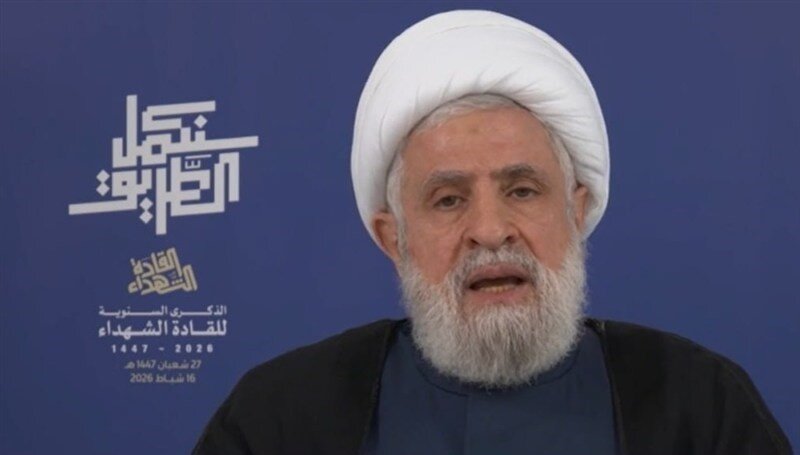
TEHRAN — In an address on Monday honoring the memory of the martyred Lebanese resistance leaders, Hezbollah Secretary-General Sheikh Naim Qassem redefined the current conflict as an existential struggle for Lebanese survival.
Speaking to a massive audience at the Sayyed al-Shuhada complex—with simultaneous gatherings in Nabi Chit, Jibchit, and Teir Debba—Qassem honored the foundational sacrifices of Ragheb Harb, Sayyed Abbas al-Mousawi, and the strategic “architect of victories,” Imad Mughniyeh.
He asserted that the path forged by these commanders remains the only viable defense against an “expansionist entity” that seeks to consume the entire region.
Qassem issued a critique of the international community’s role in the ongoing devastation of Gaza and the “official and gradual annexation” of the West Bank.
He explicitly identified the United States as the primary manager of these operations, warning that any diplomatic guarantees offered to Lebanon or Palestine are often “only on paper” and designed to facilitate Israeli aggression.
“Do not underestimate what the occupation is doing,” Qassem cautioned, noting that the “humanitarian” dimension of the resistance is rooted in the refusal of any free person to accept such systemic displacement and killing.
Addressing the internal Lebanese debate, the Secretary-General was uncompromising regarding the “trinity” of the state, the army, and the people as the bedrock of national security.
He warned that accepting foreign “assistance” that compromises Lebanese sovereignty would turn the nation into a “tasty morsel” for Israeli ambitions.
“If you want to surrender, then amend the constitution,” Qassem challenged, pointing out that the nation’s founding document mandates the use of all necessary measures to liberate occupied Lebanese land.
While clarifying that Hezbollah does not seek an initiation of war, Qassem emphasized that “there is a vast difference between starting a war and defending one’s land.”
He signaled that the movement’s current patience is a strategic choice aimed at protecting Lebanese society, but warned that the status quo is inherently unsustainable.
Vowing that the resistance remains ready to inflict significant “pain and suffering” on the enemy should the need arise, Qassem concluded by leaving the timing and nature of future developments to the “logic of the battlefield.”
Leave a Comment