Tehran, Moscow target $10b trade amid calls to ease customs hurdles
TEHRAN – Iranian and Russian business representatives called for the removal of customs restrictions and faster trade procedures, setting a $10 billion target for bilateral trade over the next three years.
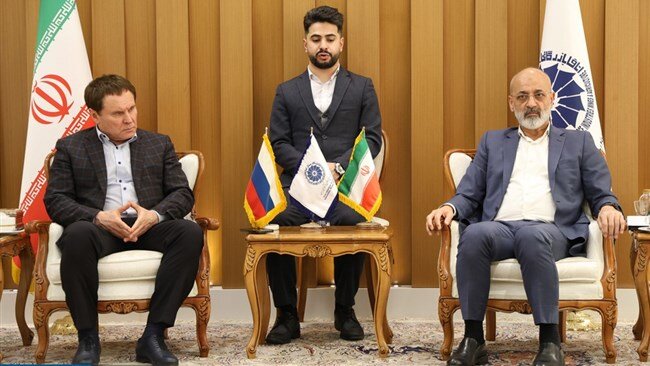
Qadir Qiafeh, deputy head of the Iran Chamber of Commerce, Industries, Mines and Agriculture (ICCIMA), met Leonid Lozhechko, Chairman of the Russian-Iranian Business Council at the Chamber of Commerce and Industry of the Russian Federation, in Tehran to discuss trade bottlenecks, logistics and financial cooperation.
Qiafeh said Russia represents a large market and Iran has significant export capacity, but bilateral trade has not matched the economic weight of the two countries since the collapse of the Soviet Union.
He said trade relations have improved in recent years and that the Eurasian free trade agreement resulted in about $4 billion in goods exchange in the first nine months of the Iranian year 1404 (March-December, 2025). However, he added that current trade volumes remain well below potential estimates of $10 billion to $30 billion.
He cited implementation challenges under the Eurasian agreement, including application of preferential tariffs, limited familiarity among businesses with tariff schedules and delays in information exchange. Customs procedures and slow responses by relevant agencies, particularly for perishable goods, also pose problems, he said.
Logistical constraints, including limited regular shipping services and underutilization of the International North–South Transit Corridor (INSTC), have increased transport costs and delivery times, Qiafeh said, adding that full completion of the corridor would expand transit capacity and reduce shipping time for both Iranian and Russian exports.
He also pointed to financial constraints, noting that both countries face limited access to international financial systems and that settlements in national currencies remain incomplete. Exchange rate volatility in both markets has raised costs for traders, he said.
Talks to link Iran’s Shetab banking network with Russia’s Mir payment system have been under discussion for more than six years and have been piloted, but full-scale implementation has yet to materialize, Qiafeh said.
Lozhechko said 89 percent of bilateral trade is conducted under direct contracts in national currencies, but a significant share of transactions still passes through third countries, increasing costs.
He said Russia is seeking to reduce the role of intermediaries and expand direct financial channels, including through the opening of a Russian bank branch in Iran. VTB Bank has allocated $2 billion to provide financial services to Iranian traders, he added.
In the transport sector, Lozhechko said 28 vessels have been added since last year to facilitate cargo shipments across the Caspian Sea, with plans to add 30 more by 2035. Some lower-capacity vessels have been replaced with ships capable of carrying up to 600 forty-foot containers.
He also outlined rail plans via the western Astara route to deliver cargo to Moscow within five days, as well as eastern routes coordinated with Kazakhstan and Turkmenistan to move goods to Iran’s Incheh Borun border. Agreements have also been signed with logistics operators in the United Arab Emirates, Iran and Russia to move containers from Bandar Abbas to Moscow within two weeks.
Both sides said customs procedures remain a major obstacle, especially for food products. Goods transiting through Azerbaijan can face multiple border checks, while errors in valuation forms can cause additional delays and affect product quality. Russian officials said training seminars for Iranian traders are planned to address documentation issues.
Qiafeh said chambers of commerce in both countries should play a more active role in facilitating information flows, joint investment and technology transfer in sectors including oil, gas, petrochemicals, mining and logistics.
He said achieving $10 billion in bilateral trade within three years is attainable with stronger private sector support and more effective implementation of existing agreements.
EF/MA
Photo: ICCIMA Deputy Head Qadir Qiafeh met Leonid Lozhechko, Chairman of the Russian-Iranian Business Council, in Tehran on Monday.
Leave a Comment