Tehran cultural center to host reading performance of Anton Chekhov’s “The Bear”
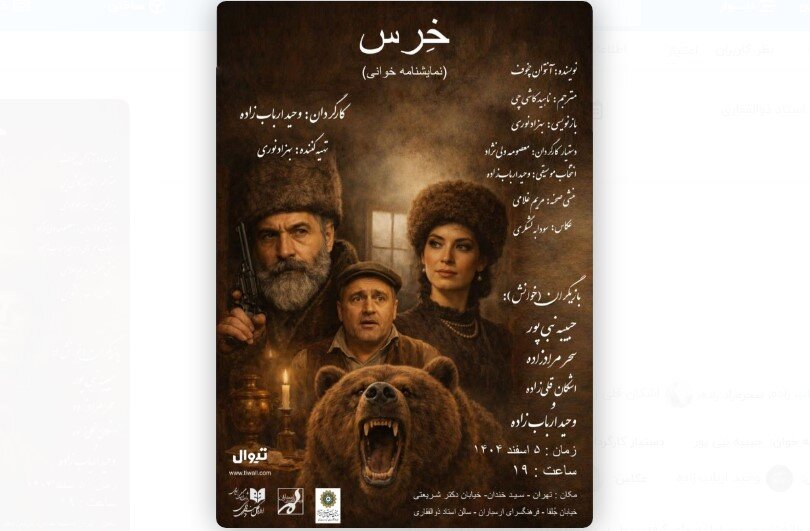
TEHRAN- Arasbaran Cultural Center in Tehran will be playing host to a reading performance of the renowned Russian author Anton Chekhov’s play “The Bear: A Joke in One Act” on Tuesday.
The performance will be directed by Vahid Arbabzadeh with a cast composed of Sahar Moradzadeh and Ashkan Qolizadeh.
“The Bear” unfolds entirely in the drawing room of the estate belonging to Elena Ivanovna Popova, a young widow who has secluded herself since the death of her husband seven months earlier. Popova insists on remaining in deep mourning, determined to prove eternal fidelity to her late spouse. She refuses to leave the house or engage with society, believing that her isolation is a testament to her unwavering devotion. Her elderly footman, Luka, who is loyal but somewhat naïve, gently urges her to abandon her excessive grief. He reminds her that life continues outside the estate and suggests that such rigid mourning may not be healthy. Popova, however, remains resolute, asserting that she promised her husband she would remain faithful to his memory for the rest of her life.
Their quiet exchange is abruptly interrupted by the arrival of Grigory Stepanovitch Smirnov, a middle-aged landowner with a volatile temper. Smirnov insists on seeing Popova despite Luka’s attempts to turn him away. Once admitted, he bluntly explains the purpose of his visit: Popova’s late husband owed him 1,200 roubles, and he requires immediate repayment. Smirnov is under financial pressure, as he must make an interest payment on his mortgage the following day. Popova calmly replies that she does not have the money available and cannot settle the debt until her steward returns the day after tomorrow. Her response, though polite, infuriates Smirnov, who has already endured numerous frustrations with other debtors.
Smirnov’s irritation quickly transforms into open hostility. He mocks Popova’s mourning as theatrical and self-indulgent, dismissing her “state of mind” as irrelevant to his urgent financial needs. In his view, grief does not excuse her from meeting legal obligations. He declares that he will not leave the estate until he receives the money, even if it means remaining there for days. The conflict intensifies as Smirnov demands refreshments and treats the household with increasing rudeness. What begins as a dispute over money evolves into a broader argument about love, loyalty, and the nature of men and women.
The quarrel soon shifts from finances to ideology. Smirnov claims that women are incapable of genuine, steadfast love, asserting that they are fickle and prone to melodrama. Popova vehemently rejects this accusation, insisting that she loved her husband deeply and sincerely, even though he was unfaithful and often unkind to her. The irony of her devotion to a flawed husband underscores Chekhov’s satirical tone. As tempers flare, the insults grow sharper. In a moment of fury, Popova calls Smirnov a “bear,” and a “monster,” attacking both his manners and his character.
Smirnov, stung by the insult and priding himself on his honor, challenges Popova to a duel. In a comic twist that heightens the absurdity of the situation, Popova immediately accepts. She refuses to be intimidated and leaves the room to retrieve a pair of pistols once owned by her husband. Luka, overhearing this alarming development, becomes frantic and rushes off to seek help from the gardener and coachman, fearing bloodshed.
Left alone briefly, Smirnov undergoes an unexpected emotional transformation. Instead of remaining angry, he finds himself admiring Popova’s courage and spirit. Her fiery temperament and refusal to submit impress him deeply. By the time she returns armed and prepared to fight, Smirnov realizes that his feelings have shifted from rage to admiration—and then to love. The sudden reversal is central to the play’s farcical structure, as intense hostility gives way to romantic attraction.
When Smirnov confesses his love, Popova reacts with confusion and indignation. She orders him to leave, yet simultaneously hesitates. Her emotions fluctuate between outrage and fascination. The duel is forgotten as the argument dissolves into a charged exchange of declarations. Ultimately, the former adversaries succumb to their mutual attraction and embrace.
The play belongs to a group of short comic works Chekhov referred to as “farce-vaudevilles,” including “The Proposal” and “The Anniversary”. These pieces rely on exaggerated emotion, rapid dialogue, and sudden reversals to generate humor. Though Chekhov sometimes dismissed such works as trivial, “The Bear” proved immensely successful.
The play has enjoyed enduring appeal, with numerous adaptations across different media. It inspired operatic versions by composers such as William Walton and Dominick Argento, as well as reinterpretations for radio, television, and stage revivals worldwide. Its compact structure and universal themes of pride, passion, and unexpected love continue to resonate with audiences.
SAB/
Leave a Comment