WHO hails Iran’s mental health strategy as an “innovative and replicable global model”
TEHRAN – The World Health Organization has praised Iran’s SERAJ – a pioneering model for integrated mental health and social care, describing it as an “innovative and replicable global model.”
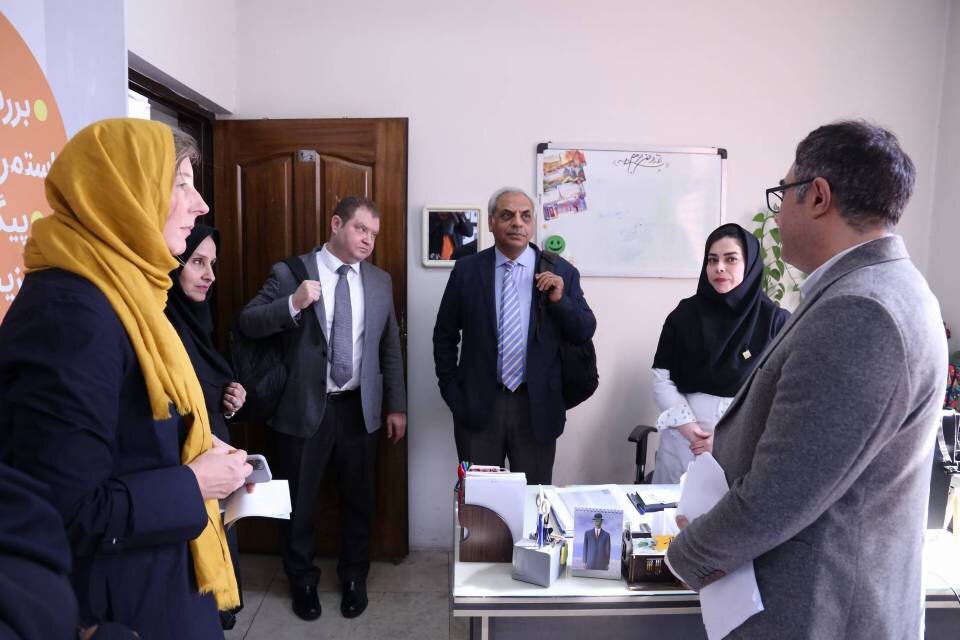
A WHO delegation paid a visit to mental health care systems across the country from November 8 to 12, 2025, hailing the Iranian mental health care as a global model and a blueprint for other nations grappling with rising mental health needs and limited resources.
In a south Tehran neighborhood, a quiet transformation in mental health care is unfolding. Inside the Shahid Mohammad Ali Ghofrani Centre, psychiatrists, physicians, psychologists, dedicated social workers, and community volunteers work side-by-side, offering everything from psychotherapy and addiction counselling to parenting workshops and job placement assistance, WHO website announced in a press release on February 23.
The SERAJ approach: a three-tier lifeline
At the heart of the country’s mental health strategy is the SERAJ programme – a structured three-tier service-delivery framework that integrates primary care, specialized outpatient clinics and community-based social action.
Tier 1: Frontline detection
A nationwide network of approximately 5750 comprehensive health service centres, with around 3400 psychologists, serves as the first point of contact. Trained community health workers use standardized tools to screen for mental health issues, substance use and social risks. Individuals are then referred, as needed, to on-site psychologists or general practitioners for initial care.
Tier 2: Specialized support
More complex cases – such as severe psychiatric disorders, post-discharge patients, or suicide attempts – are referred to 104 specialized SERAJ centres. Each center is staffed by a multidisciplinary team, including a psychiatrist, a physician, a psychologist and a dedicated social worker who acts as a case manager.
Tier 3: Community action
Beyond clinical care, SERAJ centres actively engage local authorities, public agencies, charities and volunteers to tackle social determinants such as housing, employment and social inclusion. This ensures that interventions are delivered seamlessly across the health and social care systems.
“We don’t just treat symptoms – we enable individuals to contribute towards their community’s development,” explained a psychologist at the Mehrgan Centre in District 17 of Tehran, where the WHO team observed a group therapy session. “If someone is depressed, we ask: Do they have a job? A home? Family support? Without addressing these, medication alone is not enough.”
Based on programme monitoring and evaluation data, among participants of the programme there has been:
*A 69% reduction in psychiatric hospital readmissions
*An 80% drop in suicidal behaviors
*An 83% decrease in severe marital conflicts reported.
“This is community-based resilience in action,” said Dr Khalid Saeed, WHO Regional Advisor for Mental Health and Substance Abuse, who led the mission. “Iran has moved beyond a medicalized approach to one that embraces social determinants of health. This is exactly what the global mental health movement advocates.”
Beyond harm reduction: building hope and recovery
At the Vali-e-Asr drop-in center in Tehran’s Yaft-Abad neighborhood, harm reduction is not a slogan – it’s a daily practice. Here, people who use drugs can access sterile syringes, methadone maintenance therapy, HIV testing, tuberculosis screening and psychological counselling – all under one roof.
“We meet people where they are,” said the center’s director, showing the delegation their hot meal service and shower facilities. “Dignity comes first. Recovery comes after.”
But meeting people where they are is more than a philosophy – it’s a systematic strategy. The country’s harm reduction programme employs a rigorous “mapping of high-risk populations” at two levels:
Operationally, teams continuously identify and update consumption “hotspots” to plan targeted outreach visits;
Strategically, GIS technology is used at city, regional and national levels to estimate population sizes, visualize distribution patterns and determine the optimal service delivery model – whether through drop-in centres, mobile units, or outreach teams.
This data-driven, geographically precise approach ensures that despite resource constraints, services reach those most in need, when and where they need them.
While SERAJ addresses common mental health conditions, a parallel system has been established to tackle substance use disorders. The national substance use response is notable for its multisectoral coordination, with the Ministry of Interior working closely with health authorities on prevention, treatment and social reintegration. Currently, some 2 million people are in treatment for substance use disorders nationwide, supported by over 10 000 government-run centres.
The research engine: data, foresight and innovation
In Kerman, the delegation visited the Institute for Futures Studies in Health (IFSH), a WHO Collaborating Centre that functions as the country’s health foresight and innovation hub. Researchers there are studying everything from smartphone addiction among students to the mental health of refugees and migrants.
“We’re not just looking at today’s problems – we’re anticipating tomorrow’s,” said the Institute’s director. IFSH leads national missions on health informatics, statistical modelling and future studies, ensuring that the country’s policies are evidence-based and forward-looking.
Meanwhile, at the Iran Psychiatric Hospital in Tehran, specialized units for addiction and psychosocial rehabilitation are training the next generation of psychiatrists. While the SERAJ model was originally conceptualized and piloted at Tehran University of Medical Sciences (TUMS), affiliated research centres here, such as ReCARB and the Mental Health Research Center (MHRC), under Iran University of Medical Sciences, have played a vital role in researching, evaluating and helping to scale up the model nationwide.
Crisis ready: when disaster strikes
The Iranian mental health system has been tested repeatedly – by earthquakes, floods, pandemics and conflict. Each time, the mental health and psychosocial support system activates.
In the aftermath of the 2003 Bam earthquake, the country developed one of the Region’s first organized psychosocial response protocols. Today, a network of over 500 mobile mental health teams and a national psychological support hotline (4030) stand ready.
During the COVID-19 pandemic, SERAJ centres pivoted to tele-counselling and community needs assessments.
“This system doesn’t just wait for emergencies – it anticipates them,” observed Dr Anja Busse of WHO headquarters. “That’s a level of preparedness many countries still lack.”
The road ahead: challenges and champions
Despite its successes, the Iranian mental health system faces real hurdles. Sanctions continue to limit access to essential psychotropic medicines. Data systems need strengthening. Stigma persists.
To address this situation, the WHO mission identified a clear path forward:
Regional leadership: with six decades of experience, the Islamic Republic of Iran is poised to become a regional training hub, offering fellowships and technical support to neighboring countries.
Digital innovation: plans are underway to develop home-grown digital tools for self-care and to address emerging issues like gaming addiction.
Global collaboration: the country has proposed joint research platforms with WHO on stimulant use, maternal mental health and AI-assisted therapy.
A message to the world
As the mission concluded, a clear consensus emerged: the country’s integrated, community-based model offers a powerful alternative to hospital-centric mental health care.
“What we’ve seen here is a system that treats the person, not just the illness,” summarized Dr Fahmy Hanna, a WHO technical specialist. “It’s humane, it’s practical and it works.
In a world where mental health needs are rising, Iran’s experience is not just relevant – it’s essential learning.”
WHO and the Islamic Republic of Iran are now establishing a technical working group to scale up this model and share its lessons globally. For the millions living with mental health conditions worldwide, the Iranian story is more than a case study – it’s a beacon of what’s possible when care is built around community, compassion and continuity.
Leave a Comment