Commodities worth $285m exported from Sistan-Baluchestan in 9 months
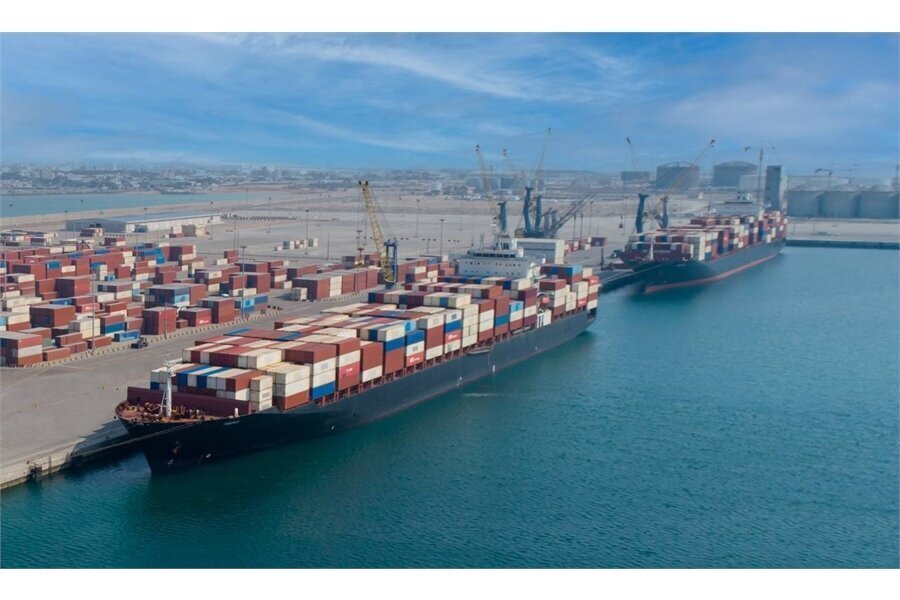
TEHRAN- Non-oil products valued at $285 million were exported from Sistan-Baluchestan province, in southeast Iran, during the first nine months of the current Iranian calendar year (March 21-Decemebr 21, 2025), a provincial official announced.
Gholamreza Balouti Mirza, the acting head of the province’s Customs Department, said that customs offices in Sistan-Baluchestan exported over $285 million worth of goods in the first nine months of this year, demonstrating the province's commercial capabilities in international markets. This achievement highlights the region's high capacity for foreign trade and its important role in boosting the economy of eastern Iran.
Customs offices in Sistan-Baluchestan have played a pivotal role in foreign trade this year. Over two million tons of goods, valued at more than $285 million, were exported from the province in the first nine months of this year, compared to $272 million in the same period last year.
These statistics indicate the high capacity of Sistan-Baluchestan province in international exchanges, establishing the region as one of the country's important non-oil trade hubs.
A major portion of the exports and imports of Sistan-Baluchestan consists of essential goods and materials needed for the industrial sector. Rice and meat account for a significant share of these exchanges, reflecting a balance between meeting domestic needs and export activities. This composition of goods, in addition to generating foreign currency, plays a vital role in food and industrial security.
The supervisor of Sistan-Baluchestan Customs Department also announced that imports through the province's customs in the first nine months of the current year amounted to one million tons of goods, valued at $1.586 billion.
He stated that approximately 50 percent of the total imports and exports of Sistan-Baluchestan customs are related to essential goods, including rice and meat, with a major part of imports dedicated to meeting the needs of the industrial sector.
Gholamreza Balouti-Mirza, referring to infrastructural measures, said: "Through arrangements made by the government, particularly at Chabahar and Rimdan customs, effective measures are being implemented to develop the modern customs and the separate Chabahar area in cooperation with its free trade zone."
Regarding the status of Zahedan customs warehouses, he emphasized: "Currently, about 25,000 tons of goods are stored in the covered warehouses of Zahedan customs, and there is no cargo accumulation in open spaces whatsoever—not even a single sack of rice is stockpiled in the customs yard."
Sistan-Baluchestan is Iran's largest province. Its trade status is dominated by the port activity and cross-border exchanges, but remains below potential. Transit-logistics is the province's core competitive advantage.
The province holds a uniquely strategic position, making it a critical node for regional connectivity:
* Gateway to the Indian Ocean: It has approximately 300 km of coastline along the Makran shores of the Gulf of Oman, providing Iran with direct access to open seas, bypassing the strategic chokepoints of the Strait of Hormuz.
* Key International Corridors:
- North-South Transport Corridor (INSTC): The province is the southern terminus of this major multinational corridor, connecting Russia, the Caucasus, and Central Asia to Indian Ocean ports. The port of Chabahar is the linchpin of this route.
- East-West Connectivity: It links Pakistan (and through it, China via CPEC) to Iran and onward to Turkey and Europe.
* Port of Chabahar: This is the province's most critical asset. Developed with Indian investment, it consists of Shahid Beheshti Terminal and Shahid Kalantari Terminal.
Port of Chabahar is Iran's strategic crown jewel and arguably its most important infrastructure project in decades. Its importance extends far beyond being just a port; it's a geopolitical, economic, and logistical linchpin for Iran's future.
1. Geographic & strategic importance
* Only Iranian Port with Direct Access to the Indian Ocean: Unlike Iran's major ports in the Persian Gulf (like Bandar Abbas), which must navigate the narrow and geopolitically tense Strait of Hormuz, Chabahar is located on the Gulf of Oman. This provides an alternate route to the open sea, reducing vulnerability to blockade or disruption in the Persian Gulf.
* Gateway to the East: It is Iran's closest and most natural maritime outlet to the Indian Ocean, facing the key sea lanes to India, Southeast Asia, and Africa.
* Proximity to Key Markets: It is very close to Pakistan's Gwadar Port and is near the mouth of the Strait of Hormuz, offering a vantage point for monitoring traffic.
2. Economic & trade importance
* Special Economic Zone (Chabahar Free Trade-Industrial Zone): The port is part of a large free zone offering tax holidays, customs exemptions, and simplified regulations to attract domestic and foreign investment in manufacturing, warehousing, and services.
* Diversifying the economy: It is a cornerstone of Iran's efforts to develop its long-impoverished Makran coast (in Sistan-Baluchestan province), create jobs, and shift from a purely oil-dependent economy to a transit and logistics-based economy.
* Boosting trade: By handling larger cargo ships and offering modern container facilities, it aims to increase Iran's non-oil exports (like minerals, agricultural products) and reduce import costs.
3. Geopolitical & international importance
This is where Chabahar's role becomes truly pivotal. It positions Iran at the center of major international corridors.
* Iran's key to the INSTC (International North-South Transport Corridor): Chabahar is the indispensable southern ocean port for this 7,200-km multi-modal corridor. The INSTC connects India to Iran, and then via Iran's rail network to the Caspian Sea, Russia, the Caucasus, and ultimately Europe. It drastically reduces travel time and cost compared to the traditional Suez Canal route.
* Counterbalance to Pakistan's Gwadar & China's BRI: While Gwadar (part of China's Belt and Road Initiative) is a rival, Chabahar gives Iran and its partners (notably India) strategic autonomy. It allows India to trade with Afghanistan, Iran, and Central Asia without relying on Pakistan's land routes.
* Lifeline to Landlocked Afghanistan: For Afghanistan, Chabahar is a vital, stable sea access point granted by a treaty. It is Afghanistan's alternative to relying on Pakistani ports (Karachi), subject to political tensions.
In essence, Port Chabahar is Iran's master key to unlocking its geostrategic potential.
MA
Leave a Comment