‘Safeguarding exports under sanctions requires operational measures, regulatory reform, private-sect
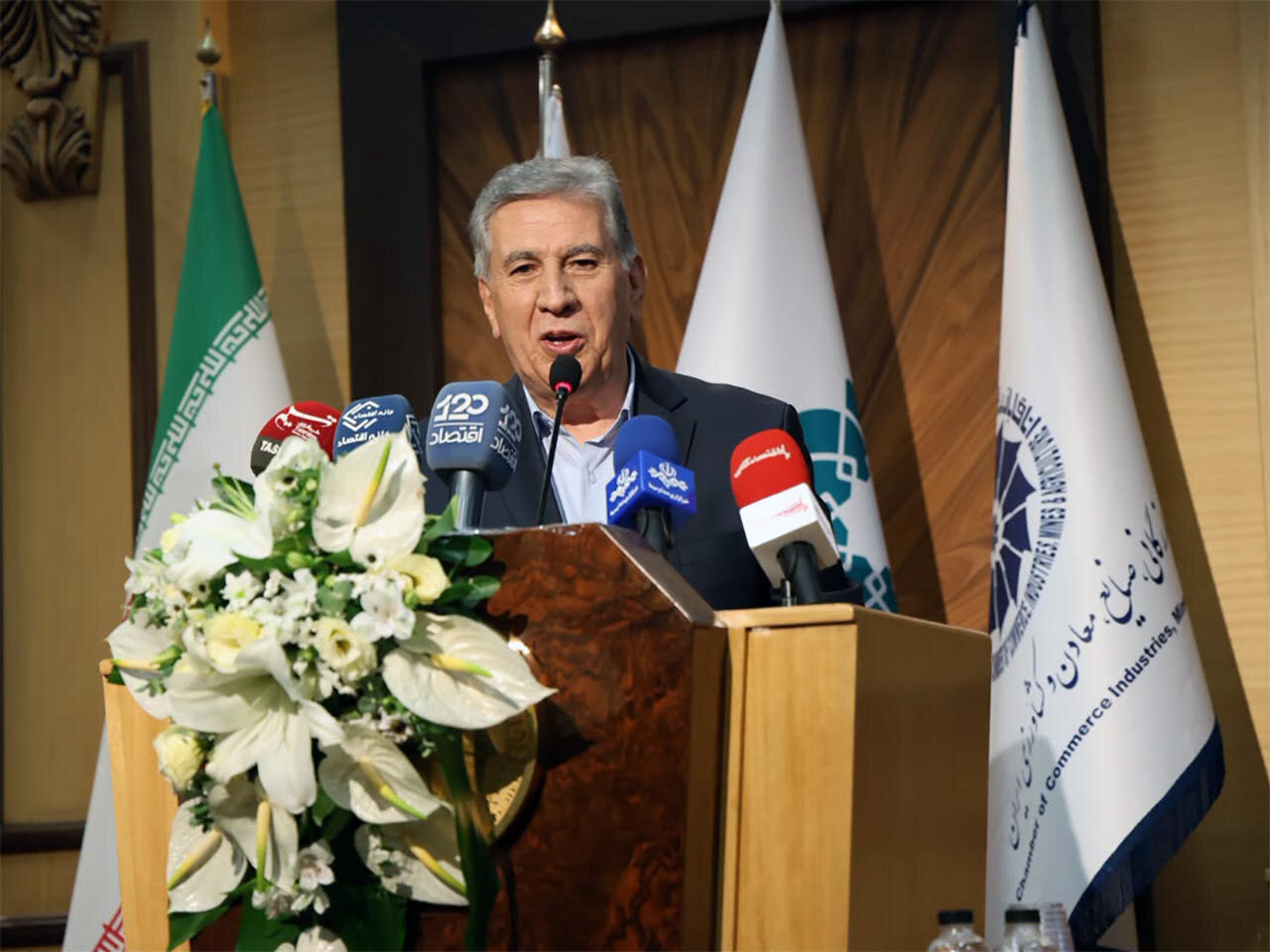
TEHRAN- Samad Hassanzadeh, President of the Iran Chamber of Commerce, Industries, Mines and Agriculture (ICCIMA), said on Monday at the National Export Associations Conference, held at the Iran Chamber under the slogan “Capable Exporter, Strong Association, Sustainable Exports”: Foreign trade cannot be examined merely within the framework of export and import statistics, trade balance, or foreign-exchange earnings; rather, foreign trade is directly linked to national production, employment, investment, economic security, access to technology, and the country’s position in regional and global division of labor. From this perspective, any disruption in trade relations affects the country’s production and economic capacities.
Emphasizing diversification of transportation routes, he said: The first necessity for safeguarding trade flows is reducing foreign trade’s dependence on limited transportation routes. Therefore, by assessing the capacity of northern ports, railways, land borders, and regional corridors, alternative routes should be designed appropriate to the type of goods so that disruption on one route does not halt exports and the supply of raw materials.
The President of the Iran Chamber, presenting the Iran Chamber’s proposal to form a Foreign Trade Continuity Task Force, stated: We propose that an operational task force be formed at the earliest opportunity with the participation of the government, the Iran Chamber, Customs, the Central Bank, the Ports Organization, and export associations to develop export programs so that no stoppage occurs in existing minimums.
He emphasized facilitating customs and border formalities and said: When transport time and costs increase, prolonged customs formalities and unnecessary stops at borders impose double damage on trade. Therefore, we recommend that expansion of electronic document exchange, coordination of border working hours, pre-arrival processing of goods, and reduction of repeated inspections be placed at the top of executive reforms.
The President of the Iran Chamber considered securing working capital for exporters essential for the sustainability of the country’s export programs and added: Designing working-capital facilities, accelerating repayment of claims, and financing appropriate to the real export cycle are necessary so that external disruptions do not lead to production stoppage, reduced employment, and loss of markets. The Central Bank and operating banks must devise measures to provide working capital for exporters.
He emphasized the need for flexibility in fulfilling foreign-exchange obligations and said: One cannot insist on the repatriation of export earnings while ignoring operational considerations, differences in market conditions, and real restrictions on financial transfers in designing executive mechanisms. An efficient trade policy is one that links macroeconomic objectives with the operational realities of firms and, instead of continuously transferring uncertainty to economic actors, provides the possibility of risk management and informed decision-making.
Samad Hassanzadeh considered codified insurance support for exports and trade risk management necessary and noted: Increased risk on transportation routes can raise insurance costs and make implementation of export contracts difficult. Therefore, we propose that, with the participation of insurance companies, financial institutions, and economic associations, the possibility of developing insurance coverage, credit guarantees, and risk-management instruments suited to new trade conditions be examined.
He cited diversification of export markets as another necessity for safeguarding foreign trade flows and said: In past years, Iraq was Iran’s largest trading partner, but today, following policies Western countries have applied in Iraq’s economic programs, it is predicted that Iran’s exports to that country will reach a minimum next year, because due to increased export costs, Iranian rates and prices are no longer acceptable for the Iraqi market. India, China, and Turkey send goods to Iraq with zero tariffs and six-month and one-year LCs in a way that neither Iraqi merchants are prepared to buy Iranian goods nor will any volume of Iranian goods exports to Iraq be justified.
The President of the Iran Chamber considered development of economic diplomacy programs key and added: Continuity of foreign trade, in addition to domestic capacities, depends on cooperation with neighboring countries and trading partners. Therefore, economic diplomacy must focus on facilitating transit, customs coordination, developing transportation agreements, and maintaining legal access to international markets, and reducing trade restrictions should also be pursued through diplomatic channels.
Hassanzadeh, stating that the Iran Chamber and the Iran Chamber’s Export Development Commission can be a continuous link between exporters and decision-making bodies, said: Chambers of commerce have made many efforts at all times when problems have arisen for the country, and we believe that in the Iran Chamber, provincial chambers, commissions, and economic associations must present every necessary measure and proposal that helps improve the country’s economic situation to officials with a scientific and expert approach.
The President of the Iran Chamber of Commerce, Industries, Mines and Agriculture emphasized: Systematic collection of problems, presentation of expert solutions, publication of periodic reports, and follow-up of demands through to implementation will help transform firms’ experience into effective decisions and increase the resilience of foreign trade.
He considered revision of the approach toward the private sector one of the prerequisites for improving the performance of Iran’s economy and stated: The private sector is neither a substitute for sovereign responsibilities nor can it alone bear the burden of all the country’s economic problems. The government, without the effective participation of producers, exporters, investors, and specialized associations, will not have sufficient capacity to design and implement efficient economic policies, and officials must take measures to remove ambiguities.
The President of the Iran Chamber, enumerating the responsibilities of the state and the private sector, said: The main issue is creating a clear and constructive relationship between the state and the responsibility of economic actors. The state must focus on macro policymaking, transparent regulation, provision of public infrastructure, legal stability, and guaranteeing fair competition, and the private sector must, within the framework of the law, assume responsibility for investment, productivity improvement, market development, innovation, job creation, and increasing the competitiveness of its firms.
Hassanzadeh, referring to the country’s difficult economic conditions, said: Although managing economic firms has become very difficult, we believe that when the name of Iran and the nation is mentioned, we all have a great responsibility and duty. Today all our country’s officials are making their utmost efforts to solve problems, and good planning is always carried out, but the hostile enemy also always takes actions to neutralize the country’s plans.
The President of the Iran Chamber, stating that today is the time for all of us to stand with all our strength alongside the Iranian nation and cooperate with the government’s policies, noted: The Iran Chamber’s greatest conscientious recommendation under the country’s current conditions is that we must certainly strive to keep economic firms operating, preserve employment for Iranian households’ workforce, and help people’s livelihoods as much as possible so that problems are soon resolved with the dignity and magnanimity of the Iranian nation and the authority of the Islamic Republic of Iran.
The Head of the Iran Trade Promotion Organization, emphasizing the need to increase the volume and value added of the country’s non-oil exports, said: To achieve the real capacities of Iran’s economy in the export sector, while supporting private-sector initiatives, a fundamental transformation in the environment of trade laws and regulations must be created with the participation of responsible institutions and the private sector.
Mohammad Ali Dehghan Dehnavi said on Monday at the Export Conference at the Iran Chamber of Commerce, referring to the impact of sanctions, transportation restrictions, and difficult foreign trade conditions on exporters’ activity: Part of export problems are outside the authority of domestic bodies, but in the area of legal, regulatory, and administrative obstacles, responsibility for solving problems lies with domestic bodies, and more effective measures must be taken in this regard.
He added: Compared with last summer, in some regulatory areas more facilities have been provided for economic actors, including the possibility of agreement between exporter and importer and the possibility of direct transactions, at least for second-group goods, as well as openings in customs and trade agreements.
Dehghan Dehnavi continued: There are reports from economic actors that, due to pressures and existing restrictions, they have abandoned their export activity or faced legal and judicial issues. Such conditions show that the country’s regulatory environment needs transformation and review in various dimensions.
Emphasizing that reforming the regulatory environment is not possible through the action of one body alone, he stated: This transformation must be pursued with the cooperation of legislators, policymakers, regulatory bodies, and the private sector, while economic associations and actors in trade, export, import, and production must also play a demand-making and active participation role in this path.
He added: Part of the obstacles that today face economic actors in the form of regulations can be removed more simply and at lower cost through the participation of associations and the design of voluntary mechanisms.
Dehghan Dehnavi, announcing the Trade Promotion Organization’s readiness to support proposals from economic associations, stated: We welcome any initiative that can help develop exports, including creating export consortia, establishing trade centers in target countries, sending trade delegations, inviting foreign trade delegations, and offering proposed solutions to facilitate settlement of exporters’ foreign-exchange obligations.
He considered creating special paths for exporters and offering practical proposals to facilitate trade activities among areas for association participation and emphasized: The Trade Promotion Organization is ready, in areas where cooperation is possible, to use the capacity of associations and provide the necessary ground for greater private-sector role-playing.
Dehghan Dehnavi, referring to the designation of Mehr 29 (October 21) as National Export Day, stated: The purpose of holding Export Week is to address various issues in this field and to appreciate exporters, economic associations, and entities active in the path of developing the country’s exports.
Appreciating exporters as pioneers in the export field and the Iran Chamber of Commerce and other guild, industrial, and commercial associations, he added: Over the past two years, numerous meetings have been held with associations, federations, commissions, and various organizations, and issues related to exports, programs, and development solutions in this sector have been examined; however, many measures remain to improve the country’s export conditions.
The Head of the Iran Trade Promotion Organization, referring to the country’s non-oil export performance, stated: In the Iranian calendar year 1403 (March 2024-March 2025) the country’s non-oil exports reached $58 billion, one of the highest figures recorded in recent years. In 1404, despite numerous incidents and restrictions, including the Shahid Rajaee Port incident and the 12-day war, the country’s non-oil exports reached $52 billion.
Dehghan Dehnavi noted: Although at first glance a decrease in export statistics may create a negative image, examination of the conditions and restrictions governing trade shows that the private sector has made considerable efforts to maintain export flows.
Stating that about 75 percent of the country’s trade by weight depends on maritime transportation, he added: Despite the restrictions created, the weight decrease in trade during the period mentioned was about 30 to 35 percent, while the decrease in export value was reported at about 20 percent. This difference shows that some goods with higher economic value were still able to be exported.
He continued: Increased transportation costs and other trade costs have caused exports of some goods, especially goods with low value per ton, to lose economic justification. Nevertheless, the private sector has been able to maintain part of the export flow by finding alternative routes and methods.
Referring to Turkey’s export performance, this official stated: In Iran’s neighborhood, Turkey has about $1 billion in non-oil exports daily. This shows the necessity of examining the obstacles and neglected capacities of Iran’s economy to increase exports.
The Head of the Iran Trade Promotion Organization considered increasing export volume and improving the economic value of exported goods as two fundamental axes of policymaking in this field and emphasized: The average value of each ton of Iran’s exported goods is about $300 to $400, and it is necessary to provide the ground for increasing the value added of goods before export.
He added: In some cases, Iranian goods, after entering the destination country, are offered at a much higher economic value after one stage of processing or completing the value chain. Therefore, we must examine why part of this value added is not created inside the country and how, by developing value chains, a greater share of the economic benefits of trade can be retained inside the country.
MA
Leave a Comment