US bases on Iran’s target list in event of war
Araghchi says Iran seeks to avoid conflict but is prepared to strike
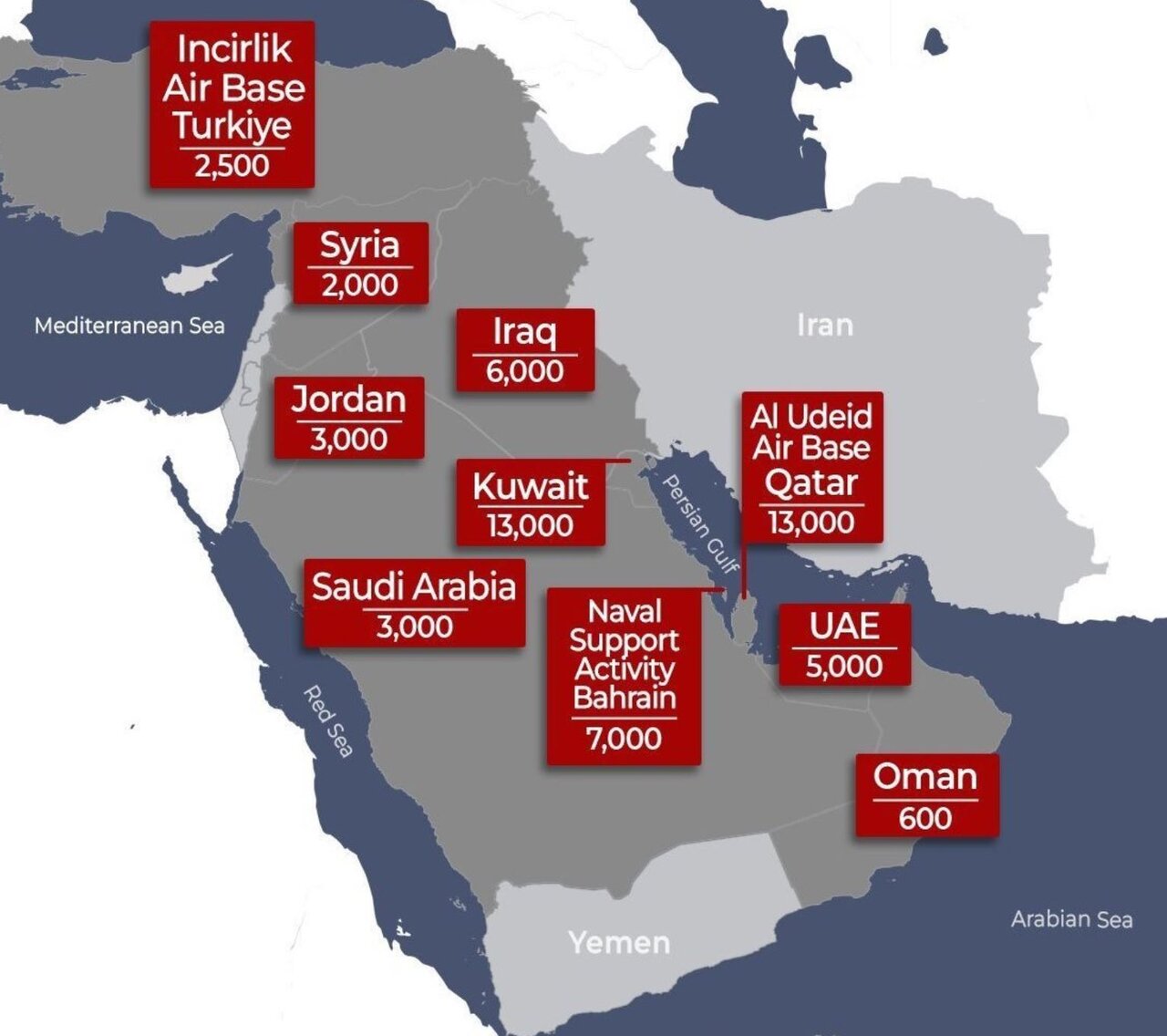
TEHRAN – Iranian Foreign Minister Abbas Araghchi says that should a war break out with the United States, and should the United States attack Iran’s nuclear facilities again, then Washington should expect Iran to strike American bases wherever they might be.
“The location of these bases is irrelevant,” the top diplomat told Al Jazeera during an exclusive interview. “We coexist peacefully with neighbors like Qatar, but some countries host U.S. forces. In a war, those bases will be targeted.”
Back then, he told Al Jazeera, Iran expressed solidarity with Qatar and emphasized that Tehran had targeted the U.S. base, not Qatar.
The Israeli regime launched a flagrant and unprovoked act of military aggression on Iran on June 13, 2025, triggering a 12-day war that killed well over 1,000 people in the country, including military commanders, nuclear scientists, and ordinary civilians.
The United States was “in charge of” the war since the beginning, according to U.S. President Danald Trump, but directly got involved by bombing three Iranian nuclear sites in gross violation of international law.
In response, the Iranian Armed Forces struck strategic sites across the occupied territories as well as the al-Udeid air base in Qatar, the largest American military base in West Asia.
Following Iran’s retaliatory attacks, Trump claimed that American forces had intercepted all incoming missiles and that one projectile had landed in an open area, causing no significant damage.
Western media soon questioned these assertions, publishing images that showed clear destruction at the air base. Satellite imagery reviewed by The Associated Press, for instance, revealed that Iran’s strike had damaged a geodesic dome used to house secure U.S. communications equipment.
Later on, the Pentagon’s chief spokesman, Sean Parnell, acknowledged that one Iranian ballistic missile had struck the al-Udeid Air Base. “One Iranian ballistic missile impacted Al Udeid Air Base on June 23, while the remainder were intercepted by U.S. and Qatari air defense systems,” he said in a statement.
“Al Udeid Air Base remains fully operational and capable of conducting its mission,” Parnell added.
Iranian officials, however, said that the damage was far greater than what American authorities or Western media reported. In an interview, Iran’s Security Chief, Ali Larijani, declared that ten of the eleven missiles launched at the base had struck their targets.
The July strike on al-Udeid was the second time Iran had targeted a U.S. military base in the region. The first was the 2020 attack on al-Asad Airbase in Iraq, which came in retaliation for the U.S. assassination of Iran's top anti-terror commander, General Qassem Soleimani, at Baghdad airport. That incident was also initially downplayed, though U.S. military authorities later disclosed that it had left numerous soldiers with traumatic “brain injuries”.
The U.S. has invested billions of dollars in its 19 bases across West Asia, including in Bahrain, Saudi Arabia, Kuwait, and the UAE. Approximately 50,000 American personnel are deployed in the region under the Pentagon's command.
Elsewhere in the interview, Araghchi said he hopes another conflict would not break out. “I hope this would not happen, and the previous time, too, the Americans immediately realized that the war should end,” he said, adding that there is no “military solution” to the dispute on Iran’s nuclear program.
“We do not trust the Americans. But we are always ready for diplomacy,” the diplomat stated.
Leave a Comment