Iran presses UN nuclear watchdog to clarify stance on June attacks
IAEA has yet to condemn illegal US-Israeli strikes on Iranian atomic sites
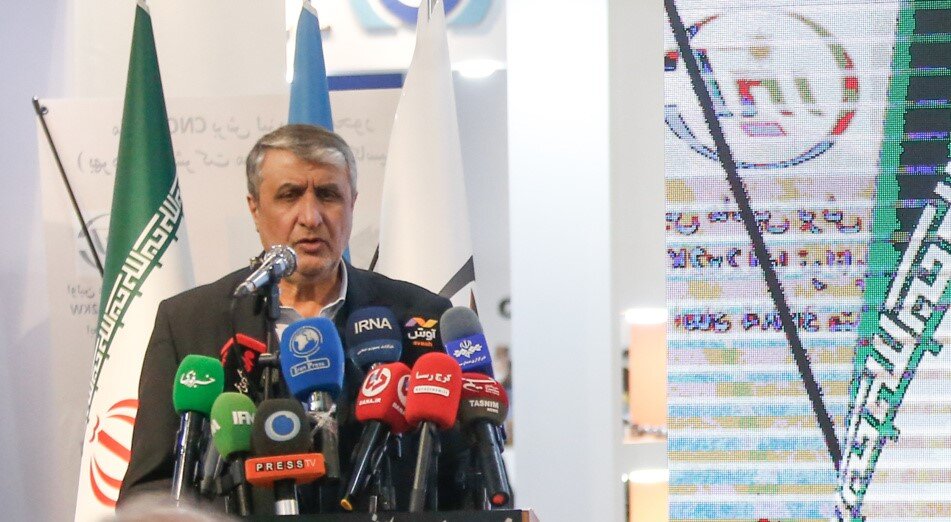
TEHRAN – Iran’s top nuclear official said Thursday that Tehran has formally asked the International Atomic Energy Agency (IAEA) to clarify its position on U.S.-Israeli attacks that targeted Iranian nuclear facilities in June, insisting that inspections cannot proceed without clear international standards and accountability.
Mohammad Eslami, head of the Atomic Energy Organization of Iran (AEOI), said Iran had written to Rafael Grossi, the director general of the IAEA, demanding that the agency explicitly state its position on the military aggression against Iran’s safeguarded nuclear sites.
The U.S.-Israeli strikes severely damaged Iranian nuclear sites at three locations, though it is not yet clear whether the facilities remain operational.
“The agency must clarify its stance on the attack on nuclear facilities,” Eslami told reporters on the sidelines of an international technology exhibition in Tehran. “Inspection procedures for sites that have been attacked must also be clearly defined.”
His remarks come amid persisting tensions following U.S.Israeli strikes on Iranian territory in June 2025, which also included nuclear-related facilities. Tehran has noted that such attacks, which are in clear violation of international law, undermine the global nonproliferation regime by normalizing military action against civilian nuclear infrastructure.
Eslami said inspections of damaged facilities raise new environmental and safety risks that are not covered by existing IAEA frameworks. “When a military attack takes place and environmental hazards are involved, a new definition and clear guidelines are required,” he said.
Inspectors no longer in Iran
Responding to comments by Grossi calling for inspections of bombed Iranian sites, Eslami said that IAEA inspectors are currently not present in the country. He added that previous inspections had been limited to facilities that were not damaged in the attacks.
“Iran proposed at the IAEA General Conference that nuclear sites should never be attacked,” he said. “That proposal was not even reviewed. Now clarity is required. Mr. Grossi must first explain his position and how access is supposed to work under these circumstances.”
Grossi has never condemned the attacks on Iranian nuclear sites. Instead, he has focused his efforts solely on renewing inspections in Iran—without addressing how Tehran can be assured that the United States and Israel will not strike again if they conclude the facilities suffered only limited damage. The IAEA chief is widely viewed in Iran as an unprofessional figure who advances Western and Israeli interests under the guise of international oversight.
Speaking earlier at the unveiling of new laser and quantum technology achievements at the Sixth International Laser, Photonics and Quantum Exhibition, Eslami also emphasized that Iran’s nuclear program is not a liability but a strategic national asset.
“The Atomic Energy Organization of Iran is not a ‘problem’; it is a solution,” he said, adding that Iran’s scientific capabilities now operate on par with leading nuclear nations in several fields. “The reason for hostility is precisely this — that Iran and its people have reached a high scientific standing.”
He highlighted the organization’s expanding role in health care, industry and advanced technologies, saying there is “no sector” in which AEOI technologies do not play a role. He credited Iran’s progress to an “opendoor policy” that draws on the country’s scientific and research capacity despite years of sanctions.
Eslami said Iran plans to dramatically expand its nuclear energy output, with the goal of nuclear power accounting for 21 percent of electricity generation by 2050. The country also aims to triple the number of nuclear power plants, a strategy he said was studied and approved even before the 1979 revolution but later stalled due to Western withdrawal from cooperation.
“This is a serious national need,” he said. “We cannot allow delays in this program.”
The official also pointed to rapid advances in quantum computing, communications and laser technology, areas that analysts say are critical to Iran’s future development. He announced that Iran hopes to unveil its first quantum computer next year and said field tests in quantum communications have already been conducted with the national telecommunications sector.
“These are technologies of today and tomorrow,” he said. “They affect every aspect of people’s lives.”
Despite mounting external pressure, Eslami stressed that none of the organization’s activities have been halted. “All programs are advancing according to plan,” he said.
Leave a Comment