America’s ‘big armada’ won’t change the equation — at least not in Trump’s favor
Rather than forcing capitulation, escalating US pressure is driving Iran to prepare for worst-case scenarios
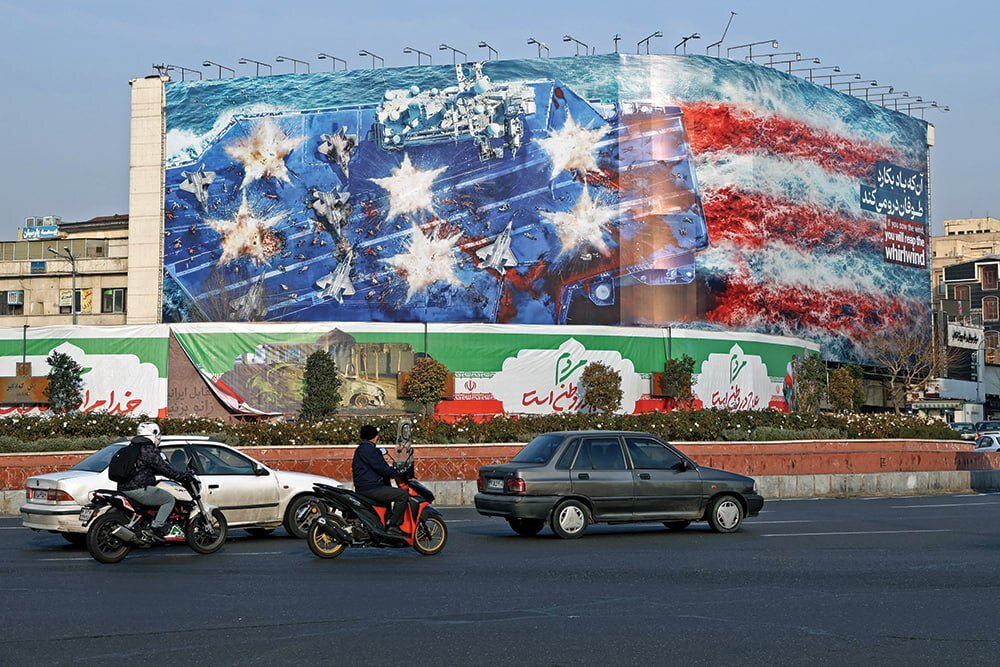
TEHRAN – Since 2018, Tehran has been the primary actor exercising strategic patience to prevent tensions with Washington from spiralling into an all-out regional conflagration. This restraint has sprung from a recognition of the catastrophic costs of conflict—not only for Iran but for the Arab neighbors it has sought to court against Israeli expansionism, and for extra-regional allies like China that depend on West Asian energy.
Yet, as American pressure mounts and Washington continues to demand total capitulation, the calculation in Tehran is also shifting. Faced with economic strangulation and periodic U.S.-Israeli security breaches, a growing consensus suggests that the devastating regional war Iranians have so assiduously avoided is, at the end of the day, inevitable—and, if fought well, may be the only exit from the current deadlock.
In a recent interview with Axios, President Donald Trump boasted of the "big" American armada deployed to the Persian Gulf, outlining the capitulations required of Tehran to avoid its use. "We have a big armada next to Iran. Bigger than Venezuela," Trump told the reporter—a figure noted for deep ties to Zionism.
Washington has dispatched a carrier strike group, alongside additional squadrons of F-15s and F-35s, to the region. This buildup follows threats of aggression should Iran crack down on the armed insurgents who hijacked protests earlier this month, sparking what officials have termed "urban terrorism." Between January 8 and 14, the country was convulsed by deadly violence that claimed approximately 3,100 lives, including nearly 2,500 civilians and security personnel.
Analysts argue these riots were engineered to pave the way for a second wave of American attacks, following the 12-day war the U.S. and Israel imposed on Iran in June 2025. The calculus in Washington allegedly relied on the unrest spreading—with terrorists seizing police and military sites, a scenario claimed to have briefly occurred in isolated outposts on January 8 and 9—thereby distracting the Iranian military. That military had previously wreaked significant havoc across the occupied territories and struck a U.S. base in Qatar during the June conflict. However, with the collapse of the riots, the likelihood that a new war would topple the Islamic Republic has plummeted—removing the central justification the Trump administration might have used to absorb the blows of another conflict.
Trump’s remarks to Axios suggest that despite the dim prospects for successful military action, the window for diplomacy remains all but closed. The President seeks nothing less than Iran’s total capitulation, pursued through either war or a campaign of suffocating pressure.
"They want to make a deal. I know so. They called on numerous occasions. They want to talk," Trump claimed, directly contradicting Iranian officials who have consistently denied requesting talks under the current circumstances. "If they want to contact us and they know what the terms are, then we're going to have the conversation."
Having abandoned the Joint Comprehensive Plan of Action (JCPOA) in 2018 to initiate a "maximum pressure" campaign, Trump is revisiting old demands. The 2015 accord, achieved after two years of painstaking diplomacy, traded limits on Iran's nuclear program for sanctions relief. But Trump has been demanding that Tehran not only dismantle its nuclear infrastructure under a new deal but also cripple its missile program and sever ties with regional Resistance forces—concessions Iranians have deemed non-negotiable.
These conditions were previously raised during negotiations in April and May of 2025—talks the administration effectively scuttled by launching the June 2025 war.
"Neither the new armada Trump has sent to the Persian Gulf, nor any other equipment he may send to the region, will cause us to abandon our principles," a source familiar with the Iranian leadership's thinking told the Tehran Times, echoing recent official statements. "Iran and the U.S. can always strike a respectful and logical deal, but if the U.S. president decides he does not want that, then we are ready for worst-case scenarios."
What the war everyone fears could look like
Analysts and insiders in Tehran warn that a second conflict would bear little resemblance to the twelve-day skirmish of June 2025. While Iran fought that war largely alone and with calculated restraint—striking a U.S. base in Qatar and launching 21 waves of missiles and drones against the occupied territories before accepting a ceasefire—a renewed American offensive would likely trigger a doctrine of "unrestricted warfare."
Iranian officials have signalled that the era of strategic patience is ending. Beyond the conventional missile barrages that overwhelmed Israeli air defenses last year, Tehran has threatened to play its economic trump card: the closure of the Strait of Hormuz. With roughly one-fifth of the world’s oil supply passing through this chokepoint, such a move, potentially combined with drone swarms targeting energy infrastructure across the Persian Gulf, would likely plunge Western economies into an immediate and catastrophic recession.
Shoaib Bahman, an expert on international affairs in Tehran, suggests the traditional Iranian caution may no longer be a viable defense strategy.
"Multi-faceted crises cannot be managed with linear solutions," Bahman said. "If we want to change the game, we must exit the state of passivity and become unpredictable."
This unpredictability would be compounded by the full entry of the Axis of Resistance. Unlike in 2025, when Iran’s regional allies held their fire, groups in Lebanon, Iraq, and Yemen have issued coordinated warnings that they will treat an attack on Iran as an attack on themselves.
In Lebanon, Hezbollah Secretary General Sheikh Naim Qassem has declared a "theological and strategic bond" with Tehran, viewing the defense of Iran as a religious obligation. With an arsenal of precision-guided missiles capable of evading Israel’s defensive sphere, Hezbollah can target Israel’s critical infrastructure—power grids, ports, and military installations—potentially paralyzing the United States' primary regional outpost. Meanwhile, Yemen’s Ansarallah movement has vowed to "sink all U.S. fleets" in the Red Sea, effectively closing a second global trade artery.
Closer to American ground troops, Iraq’s Kataib Hezbollah has warned that a new invasion would result in "sudden and bitter death," instructing its vast network of fighters to prepare for "victory or martyrdom."
Hossein Pak, a veteran conflict journalist who has embedded with Resistance forces across the region, describes the mood on the ground as one of determination.
"We are standing in an existential battle, a conflict I have lived at zero distance on multiple fronts," Pak said. "The lived experience of war has taught us to be ready for any probability and to prepare for the worst scenarios. Our regional assets remain winning cards capable of pushing the enemy back."
Pak noted that while the enemy attempts to psychologically disarm the population, the physical mobilization is already underway. "Millions of martyrdom-seeking forces must be present on the ground... If minds remain ready and steadfast, then we will see who is forced into regret."
Leave a Comment