Urgent repairs ordered after water leak damages Isfahan’s UNESCO-listed mosque

TEHRAN – Cultural heritage authorities have launched emergency measures to contain water leakage and ground subsidence at the UNESCO-listed Jameh Mosque of Isfahan after moisture and cracks were detected near its centuries-old Nezam al-Molk dome.
Omidali Sadeqi, director of the World Heritage base of the Jameh Mosque, on Thursday said the damage was partly caused by external factors, including a burst drinking water pipe that went unnoticed for weeks, leading to rising moisture in the mosque’s foundations.
Sadeqi told ISNA that water leakage behind the Nezam al-Molk dome had caused a slight substructure and visible impacts in western passageways, prompting an emergency crisis management meeting in Isfahan province to assess the situation and coordinate interventions.
He said a technical committee had been formed, on the order of the provincial cultural heritage director, to implement corrective measures to the urban water and wastewater system and to lower the level of surrounding passageways to reduce pressure on the historic structure.
According to Sadeqi, a meeting involving relevant authorities was held last week, at the provincial cultural heritage department, where a comprehensive report on subsidence-related damage was presented. The report identified faulty pipes and other sources of moisture contributing to the problem.
He said the meeting also agreed to revise and update regulations governing the protected area and buffer zone of the mosque to strengthen safeguards, incorporating risks that had not been previously addressed.
Sadeqi further said the mosque’s heritage base was tasked with compiling a risk assessment covering moisture and subsidence and submitting it through the provincial cultural heritage office to the Isfahan governor, enabling the use of national crisis management resources.
He added that a one-year monitoring and documentation program would be carried out to record remedial actions and report outcomes to crisis management authorities.
As part of the plan, the provincial water and wastewater company has begun excavations to replace damaged pipes. The official said another leak was discovered during the work and was also being repaired, which he said was expected to resolve most of the moisture-related problems.
He said parallel measures include reorganizing electricity, telecommunications and gas lines around the mosque, standardizing drainage channels, repairing cracks, managing downpipes and addressing areas of subsidence to limit further damage.
Separately, Mansour Shishehforoush, director of crisis management at the provincial governor-general’s office, said authorities had convened an emergency session and launched field inspections following reports on social media showing moisture, cracks and limited subsidence near the Nezam al-Molk dome.
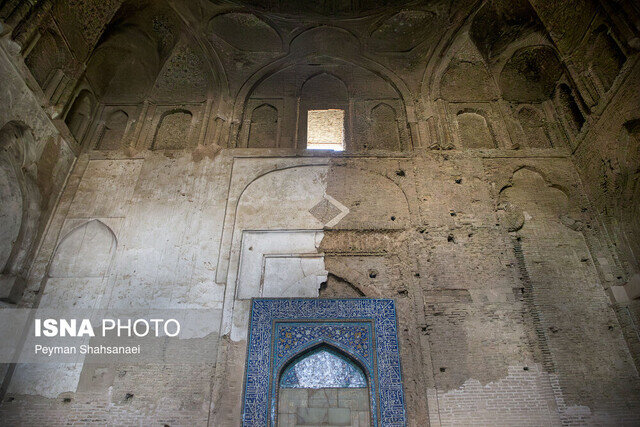
“Given that the situation may lead to a critical stage, we must act immediately,” Shishehforoush said on Tuesday during a site visit, according to IRNA. He said defects in water and wastewater networks and deteriorated paving in surrounding passageways posed a direct risk to the historic fabric.
He said crisis management teams were being deployed under the supervision of cultural heritage authorities, with cooperation from the municipality and utility companies, to carry out urgent repairs and prevent further damage to the mosque.
The Jameh Mosque of Isfahan, located in the historic center of the city, is one of the oldest Friday (congregational) mosque in Iran and one of the most significant monuments of Islamic architecture worldwide. It represents more than 12 centuries of architectural evolution, encompassing styles and innovations from the Abbasid, Buyid, Seljuq, Ilkhanid, Muzaffarid, Timurid and Safavid periods.
Following major expansion under the Seljuqs, the mosque became the prototype for the four-iwan (Chahar Ayvan) layout that later spread widely across the Islamic world. It is renowned for its two extraordinary domes, including the Nezam al-Molk dome, one of the earliest double-shell ribbed domes in Islamic architecture, and the Taj al-Molk dome, celebrated for its refinement and proportional harmony.
Built on the site of an earlier fire temple, the mosque’s origins date back to the second century of the Islamic calendar. Over centuries, successive dynasties added prayer halls, iwans, courtyards and decorative elements, turning the complex into what many scholars describe as a living museum of Iranian architecture.
AM
Leave a Comment