American security and double standard of disorder
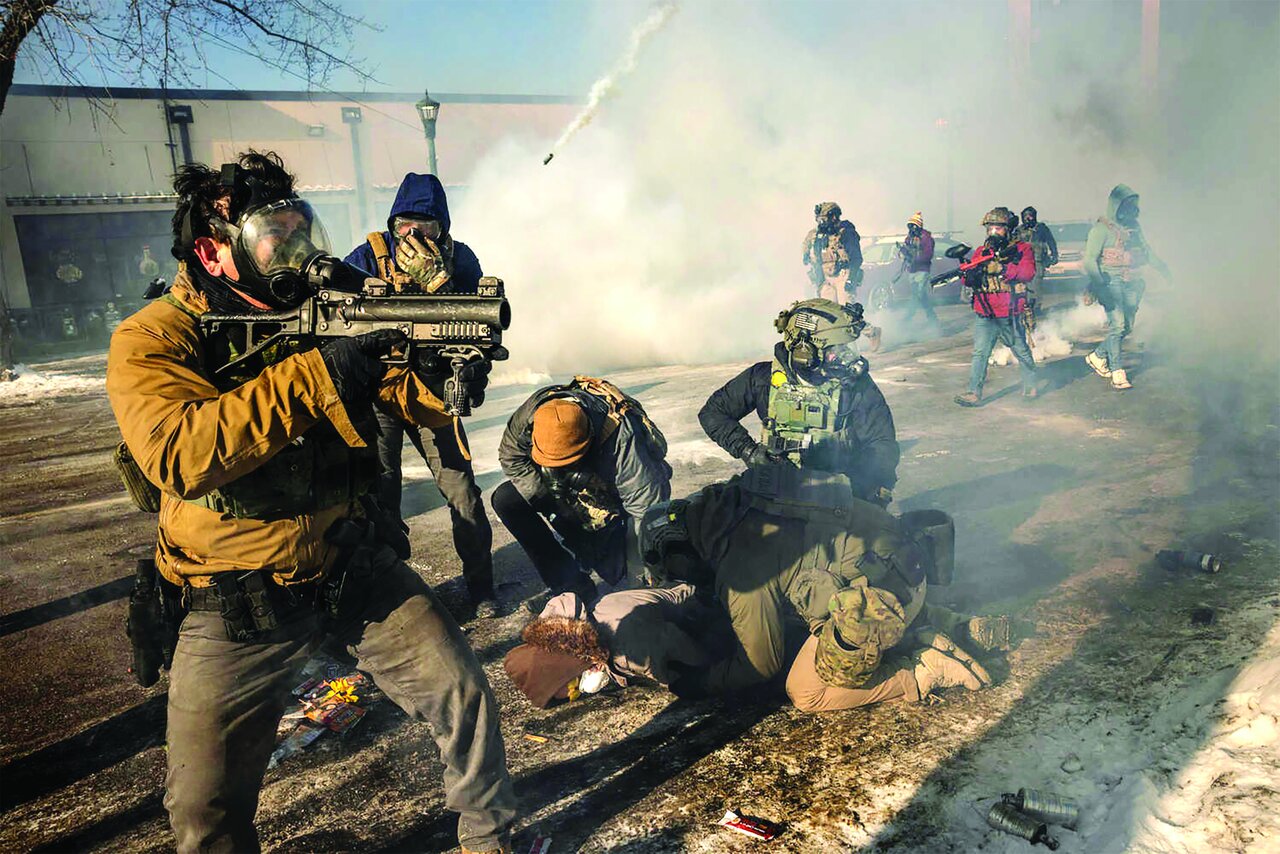
TEHRAN - While Donald Trump labels American protesters “professional agitators” and calls for their imprisonment or deportation, the very same pattern of behavior has for years been framed in Western narratives of insecurity in Iran as “civil protest”—a stark rupture in how order, security, and the legitimacy of violence are defined.
Trump’s recent remarks on the widespread protests in Minnesota have once again brought an old yet unresolved contradiction to the media's forefront. Responding to attacks on public sites, including a church, Trump described the protesters as “professional,” “trained,” and “disruptive of public order”—individuals who, in his view, should either be imprisoned or expelled from the country. This stance is not only harsh but overtly security-driven, leaving no room for empathy under the banner of “protest.”
Although such rhetoric is hardly new to the American public, it takes on a different meaning at the international level—especially when placed alongside the official and media narratives of the West regarding Iran’s winter unrest. In those events, widespread destruction of public property, armed attacks, the killing of security personnel and ordinary citizens, and the organized activity of violent groups were all present, yet many Western outlets portrayed them simply as “popular protests.”
Security narratives at home
In his comments on Minnesota, Trump explicitly emphasized the “trained” nature of the protesters. From his perspective, violent behavior cannot be the product of spontaneous social anger; it is instead the result of professional organization and direction. This is precisely the language long used in the security discourse of various states to describe organized instability—but it is deemed legitimate only when such events occur within U.S. borders.
Within this framework, an attack on a church is labeled a “riot,” collective chants are seen as “planned madness,” and disruptions of public order are treated as direct threats to national security. Even deportation is presented as a legitimate option—without mainstream Western media characterizing these positions as “the suppression of protest.”
Protest beyond the borders
Yet this same logic undergoes a sudden transformation when applied to Iran. During Iran’s winter unrest, a network of hostile media outlets worked from the earliest hours to marginalize violence and center an emotional narrative of “defenseless people.” In this framing, armed attackers became “protesters,” sabotage was recast as “civic action,” and even the assassination of security forces was portrayed as a “natural response to repression.”
The direct role of the United States and Israel in guiding the media, cyber, and even operational dimensions of these disturbances has been repeatedly exposed by Iranian officials and some independent reports. Billions of tomans in damage to infrastructure, the deaths of hundreds of Iranians, and the presence of trained elements carrying out violence under the guise of ordinary citizens never found a serious place in the dominant Western narrative.
Media as a tool of legitimization
The core difference lies not in the nature of the events, but in how they are narrated. Western media, depending on geography and political interests, decide whether a violent act is called “protest” or “riot,” a “popular movement” or “terrorism.” This is the point at which security ceases to be a universal principle and becomes a political instrument.
Trump—the same politician who repeatedly threatened military action against Iran under the pretext of “supporting protesters”—now shows not the slightest tolerance for the concept of protest when confronted with domestic unrest. This duality is neither accidental nor cultural; it is rooted in the logic of power.
Selective security in the American order
In a political order where the United States sees itself as both architect and arbiter, security is not an absolute right but a selective privilege. If instability serves to weaken an independent state, it is celebrated as a “cry for freedom”; if the same instability threatens internal power structures, it is instantly reduced to “professional rioting.”
Trump’s recent remarks are less about Minnesota than they are a mirror of this double standard—a logic that reveals how the line between protest and disorder is drawn not by human or legal criteria, but by political interests. In such a landscape, what is ultimately sacrificed is not only truth, but the lives of human beings—labeled “protesters” in one moment and “agitators” in another, solely because the geography of violence has changed.
Leave a Comment