Iran strengthens offensive posture with Khorramshahr-4 missile
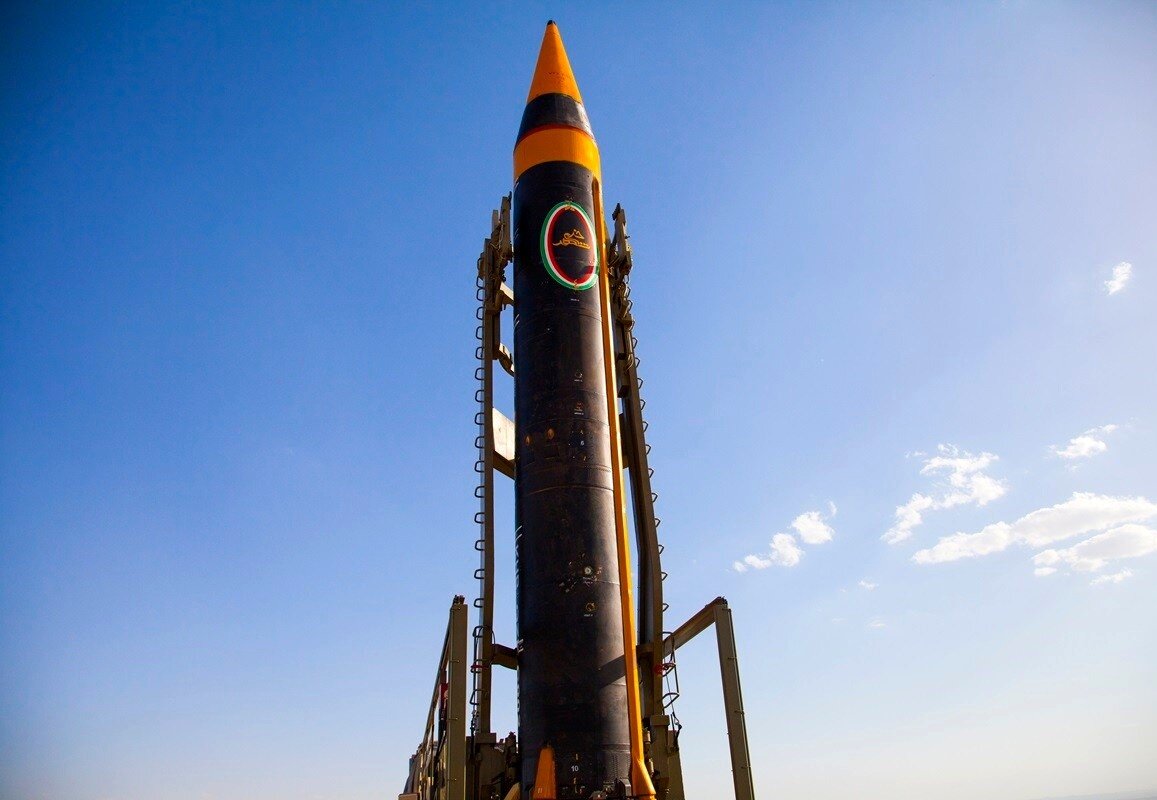
TEHRAN — The Islamic Revolution Guards Corps (IRGC) Aerospace Force has inaugurated a massive new underground missile city, marking the operational induction of the Khorramshahr-4 ballistic missile.
The Khorramshahr-4, the latest iteration of a storied lineage, is a showcase of Iran’s indigenous engineering tailored for high-intensity theater dominance.
Boasting a range of 2,000 kilometers and a staggering 1,500-kilogram warhead, the missile is engineered to penetrate the world’s most sophisticated integrated air defense systems.
By achieving hypersonic speeds of Mach 16 outside the atmosphere and Mach 8 upon reentry, it effectively reduces enemy reaction windows to near-zero.
Its maneuverable reentry vehicle (MaRV) and mid-course guidance systems enable surgical precision within 30 meters, complemented by a low radar cross-section and strong resistance to electronic warfare.
Iran’s missile program, developed domestically amid decades of sanctions, has evolved into a cornerstone of national defense.
From the original Khorramshahr unveiled in 2017 to this fourth-generation variant, these advancements reflect a legacy of continuous innovation and self-reliance.
The timing of the induction carries significant diplomatic weight, occurring just as Iranian negotiators were preparing for nuclear talks in Oman.
Brigadier General Yadollah Javani, the head of the political bureau of the IRGC, emphasized that the Khorramshahr-4 sends a firm message to Washington that military power is a non-negotiable pillar of national identity.
“The U.S. has returned to negotiations humbled,” Javani remarked in an interview with Al Mayadeen on Thursday, noting that the West’s desperation to include the missile program in talks is the ultimate validation of its deterrent efficacy.
He warned that any “mistake by the enemy” would be met with a response so coercive it would be their last in the region.
The deployment of Khorramshahr-4 represents more than a hardware upgrade; it marks the forefront of the Islamic Republic’s transition to an “offensive doctrine” based on the lessons learned after the June 2025 12-day war, as recently announced by Iran’s military chief, General Abdolrahim Mousavi.
This doctrine is intended to enable rapid, sustained, and unpredictable strikes against any perceived source of aggression.
During the 12-day war —ignited by illegal U.S.-Israeli strikes on Iranian sites—Tehran’s missile forces shattered the myth of Western air superiority.
While the nation mourned over 1,000 martyrs, the IRGC responded with a calculated storm that targeted critical military, intelligence, and infrastructure sites across Israel, as well as the U.S. military’s Al-Udeid airbase in Doha, Qatar.
The effectiveness of those strikes, which neutralized key communications and logistical hubs despite the density of enemy defenses, provided the empirical foundation for the current shift in military philosophy.
Satellite images released by the New York Times on Friday allege that ballistic missile sites, claimed to have been damaged during the 12-day war, were quickly repaired by Iran.
As Major General Abdolrahim Mousavi noted during his inspection of the new facility, the era of mere defense has evolved into an “active deterrence” posture that bypasses all Western military calculations.
The existence of these “drone and missile cities,” buried hundreds of meters beneath layers of concrete and rock, ensures that Iran’s retaliatory capacity is immune to preemptive strikes.
These facilities allow the IRGC to maintain a state of constant, invisible readiness, monitoring every move of foreign naval assets—exemplified by the recent precision drone surveillance of a U.S. aircraft carrier.
Leave a Comment