Fars plans to make historical sites, traditional accommodation centers suitable for disabled, elderl
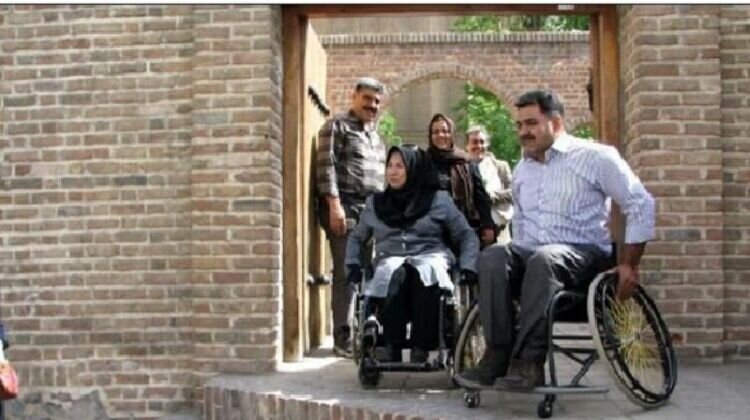
TEHRAN – Although the adaptation of hotels and accommodation centers in Fars province for the disabled and elderly has been completed to some extent, and tourism investors are particularly concerned that the principles are observed in construction of new centers, historical sites and traditional accommodation centers still face problems in this regard.
When it comes to adapting public places for the disabled and elderly, only designing wheelchair-accessible spaces comes to mind, while according to Saeed Fani, manager of the Fars Cultural, Sports, and Tourism Association for the Disabled, adaptation is not just creating a ramp, but a complex issue and the needs of the blind and deaf must also be taken into account, IRNA reported.
He continued that creating special signs for the blind, the presence of deaf, and expert tour leaders are essential to communicate with the disabled in historical places.
Fani said that it would be good to install a Braille sign in addition to the identity card and work introduction signs so that the blind can use it.
He emphasized that several pieces of rehabilitation equipment such as wheelchairs should be placed at the entrance to tourist sites so that the elderly can use them.
Fani also said that ramps should also have standard slopes and be implemented in a principled manner. This is while these ramps are designed with non-standard slopes in some historical and cultural sites in Fars province such as Sa’dieh, he added.
He examined Persepolis, the Pars Museum, and the Karim Khan Citadel as examples of the challenges faced by the elderly and the disabled in visiting the historical attractions of Fars, and said that the outer space of Persepolis, which is covered with sand, is not suitable for wheelchair traffic, and the long stairs and uneven flooring of the Karim Khan Citadel make it impossible for the elderly and disabled to visit the ancient monument.
As mentioned, if today in urban and public spaces it is possible to reconstruct spaces in accordance with the needs of elderly and disabled citizens, but the adaptation of historical sites faces limitations due to the necessity of its authenticity and landscape.
According to him, there are solutions; for example, part of the floor of the Karim Khan Citadel can be covered with wood for wheelchair traffic in style of Persepolis, or electronic lifts and hydraulic structures can be used to transfer the elderly and the disabled to the upper rooms.
Fani said: “In countries that are historical tourism hubs such as Greece and Italy, these methods have been used to adapt them specifically for the disabled and the elderly.”
He also referred to other tourist sites and said that even in the Persian Gulf countries, health, welfare and swimming facilities have been considered for the disabled on the beaches, which are very popular with tourists.
Also, Deputy Head of Far Cultural Heritage Department Sadeq Zare said that adaptation in historical sites is a different matter; even in some places, it is not possible to use new technologies.
Specifically, regarding the Karim Khan Citadel, glass stairs of the standard height were created on the high stairs to facilitate movement for the elderly, but even if they are moved up, it is not possible for wheelchairs to move because of the footrests at the entrance to the historical doors, he added.
Stating that there are persons who render services and support for people with disabilities in these places, he said: “They will help as much as possible to provide the opportunity for everyone to visit, but we need a comprehensive and principled plan.”
Zare continued that the adaptation of historical sites requires both the completion of studies and the preparation of a comprehensive technical plan, as well as funding.
He announced that studies and preparation of a technical plan for adaptation in historical places have been put on the agenda in cooperation with various companies.
According to Article 2 of the Comprehensive Law on the Protection of Persons with Disabilities, all public places and buildings must be adapted in accordance with the standards.
Fani said that Fars Cultural, Sports, and Tourism Association for the Disabled is ready to hold a special training course for managers of accommodation facilities, and especially the staff of the information department of tourist sites must have the knowledge to communicate with the disabled.
Also, Head of Fars Cultural Heritage, Tourism and Handicrafts Department Behzad Moridi said that with consultation, principled planning and implementation of scientific and international standards, a pleasant, safe and accessible space can be created for all segments of the society and steps can be taken towards the development of sustainable and inclusive tourism.
He added that an assessment of the accessibility of historical and tourist sites and the modification of traffic routes to historical and cultural sites in Fars are being carried out so that people with disabilities, the elderly and other disabled groups can benefit from the province's tourism capacities without restrictions.
Conditions in many historical and cultural sites in Fars are not suitable for visiting by the elderly and the disabled, and this challenge has deprived them of seeing some of the province's tourist attractions.
According to IRNA, Fars, with more than 3,200 national heritage sites, has a prominent position in the field of historical and cultural tourism. Hafezieh, Sa’dieh, Persepolis, Pasargadae, and Karim Khan Citadel are always among the most visited heritage sites in the country.
Just as the movement and use of the elderly and disabled are not considered during urban development and the construction of many public places, and they are deprived of the possibility of independence in carrying out public activities, many historical sites are also out of reach of those who are physically injured or have disabilities.
KD
Leave a Comment