Khalid Nabi cemetery blends archaeology and pilgrimage
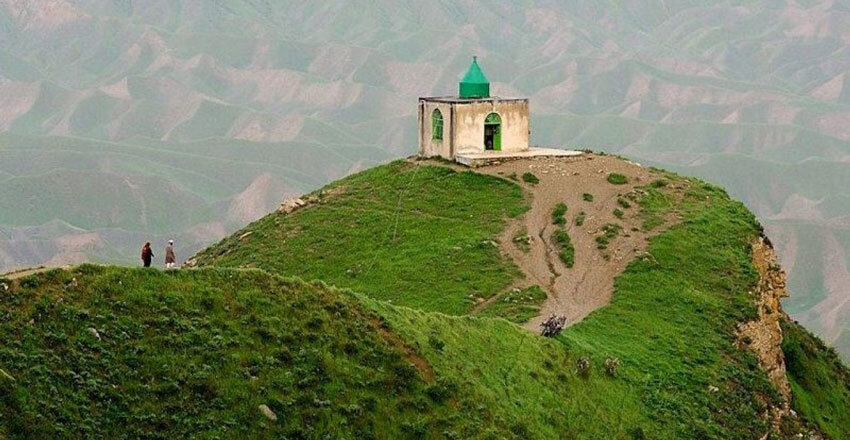
TEHRAN – Surrounded by vast skies, green hills in spring, and golden grasses in late summer, Khalid Nabi Cemetery stands as one of northern Iran’s most distinctive heritage destinations. It embodies a convergence of myth, memory, landscape, and identity—where pilgrimage, archaeology, and tourism meet on a remote mountain ridge overlooking Turkmen Sahra.
Located in Golestan province near the Turkmenistan border, about 70 kilometers northeast of Gonbad-e Kavous and roughly 55 kilometers from Kalaleh, the site lies at an elevation of around 700 meters above sea level, overlooking the sweeping landscapes of Turkmen Sahra.
The cemetery forms part of a broader sacred complex set amid rolling highlands and open valleys. It stands about one kilometer from the mausoleum known as Khaled Nabi, a domed shrine believed--according to the oral traditions of the Yomut Turkomans--to belong to a pre-Islamic prophet. For local communities, particularly Turkmen pilgrims, the site remains a place of devotion and seasonal visitation.
The mausoleum itself is a rectangular structure topped with a dome and marked by metal columns, arched iron doorways, and windows. Inside lies a tomb about one and a half meters long, covered with a white cloth framed by small pieces of colored textiles. Nearby are auxiliary structures, including a mosque, several rooms, and a cistern known locally as “Lari.” Each spring, a seasonal stream called Khezr Dandan flows near the site, adding to its spiritual atmosphere.
A short distance away stands the shrine of Choopan Ata (Ata Chofun, meaning “Father Shepherd”), traditionally regarded as Khalid Nabi’s son-in-law. This rectangular building features a conical metal dome and arched windows. Close by is another shrine, Alam Baba, constructed from local stone known as Looneh. A sacred tree in front of Alam Baba attracts pilgrims who tie ribbons to its branches while making wishes or prayers.
West of Alam Baba, along the hill ridges, lies the cemetery proper. The site is distinguished by hundreds of upright stone markers--some rising two meters or more--scattered across the ridgelines and slopes. When archaeologist David Stronach visited in 1979 and 1980, he recorded more than 600 standing stones distributed in several clusters. About half were concentrated on what he termed the “High Plateau,” with additional groups extending across neighboring ridges and hillocks. Another large cluster of roughly 150 stones occupied the southern side of the mountain.
The stones vary in form. Some are cylindrical shafts, others resemble crosses, and some feature rounded protrusions. A number of markers appear stylized or abstract, including forms that resemble human figures or even the head of a ram. Local interpretations often distinguish between male and female graves based on shape: cylindrical or cross-like forms are commonly attributed to men, while stones with one or two rounded “bumps” are associated with women.
The exact dating of the cemetery remains uncertain. Popular claims sometimes link the site to very ancient periods, even as far back as the Paleolithic era, though such assertions remain debated. Regardless of precise chronology, the cemetery reflects a complex cultural history shaped by regional traditions and Turkmen heritage.
Visitors from across Iran travel to Golestan to see the unusual stones and experience the dramatic mountain setting. The combination of sacred pilgrimage, archaeological intrigue, and striking landscape has made Khalid Nabi Cemetery a destination that blends spirituality, curiosity, and visual impact.
Cemetery tourism and cultural significance
Cemeteries around the world--from Père Lachaise in Paris to historic graveyards in Latin America and Asia--have long attracted visitors interested in art, history, and collective memory. Khalid Nabi Cemetery fits within this broader pattern of “cemetery tourism,” where burial grounds are appreciated not only as places of mourning but also as cultural landscapes.
Here, the appeal lies in multiple layers:
Spiritual significance for local Turkmen communities who continue to visit the shrines.
Archaeological and anthropological interest in the standing stones and burial traditions.
Visual and environmental attraction, as the site overlooks sweeping hills and valleys of northern Iran.
Cultural storytelling, shaped by oral traditions and popular interpretations.
Although parts of the cemetery have suffered damage and even episodes of vandalism and fire in past years, the site remains a nationally protected heritage area under the supervision of Iranian authorities.
For travelers seeking destinations beyond conventional urban attractions, Khalid Nabi Cemetery offers an experience that is at once spiritual, historical, and visually unforgettable.
AM
Leave a Comment