Iran is not Iraq, not Libya, and not Venezuela
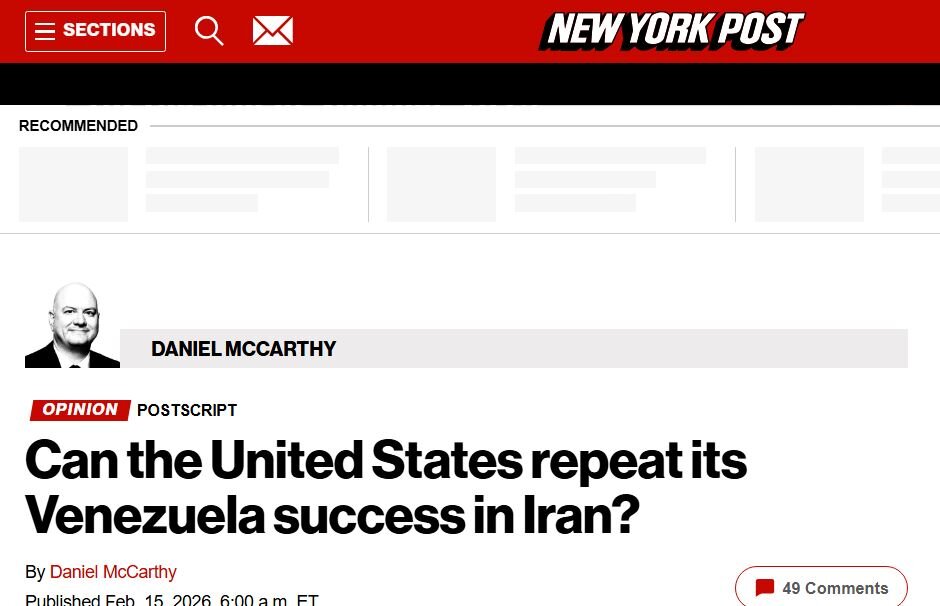
The New York Post recently claimed that the United States could dismantle Iran’s power structure using a Venezuela-style model and even suggested a figure in exile as a transitional option. The Post’s piece does not read like political analysis; it reads like a performance staged in a Washington think tank, detached from political and historical realities.
Recycling the Venezuela scenario for Iran reflects a political preference in Washington more than a grounded assessment of facts. Iran is neither a one-man state nor home to a unified opposition, nor is it a society that would rapidly disintegrate under external pressure. The region’s history has repeatedly demonstrated how such projections collide with reality.
While the region is still dealing with the aftermath of the twelve-day June war between Israel and Iran, some American media outlets have once again begun promoting the toppling of the government in Tehran. This idea has circulated in policy circles for years, each time running up against the complex realities on the ground in Iran.
The latest example is the attempt to reconstruct the so‑called “Maduro model” for Iran. It may be attractive for headline writing, but historically and structurally it is weak.
U.S. foreign policy has fallen into this trap of faulty analogy before. Iraq in 2003 began with promises of the swift collapse of the Baathist structure and ended in years of violence and instability. Libya in 2011 started with the removal of Qaddafi and resulted in parallel governments and proxy warfare. Afghanistan began with hopes of political engineering and concluded with the Taliban’s return.
Iran is even more complex than those cases. The structure of power in Tehran is multilayered. Contrary to the claims of some opponents, it is not a single-axis network but a dynamic and active system rooted in an enduring ideological and institutional framework. A four-decade bureaucracy has taken shape and is deeply embedded in the administrative fabric of the state. Removing one individual in such a system does not equal the collapse of the entire order. The notion of “decapitation and conclusion” with Iran is just a fantasy.
During the twelve-day June war between Israel and Iran, a development occurred that received limited attention in Western analyses: domestic political divisions narrowed significantly. Even serious critics of the government adopted the language of national defense in the face of external attack. Regional media reported a noticeable rise in internal cohesion.
This phenomenon is not unprecedented. During the Iran–Iraq war, political disputes of the 1980s were sidelined in the face of foreign threat. Experience shows that external pressure on Iran often produces the opposite of its intended outcome. Maximum sanctions did not trigger immediate structural collapse; instead, they led to economic and security recalibration.
Analyses premised on imminent implosion overlook a sociological reality: national identity intensifies under conditions of threat, temporarily softening internal divides.
In its report, the New York Post presents the son of the deposed shah as a potential transitional option. Yet a fundamental question remains unanswered: exactly which constituency does he represent, and through what democratic mechanism does he claim legitimacy?
Iran’s Western-based opposition is fragmented and ideologically divided. Secular republicans do not support a return to monarchy. Many ethnic political groups despise the Pahlavis. Leftist movements maintain a sharply different historical narrative regarding the Pahlavi era. Coalitions formed abroad in recent years have quickly disintegrated. Western media support does not substitute for social legitimacy. In political science, legitimacy derives from elections, from leadership rooted inside the country, or from broad elite consensus. None of these sources can be demonstrably established in this case.
The notion that Iranian society is prepared to entrust its future to a figure in exile reflects the nostalgia of segments of the diaspora more than the complex realities within the country.
The overlooked costs
The sudden removal of the apex of power in a country with missile capabilities and regional influence carries consequences. Even within such analyses, it is acknowledged that if Tehran feels cornered, it may resort to broad regional retaliation. If that risk is serious, how can the same scenario be presented as a solution?
Over the past two decades, West Asia has functioned as a laboratory for rushed interventions. Each promise of swift political transition has instead widened security vacuums. Iran, with a population approaching ninety million and a sensitive geopolitical position at the heart of global energy routes, would not confine instability within its borders if it were to descend into widespread chaos.
Responsible foreign policy is not written on the basis of aspiration but on careful assessment of costs and consequences.
Iran is a country with a long-standing tradition of centralized statehood. Even the 1979 revolution was the product of internal transformations and domestic coalitions, not a foreign operation. Any meaningful change, if it occurs, will emerge from within society and through indigenous mechanisms.
Simplified templates may serve domestic political narratives in the United States, but they are insufficient for understanding Iran. The region’s history repeatedly demonstrates that political engineering from outside produces instability far more often than it creates order.
Leave a Comment