Safavid-era cannon to undergo conservation process

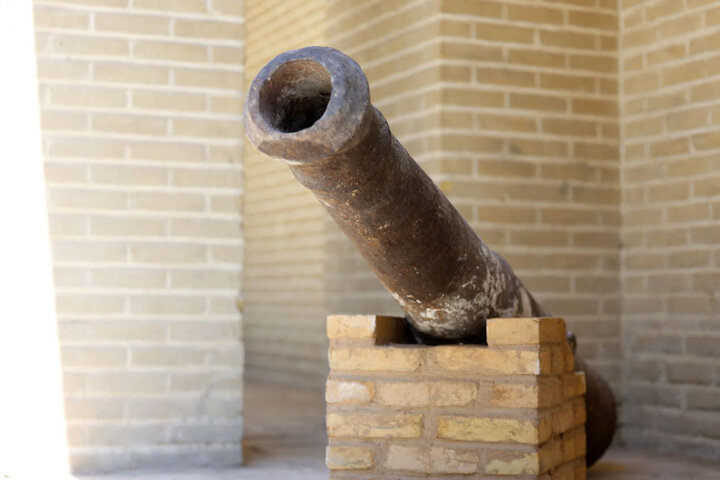
TEHRAN – A Safavid-era cannon in Isfahan’s 17th-century Chehel Sotoun Palace has entered a process of conservation and revised display after years of being kept in unsuitable conditions, the site’s director said.
Mostafa Hadipour, director of the World Heritage base of Chehel Sotoun, told ISNA that the cannon had been discovered in previous years within the complex but was stored in a warehouse under inappropriate conditions, including humidity and proximity to equipment.
“The centuries-old cannon had not been in a satisfactory conservation state,” he said. “Our first action was a rescue intervention, meaning removing it from the unsuitable space and transferring it to an area with better air circulation to prevent the intensification of biological damage.”
He said the current placement is temporary and aimed at reducing direct contact with the ground, adding that it does not mark the end of the conservation process.
Hadipour said specialized studies on the cannon have begun and parts of it have been sent for laboratory examination to determine the extent of damage sustained over the years.
“After receiving the results, the conservation and restoration plan will be reviewed by the site’s strategic council, then submitted to the provincial technical council and finally to Tehran for approval,” he said.
Following the necessary permits, deep cleaning and additional conservation measures will be carried out, he added. A new display design with security measures is also planned after restoration is completed.
Hadipour said the display of the cannon is part of a broader curatorial approach at the site. “Scenario writing in museums is a principle,” he said. “Chehel Sotoun, in addition to being a historical base, also has a museum function. Its architecture, stone and wooden decorations, paintings, miniatures, garden geometry and water axis together form a coherent narrative.”
He said elements such as the large columns, symmetry, the central pool and water axis, and decorative features raise questions for visitors and shape their interpretation of the site’s history. The Safavid-era cannon has been displayed to complement that historical narrative.
Chehel Sotoun, meaning “Forty Columns,” is a Safavid-era pavilion built by Shah Abbas II in the 17th century in Isfahan. The palace was used historically to host dignitaries and ambassadors and now functions as a museum exhibiting works from various periods of Iranian history.
The garden surrounding the palace forms part of the Persian Garden ensemble, which was inscribed on the UNESCO World Heritage list in 2011. The property comprises nine gardens across several provinces and reflects principles of Persian garden design dating back to the era of Cyrus the Great.
AM
Leave a Comment