A lifetime of resistance
Biography of Ayatollah Khamenei
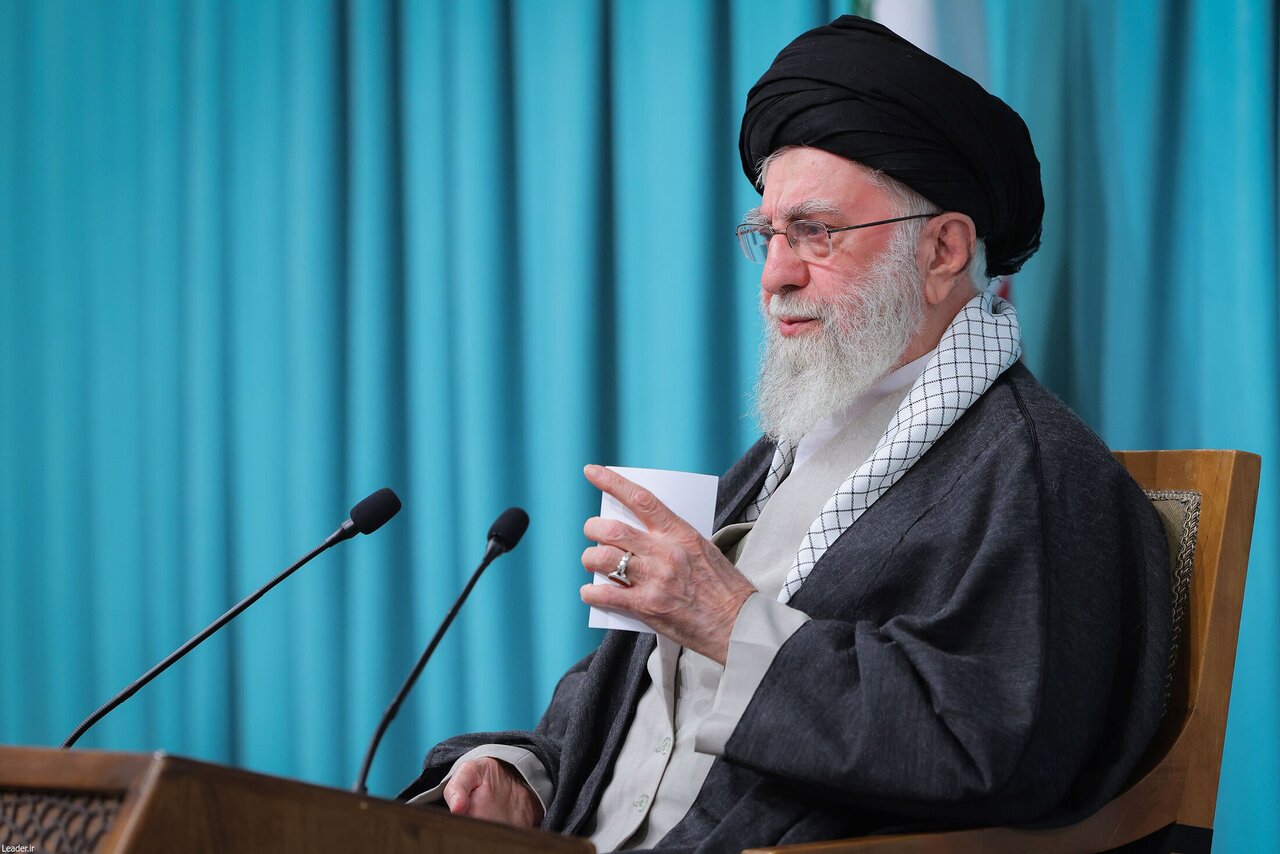
Seyyed Ali Hosseini Khamenei was born in April 1939 in Mashhad. He was the second son of his family. His father, Seyyed Javad Khamenei, was one of the scholars and jurists of his time. His father was born in Najaf and moved to Tabriz with his family during his childhood.
After completing the preliminary studies, he migrated to Mashhad. He then went to Najaf in 1966. Following his decision to return to Iran, he headed to Mashhad, where he settled permanently until the victory of the Islamic Revolution in 1979. In addition to teaching, he took on the role of the Friday prayer imam of the Sadiqiha Mosque in the Mashhad bazaar. He was also one of the prayer leaders of the Grand Goharshad Mosque.
Ayatollah Khamenei’s father, Seyyed Javad Khamenei, died on June 25, 1986. In a condolence message to Ayatollah Khamenei, Imam Khomeini called his father a committed and trusty scholar.
Ayatollah Khamenei’s mother, named Khadijeh Mirdamadi, was fond of history and literature. She struggled against the Pahlavi regime along with her children, especially Ayatollah Khamenei. Ayatollah Khamenei has said his mother was interested in Hafiz, the famous Iranian poet.
When he was just four-year- old child, he started learning Quran. His earnest love to religious studies and due to encouragement by his parents motivated him to study theology in the Soleiman Khan School. Concurrent with theological studies, he continued his study in high school.
Najaf Seminary
In short journey to the shrine city of Najf in Iraq along with his family in 1957, he attended the classes of seminary scholars such as Ayatollah Seyyed Mohsen Hakim, Seyyed Abolqassem Khouie, Seyyed Mahmoud Shahroudi and some others. However, after less than a year, his father returned to Mashhad and in 1958 he went to the Qom Seminary to continue his theological studies.
Qom Seminary
In the Qom Seminary he was the student of Haj Agha Hossein Boroujerdi, Imam Khomeini, Haj Sheikh Morteza Ha’eri Shirazi, Seyyed Mohammad Mohaqeq-Damad and Allameh Tabatabayee.
In 1954, he returned to Mashhad to help his father who had faced a problem in his eyesight. While in Mashhad, he attended the classes of Ayatollah Milani and this continued until 1970.
In Mashhad he started teaching Islamic philosophy to the youth, especially university students. From his interpretation of the Quran, his students learned of the need to establish a government in the country based on the principles of Islam. His teachings continued until 1978 (one year before the Islamic Revolution) he was exiled to Iranshahr in southeastern province of Sistan-Balouchestan. His seminary classes in interpretation of the Quran continued during his presidency and Leadership as well.
Literary Figure
Ayatollah Khamenei was interested in poetry and literature. He was also fond of novel and short story. He read the world’s most well-known novels and short stories. The ayatollah also was a literary critic and was in contact with many of the writers and intellectuals of his time.
While in Mashhad, he attended many literary associations with the participation of great poets. He was not only a critic in poetry but composed poems in the recent years. He was also studying history books and had a good knowledge of modern history.
Works
He started his research and writings when he was a theology student. He wrote and translated some books before the Islamic Revolution. Some of his books and researches are: “General Outlines of Islamic Thought in the Quran”, “Patiance”, and “A Report about Historical Past and Present Condition of the Qom Seminary”.
He also translated books entitled “Imam Hassan Peace: History’s Most Magnificent Heroic Flexibility” written by Sheikh Rezi Al-e Yassin; and “Muslims in India’s Freedom Movement” written by Abdul Man’am al-Nemer).
Political and Social Life
Ayatollah Khamenei entered political activities after his meeting with Seyyed Mojtaba Navab Safavi in Mashhad that first inspired his revolutionary spirit. He also met Imam Khomeini in 1957. However, Imam Khomeini’s political personality was revealed to him later.
He was jailed in June 1963 in Mashhad after Imam Khomeini instructed him to make people aware about the need for struggle against the Pahlavi regime. After release from prison, he continued his political struggles. Along with some other clerics in January 1963, he sent a letter to Ayatollah Mahmoud Taleqani, Mehdi Bazargan, and Yadollah Sahabi who had been jailed for backing Imam Khomeini.
Ayatollah Khamenei was also among the clerics from Khorasan province who wrote a letter to Prime Minister Hassan Ali Mansour in protest to putting siege on Imam Khomeini.
He was also among the cleric who wrote a letter in Feb. 1964 to the government of Amir Abbas Hoveida in protest to the situation in the country and sending Imam Khomeini to exile in Turkey.
Ayatollah Khamenei was also among the 11 clerics, including Abdolrahim Rabani Shirazi, Ebrahim Amini, Hossein Ali Montazeri and Akbar Hashemi Rafsanjani, who formed an 11-member group that was formed with the purpose of reforming and empowering the Qom Seminary in the struggle against the Pahlavi regime.
He was also jailed for his membership in the 11-memebr group.
In his struggle against the Pahlavi regime, he made speeches in certain political-Islamic places in Tehran, including Hosseinieh Ershad and the Tehran Al-Javad Mosque.
He was also jailed three times in 1971 due to protest to the ceremonies celebrating the 2500-year monarchy in Iran.
In view of SAVAK (the Pahlavi regime’s intelligence and security body), figures such as Ayatollah Khamenei were among the scholars and intellectuals of the Qom Seminary who were in contacts with young people, including students, and promoted the views of Imam Khomeini and made attempts to make theology students aware about political and social affairs.
In 1974 he addressed people in the Javid Mosque in Tehran as one of the main centers of the struggle against the Pahlavi regime. Following his speech, he was jailed. SAVAK said the reason for the imprisonment was his push for establishing a societal group for organizing struggles against the ruling system and using opportunities for advancing the Islamic movement in Mashhad.
He was released from Jail in Sept. 1975 but was put under strict monitoring. However, Ayatollah Khamenei continued his political and religious activities.
Following the death of Seyyed Mostafa Khomeini in Sept. 1977 in Najaf, he, along with a number of other clerics, held a commemoration ceremony for him in the Mollah Hashem Mosque and sent a condolence message to Imam Khomeini
In reaction to this move, certain famous opponents of the regime, including Ayatollah Khamenei, were exiled. He was exiled to Iranshahr for three years. Due to his interaction with the public in the Sunni populated city, he was greatly loved by the people.
During Imam Khomein’s exile in France, Ayatollah Khamenei, along with a number of other clerics in Mashhad, viewed the presence of Imam Khomeini in the country as an opportunity to create hope in the heart of people and asked him in a letter to issue the necessary decree for campaign against the Pahlavi regime. They also called for Imam Khomeini’s return to Iran.
In December 1978, he made a fiery speech against the Pahlavi regime in support of Imam Khomeini with the enthusiastic participation of people in Mashhad that coincided with the Ashura rituals.
With the accelerating fall of the Pahlavi regime and the emergence of the victory of the Islamic movement, Imam Khomeini ordered the formation of the Council of Islamic Revolution and Ayatollah Khamenei became a member of the council with a decree of Imam Khomeini. Thereafter, he left Mashhad for Tehran. Along with dignitaries like Ayatollah Mohammad Hossein Beheshti and Morteza Motahari, he made serious final efforts for the victory of the Islamic Revolution.
Along with membership in the Council of Revolution, Ayatollah Khamenei, along with Ayatollah Beheshti and Akbar Hashmi Rafsanjani, Mousavi Ardabili and Mohammad Reza Bahonar formed the Islamic Republic Party on Feb. 18, 1979.
He was also elected the third secretary general of the Islamic Republic Party after Ayatollah Beheshti and Bahonar in September 1981.
Tehran Friday prayer leader
Due to his high talent and competence, Imam Khomeini was appointed as the Friday prayer leader of Tehran on January 18, 1980. He kept this job all throughout his lifetime.
Serving as lawmaker
Ayatollah was elected MP from the Tehran Constituency in the first parliamentary elections held after the Islamic Revolution in March 1980. He served in the Defense Committee of the Majlis (the Islamic Consultative Assembly).
===============Presence in war fronts
When Saddam Hussein’s army invaded Iran in 1980, he was the first official who announced Iraq’s invasion of Iran on radio. In the first day of the war, when the Armed Forces Joint Chief of Staff formed a meeting to assess the situation, he was the only person who accepted to attend the war fronts.
Upon a decree by Imam Khomeini, the High Council of Defense was tasked with managing the issues related to the war and Ayatollah Khamenei was appointed as the Imam’s advisor in war affairs.
While he was present in the war fronts in breaking the siege on Abadan, he believed it was possible to prevent the fall of Khoramshahr by deploying more troops along the city. However, his advice went unnoticed by then President Abol-Hassan Banisadr.
In eight years of the imposed war, he was in charge of negotiations with Islamic and international delegates who made visits to Iran as intermediaries to end the war.
Preventing dissolution of the Constitutional Assembly of Experts
Amid attempts by certain members of the provisional government who attempted to dissolve the Constitutional Assembly of Experts, Ayatollah Khamenei resisted this move. 15 members of the provisional government cabinet had a plan to dissolve the council without the knowledge of Imam Khomeini. They had made a plan to resign if the Imam rejected it.
Ayatollah Khamenei considered President Bani Sadr as the representative of a political faction who were creating disunity and clash between senior officials. However, Ayatollah Khamenei did not openly reveal his opposition to Bani Sadir in order keep unity in the society.
From 1980 to 1981, Ayatollah Khamenei adopted a position against the liberal movement led by Bani Sadr. He was also against the moves by the liberal faction led by Bani Sadr to reestablish ties with the U.S.
Ayatollah Khamenei survives assassination attempt
On June 27, 1981, Ayatollah Khamenei survived an assassination attempt in the Abouzar Mosque in southern Tehran. He was seriously injured by a bomb planted in tape recorder.
Ayatollah Khamenei elected president with 95 percent of votes
After the assassination of President Mohammad Ali Rajaie - who was the second president of Iran after Bani Sadr – the central committee of the Islamic Republic Party and the Society of the Qom Seminary Teachers unanimously backed Ayatollah Khamenei as a presidential candidate. This was while the ayatollah himself was opposed to nominate as a candidate for president.
On October 2, 1981, he was elected president by winning over 95 percent of the votes and thereby he was endorsed by Imam Khomeini as the third president of the Islamic Revolution.
However, Imam Khomeini was not willing to run again for president for a second time due to his differences with the prime minister (Mir Hossein Mousavi). However, Imam Khomeini said candidacy is a Sharia duty and he decided to run for the post. However, he told the Imam to give authority to him to select his favored prime minister and the Imam agreed. However, due to some concerns by military commanders during the war about appointing anybody else as prime minister, Ayatollah Khamenei agreed to reappoint Mir Hossein as prime minister.
During his presidency, Iran’s foreign policy was highly active. As president, Ayatollah Khamenei made visits to Syria, certain north African states including Algeria, and some other African countries, including Zimbabwe. The president also made trips to Yugoslavia, Romani and China.
First Expediency Council chief
Following differences between Majlis (parliament) and the oversight Guardian Council, Imam Khomeini, in response to a letter by the heads of the three branches of government, agreed with the formation of the Expediency Council on February 6, 1988. Ayatollah Khamenei served as the chief of the council until the end of his presidency.
Like the years after the victory of the Islamic Revolution, including during Saddam Hussein’s war against Iran in the 1980s, Ayatollah Khamenei was one of closest aides and confidants of Imam Khomeini.
On June 4, 1989, while officials were holding funeral procession for Imam Khomeini, Ayatollah Khamenei read out the divine will of the founder of the Islamic Republic at the attendance of political and military officials. The afternoon of the same day, the Assembly of Experts held a meeting to elect the next Leader.
Imam Khomeini described Ayatollah Khamenei as a long-time fighter for the realization of Islamic state, as well as a person greatly committed to the Islamic Revolution and the Islamic Republic system. The founder of the Islamic Republic also praised his decades-long comprehensive political, cultural and his executive efforts for establishing the Islamic Republic system. The founder of the Islamic Republic also called him an open-minded religious scholar and qualified person.
Leave a Comment