Shockwaves of war on Iran’s historical heritage

TEHRAN – Following consecutive airstrikes by the United States and the Israeli regime from late February through the closing days of March, a number of Iran’s most important historical monuments and sites across multiple provinces have been damaged or destroyed.
Official sources and field reports indicate that these attacks have affected World Heritage sites, nationally registered monuments, and historic urban fabrics in the cities of Tehran, Isfahan, Sanandaj, Kermanshah, and Khorramabad, to name few. The incidents have raised concerns over the vulnerability of cultural heritage during military conflict, especially as many of these Iranian sites predate the very states conducting the strikes.
In Tehran, the capital, repeated explosions have caused widespread damage to numerous historic structures.
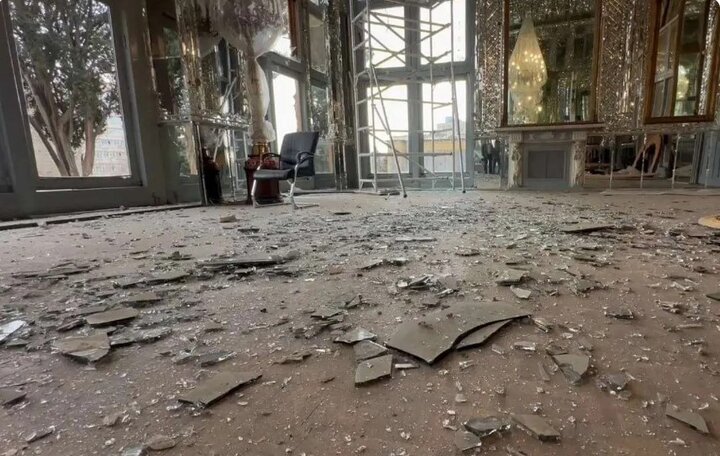
On March 1, U.S. and Israeli airstrikes targeting the Arg Square area damaged the UNESCO-listed Golestan Palace. The most severe impact occurred at the “Abyaz Palace” (White Palace) within the complex, where all windows—including interior ones—were dislodged or damaged, parts of the ceiling were punctured, and sections of the Marble Throne were cracked or partially collapsed. The ceiling of the framed section of the Abyaz Palace was also affected, though curtains appear to have absorbed part of the blast impact.
In the “Salam Hall,” the main museum hall, paintings remained intact, but windows facing the courtyard, particularly those overlooking the Golestan Palace yard, were shattered or blown out of place. The “Mirror Hall,” famously depicted by Kamal-ol-Molk and recently restored, sustained significant damage to its ceiling and wooden sash windows (orsi).
The “Brilliant Hall” experienced damage to its windows and brick-framed ceiling, while in “Shams-ol-Emareh,” both the veranda roof and the ground-floor hall suffered structural damage, especially to decorative framing. Nearly all sections with ornamental framing have become unstable, with parts collapsed and others at risk of imminent falling.
The “Diamond Hall” lost one orsi window, and two fiberglass skylights in the “Chadorkhaneh” were damaged by blast waves.
Nearby, a historic building associated with Amir Kabir’s office was completely destroyed. Mirza Taghi Khan-e Farahani, known as Amir Kabir, served as chief minister to Naser al-Din Shah Qajar during the first three years of his reign.
Repeated attacks in Tehran in subsequent days caused further serious damage. Strikes near Jomhouri Street hit the nationally registered Glassware and Ceramic Museum of Tehran, which houses collections from the Achaemenid and Sassanian periods, as well as later Islamic eras. Museum staff reported extensive shrapnel impacts affecting the façade, roof, and structural walls.
In the early hours of March 16, the Art Research Center of the Iranian Academy of Arts was damaged, with the blast point in the courtyard near a pool. The building, formerly the residence of Professor Adl, father of modern surgery in Iran, was designed by Markov in 1931, combining Russian architectural style with Iranian decorative elements.
The following day, the Sa’dabad Complex sustained serious damage, with three palaces and other structures affected. The “Green Palace,” the “Omidvar Brothers Museum,” and the “Kushk” (Vali Mansion) suffered structural damage from the blast waves. The Green Palace, the oldest Pahlavi-era palace in the complex, was among the hardest hit. A nearby brick building atop a staircase also sustained major structural damage.
Sajjad Asgari, secretary of the Tehran Historical Houses Follow-up Committee, told the Tehran Times that more than 60 heritage sites from the Qajar and Pahlavi periods have been damaged in airstrikes on Tehran. While some suffered severe damage, precise information for others is limited due to field assessment constraints. However, given their proximity to explosion sites, damage is considered likely.
A table detailing damage to each historic building, along with potential impacts, provides a preliminary assessment of war-related losses. According to the table, which records approximately 63 cases, the Timurtash Building, dating to the Qajar period, sustained mirrorwork and orsi damage on March 6. The former Gendarmerie building was completely destroyed on March 4. The Pasteur Institute building and the Tehran Radio building, Pahlavi-era structures, were damaged on March 5 and March 1, respectively.
The former Parliament building, attacked on March 2, saw both interior spaces and its roof completely destroyed. The War College building suffered approximately 70 percent destruction, while the Shahada Square power station was completely destroyed on March 16. Doors and windows of the Electricity Industry Museum and the Institute for the Intellectual Development of Children and Young Adults’ History Museum—both Pahlavi-era—were damaged.
In Isfahan, repeated attacks caused increasing damage to historical structures. Cultural heritage advocates reported that on March 8, vibrations from U.S. and Israeli projectiles caused several tiles of the Imam Mosque in Naqsh-e Jahan Square to collapse. Social media images showed thick smoke near the mosque, caused by small fires and minor explosions in surrounding streets, which were quickly controlled.
Isfahan University of Art was also affected. At the historic Tohidkhaneh building behind Ali Qapu Palace and the Faculty of Handicrafts on Hakim Street, windows were shattered, and sections including the doors of Tohidkhaneh were deformed.
Cultural heritage advocates were particularly distressed by damage to Chehel Sotoun Palace. Parts of its Safavid-era architectural decorations, including mirrorwork, collapsed. Field observations—tilted columns, cracks at bases, and ceiling damage—suggest possible structural movement affecting the main portico and overall stability.
Blast waves damaged wooden decorations, paintings, miniatures, and mirrorwork, causing both localized and widespread destruction in the central pavilion, main hall, and Chaharshanbeh Suri room. Significant damage occurred to muqarnas, Safavid-era mirrorwork of the main alcove, and the forecourt of the main portico, which were integral to Iran’s mirrorwork heritage nomination.
The palace’s distinctive geometric design, combining mirrorwork and original muqarnas, once conveyed unique spatial and symbolic aesthetics. The collapse of these sections has caused serious harm to the site’s integrity. Wooden elements, including intricate latticework and orsi doors, were also damaged. Adjacent structures, including offices, service areas, the protection unit, teahouse, and utilities, experienced partial roof collapses.
Other buildings within the Safavid-era Dowlatkhaneh complex, including the Rakibkhaneh museum and Ashraf Hall, were also damaged. Reports indicate that wooden doors, windows, and associated decorations suffered blast-related damage.
On March 8, in Lorestan province, Falak-ol-Aflak Castle in Khorramabad was struck, damaging several buildings and spaces within the complex. The Lorestan Cultural Heritage Department building was destroyed, and parts of the Archaeology and Ethnography museums housed in the castle were seriously damaged. Other structures, including the Officers’ Club, Tourism Deputy building, and surrounding historic spaces, were affected by blast waves and direct hits. Barracks No. 2 were completely destroyed.
Falak-ol-Aflak Castle, a Sassanian-era monument listed on Iran’s National Heritage register, is slated for inclusion in the World Heritage nomination “Paleolithic Caves of Khorramabad Valley.” In the days following the strike, previously unnoticed damage became apparent. Rainfall and expert inspections revealed cracks and fissures more extensive than initially expected, indicating the long-term effects of the blast waves.
Some cities experienced less damage, but their heritage was not spared. On March 26, parts of the tomb of poet Baba Taher in Hamadan were damaged, with broken stones and decorative elements causing structural harm.
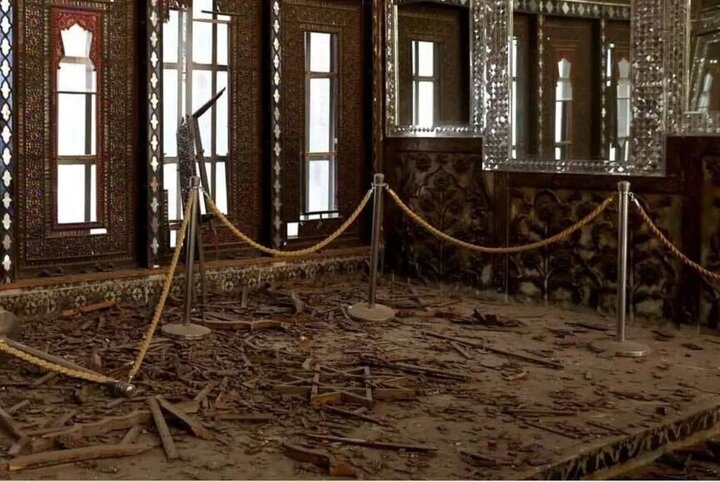
In Alborz province, the Soleymanieh Palace Museum and historic buildings in Karaj were affected, with cracks in walls and damage to stained-glass windows.
Pouya Talebnia, Director General of Cultural Heritage in Kordestan province, said much of the damage in Sanandaj resulted from direct attacks on historic areas, including Seneh Dezh, Arg Square, Chaharbagh, and Khosroabad Palace. These attacks damaged arches, domes, columns, plasterwork, latticework, mirrorwork, and hundreds of wooden and glass doors and windows.
Talebnia added that rare orsi windows, including the seven-door orsi of the Molla Lotfollah Sheikh-al-Islam building and Khosroabad Palace Museum, suffered serious damage. Other key buildings, such as Asef Mansion, Malek-ol-Tajjar Mansion, Imamzadeh Pir Omar complex, Motavassel House, and Mojtahedi House, were also affected. Some damage went beyond physical destruction, targeting historical and identity-based features, making some losses effectively irreversible.
He emphasized that the destruction of orsi windows in the four-section domed chamber and upper rooms of Soleyman Khan Ardalan’s mansion in the House of Kurds complex illustrates the scale of the tragedy. These windows, over four centuries old, were among the most authentic examples in Iran and the world.
Several Kermanshah buildings were also affected. Souri House had broken doors and windows, damaged service structures, and shattered glass. In Biglarbeygi Tekyeh, orsi windows were damaged, the roof destroyed by shrapnel, and gutters, doors, and windows were harmed. In Dolatsheh Mosque, doors and windows were broken, roof brick flooring was destroyed, and glass suffered significant damage.
Damage assessment underway
As of March 29, the Ministry of Cultural Heritage released its latest assessment of damages to Iran’s cultural heritage and tourism infrastructure caused by airstrikes. Multi-layered expert evaluations, continuous field monitoring, and rigorous verification indicate that 131 heritage sites of global, national, and regional significance were damaged. The findings highlight the growing scale of destruction and the urgent need for international attention to protect humanity’s shared heritage.
Geographically, Tehran province suffered the most with 61 sites affected, followed by Isfahan (23) and Kordestan (12). Lorestan and Kermanshah each had four affected sites, Khuzestan three, and Fars, Bushehr, Qom, Alborz, and East Azarbaijan two each. West Azarbaijan, Mazandaran, Sistan-Baluchestan, Ilam, Gilan, and Hamadan each recorded one case.
Functionally, 111 cases involved historic buildings and museums, 11 affected significant units in Tehran, and nine related to Sacred Defense heritage in Khuzestan. Fifty museums were damaged, including 14 in the Sa’dabad Complex and seven in the Golestan Palace Complex.
Damaged historic urban fabrics rose to seven, affecting Tehran, Sanandaj, Isfahan, Kermanshah, Qom, Khansar, and Tabriz—the latter added as a new damage hotspot.
The Ministry emphasized its commitment to national and international obligations and the initiation of active, multi-layered cultural diplomacy immediately after these events. To date, over nine official correspondences have been sent to international organizations—including UNESCO, ICOM, ICOMOS, the Asia Heritage Union (ACHA), the Assembly of Ancient Civilizations, and the Nowruz domain—aimed at documenting the attacks and pursuing international accountability.
AM
Leave a Comment