Tajik travelers tour attractions in ancient Neyshabur
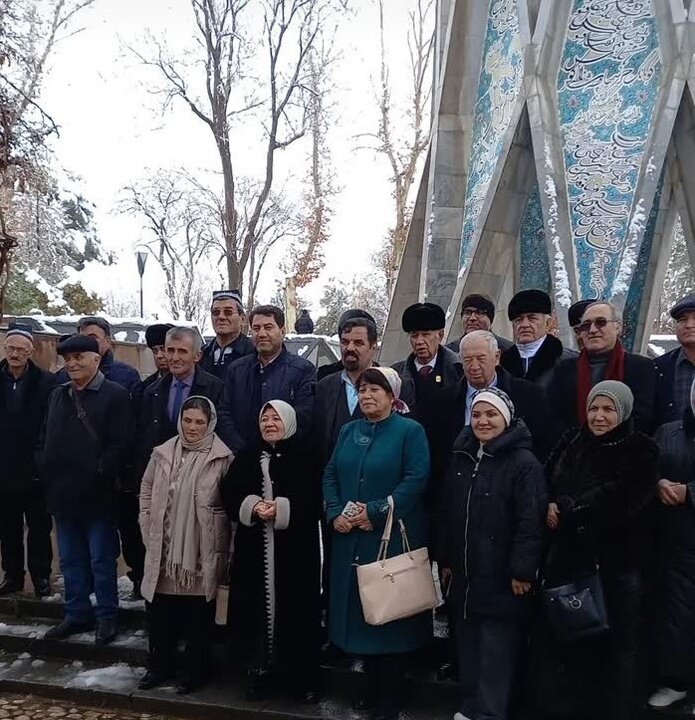
TEHRAN - A 25-member group of travelers from Tajikistan, including physicians, writers and university professors, has recently toured attractions in the ancient city of Neyshabur in Iran’s Khorasan Razavi province.
According to IRIB, Head of Neyshabur Cultural Heritage, Tourism, and Handicrafts Department Hassan Giahi said that this tour, which is organized under the title of ‘literary tourism’, has been visiting the different regions of the country for more than 10 days.
He added that during their stay in Neyshabur, the necessary explanations regarding the attractions and reading of Khayyam and Attar’s poems were given by a cultural heritage expert to the group of Tajik intellectuals, which was highly appreciated by them.
Giahi said that Neyshabur is one of the most important cities in the country that has put the issue of literary and cultural tourism on its agenda.
This issue, in addition to increasing longer stays of tourists in the city and developing tourism, provides them with greater familiarity with the cultural and literary potential of Neyshabur, he pointed out.
He added that fortunately, Persian language is enduring in Tajikistan and they are very proud of the Persian language, poetry and literature.
In this literary tour, the tour members read Persian poems while visiting the tomb gardens of Khayyam and Attar in Neyshabur, he said.
A heaven for history buffs, Neyshabur (Nishapur) was once a prosperous town during the medieval times currently situated northeast of modern Iran.
Situated some 70 km west of Mashhad, Neyshabur was founded around the third century CE. Narratives say ‘Nishapur’ derived its name from its alleged founder, the Sassanid king Shapur I.
It grew to prominence in the eighth century and was ruined by invasions and earthquakes in the 13th century. After that time, a much smaller settlement was established just north of the ancient town, and the once-bustling metropolis lay underground—until a team of excavators from the Metropolitan Museum arrived in the mid-20th century.
The town underwent rounds of excavation as of 1935 by experts from the Department of Near Eastern Art at The Metropolitan Museum of Art.
According to the Metropolitan Museum of Art, its affiliated archaeologists worked at Neyshabur between 1935 and 1940, returning for a final season in the winter of 1947–48.
The excavators had been drawn to the city because of its fame in the medieval period when it flourished as a regional capital and was home to many religious scholars. It was also known as an economic center—Neyshabur was located on the trade route known as the Silk Road, which ran from China to the Mediterranean Sea, crossing Central Asia, Iran, Iraq, Syria, and Turkey along the way.
In addition, Neyshabur was a source of turquoise and a center for growing cotton, producing cotton textiles as well as several types of fabric incorporating silk, called ‘attabi, saqlatuni, and mulham. One of the most unusual products of Neyshabur, however, was its edible earth, which was believed to have curative properties. At its peak between the ninth and thirteenth centuries, Neyshabur had a population of approximately 100,000 to 200,000 people, and development covering an area of approximately six and a half square miles.
KD
Leave a Comment