Maritime transport key to trade security: transport minister
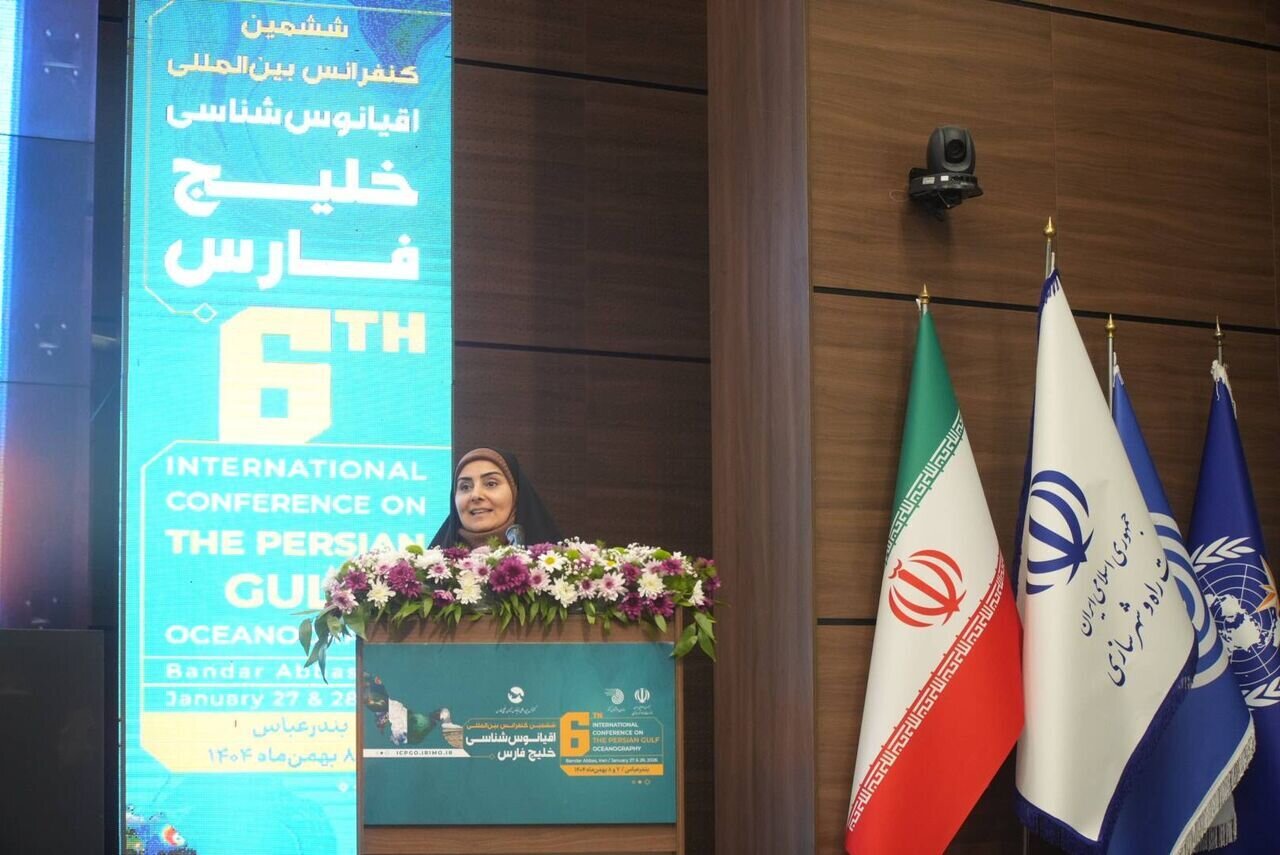
TEHRAN – Iran’s Minister of Transport and Urban Development Farzaneh Sadegh said maritime transport plays a pivotal role in trade security, cost reduction and sustainable access to global markets, describing the Persian Gulf as central to the country’s macro-level planning.
Speaking at the sixth International Persian Gulf Oceanography Conference on Tuesday during a visit to the southern port city of Bandar Abbas, Sadegh said the Persian Gulf holds strategic importance not only for Iran but also for the wider region and the international system, where geography, economics and security intersect.
She said a significant share of Iran’s long-term planning across sectors depends on the Persian Gulf, adding that its smart management requires a forward-looking approach to sustainable development, environmental protection and efficient use of natural resources, alongside closer alignment between science, technology and strategic policymaking.
Sadegh noted that Iran’s access to open waters and proximity to key maritime corridors give it a privileged geopolitical position that has featured prominently in diplomatic engagements and drawn interest from regional and extra-regional countries.
Emphasizing the importance of multimodal transport, she said the parallel development of road, rail and maritime networks forms the backbone of Iran’s trade and economy, and that strategic planning must be grounded in rigorous data, scientific analysis and long-term forecasting.
Maritime transport, she added, serves as the main artery of trade and market access, with navigational safety, accident reduction and port efficiency dependent on precise planning and the use of scientific information.
Sadegh said sustainable development of coastal and port infrastructure requires scientific studies, detailed geographic analysis and environmental considerations, as well as effective use of new technologies and advanced information systems.
Highlighting the link between maritime transport and marine meteorology, she said accurate weather and ocean data are essential for smart decision-making and safe management of Iran’s waters, enabling early warning systems, risk forecasting and resilience against climate change impacts.
Last month, Saeed Rasouli, Head of Iran’s Ports and Maritime Organization (PMO), presented a comprehensive vision for developing Iran's maritime economy. He characterized it as a unique and underutilized opportunity for national development.
His remarks highlighted a strategic shift in governmental focus, outlined key operational priorities, and announced significant international plans, particularly for the Caspian Sea region.
Rasouli formally identified the maritime-oriented economy as a "unique opportunity" for Iran.
He acknowledged a historical oversight, stating, "Unfortunately, due to the country's economic dependence on oil, we have neglected numerous sectors, including the maritime economy." This candid assessment underscores a recognition of the need for economic diversification.
The official emphasized that this sector is now receiving special and significant attention from the government.
He stressed that this heightened focus must be leveraged effectively, declaring, "now that the government is paying special attention to this issue, we must use this capacity to its fullest."
The PMO head further outlined several critical pillars for this development strategy:
* Cultivating a maritime culture: He highlighted the fundamental importance of "culture-building" regarding the maritime economy, indicating a need for broader public and institutional awareness and engagement.
* Balanced port development: A key operational focus was placed on inclusive development. While mega port projects continue, he insisted that "we must also pay attention to the country's small ports."
He announced a policy of active engagement, stating, "In this regard, we are visiting all related institutions and companies and believe we must utilize the capacity of all of them."
* Maximizing Caspian Sea potential: Specific programs for the Caspian Sea were announced. These aim to "develop and maximize freight transport as well as tourism."
In a significant announcement, he revealed concrete international collaboration plans: "Iran plans to establish a maritime consortium in the Caspian Sea with the participation of private-sector companies from Iran and Russia in the coming months."
This move signals a proactive approach to regional cooperation and economic integration.
Rasouli concluded by pointing to underlying diplomatic efforts, noting that "very good work has been done in the field of diplomacy, the effects of which will become apparent in the future."
This suggests that the tangible projects and economic plans are supported by broader foreign policy initiatives designed to facilitate maritime trade and cooperation.
The statements from the head of Iran's Ports and Maritime Organization mark a clear intent to harness the country's maritime geography for economic growth.
The strategy combines internal capacity-building—through cultural change and infrastructure development—with external partnership, as evidenced by the planned Iran-Russia Caspian Sea consortium.
This dual approach, backed by cited diplomatic efforts, frames Iran's maritime economy as a strategic priority with the potential to contribute substantially to a more diversified and resilient national economy.
EF/MA
Leave a Comment