Kiarostami commemoration highlights art diplomacy as tool for international relations
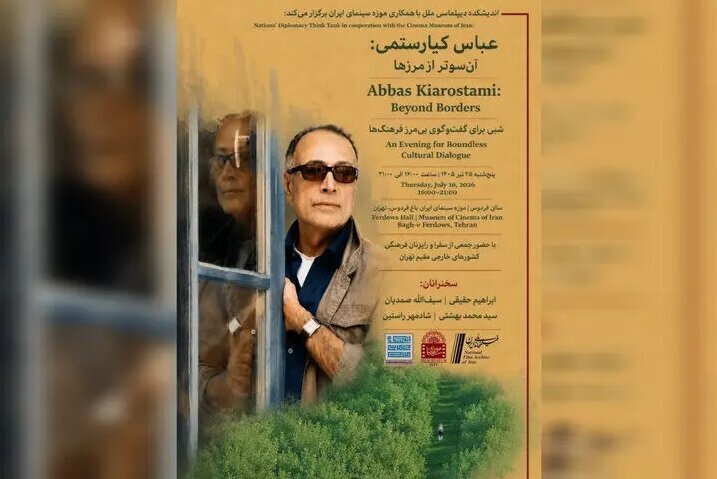
TEHRAN- A special commemoration event honoring the late master filmmaker Abbas Kiarostami, titled "Abbas Kiarostami: Beyond Borders," was held on Thursday at the Cinema Museum of Iran.
The event aimed to examine the global standing of Kiarostami’s cinematic legacy and introduce a new approach to art diplomacy to enhance international relations through culture and the arts, Mehr reported.
Organized by the Nations’ Diplomacy Think Tank and coinciding with the launch of its Art Diplomacy Department, the ceremony was attended by museum officials, prominent artistic figures, members of the press, and cultural attachés from Japan, Italy, Turkey, Kazakhstan, Lebanon, the United Kingdom, Malaysia, and Romania, the report added.
Fatemeh Mohammadi, Director of the Cinema Museum of Iran, referred to Kiarostami as the "Master of Poetic Cinema," noting that the event served as an opportunity to further introduce the global artist to new audiences.
Addressing the strategic goals of the gathering, Seyyed Mohammad Ali Seyyed Hanai, President of the Nations Diplomacy Think Tank, stated that the Art Diplomacy Department was established to create a sustainable platform for dialogue between diplomats and artists. He emphasized that in the modern era, art serves as a universal language and a form of "soft power" capable of bridging political divides and humanizing diplomacy. He described Kiarostami as a "passport-less ambassador" whose authenticity and humanism projected a profound image of Iran to the world.
In the artistic analysis segment, Seyyed Mohammad Beheshti described the contribution of Iranian cinema to the world as "cinematic poetry," naming Kiarostami its most significant poet. Recalling an incident from 1999, Beheshti explained how the then-foreign minister of Saudi Arabia's admiration for “Taste of Cherry” turned a brief 20-minute meeting into a four-hour discussion on Iranian cinema, citing this as a concrete example of art diplomacy in action.
Ebrahim Haqiqi, analyzing Kiarostami’s cinematic elements, suggested that the zigzagging roads prevalent in his films symbolize the human struggle for transcendence and love, noting the Khayyam-like intellectual dialogues and human subtleties in his work.
Furthermore, Seifollah Samadian distinguished Kiarostami’s cinema from commercial streams, such as Hollywood, by its enduring impact. He attributed this vision to Kiarostami's active inner child, which allowed him to perceive the world through a unique lens.
Concluding the event, Shadmehr Rastin remarked on the global academic presence of Kiarostami’s work in the textbooks of developed nations, expressing regret over the lack of such cinematic discourse in Iranian educational texts. He extended his gratitude to the attending cultural attachés and ambassadors, acknowledging that diplomatic support plays a vital role in facilitating the presence of Iranian filmmakers at international festivals.
Abbas Kiarostami (1940 – 2016) was an Iranian film director, screenwriter, poet, photographer, and film producer. An active filmmaker from 1970, Kiarostami had been involved in the production of over 40 films, including shorts and documentaries.
Kiarostami attained critical acclaim for directing the “Koker” trilogy (1987–1994), “Close-Up” (1990), “The Wind Will Carry Us” (1999), and “Taste of Cherry” (1997), which was awarded the Palme d'Or at the Cannes Film Festival that year.
In later works, “Certified Copy” (2010) and “Like Someone in Love” (2012), he filmed for the first time outside Iran: in Italy and Japan, respectively.
His films “Where Is the Friend's House?” (1987), “Close-Up,” and “The Wind Will Carry Us” were ranked among the 100 best foreign films in a 2018 critics' poll by BBC Culture. “Close-Up” was also ranked one of the 50 greatest movies of all time in the famous decennial Sight & Sound poll conducted in 2012. He is widely regarded as one of the greatest and most influential filmmakers of Iran, and of all time.
Kiarostami had worked extensively as a screenwriter, film editor, art director, and producer and had designed credit titles and publicity material. He was also a poet, photographer, painter, illustrator, and graphic designer. He was part of a generation of filmmakers in the Iranian New Wave, a Persian cinema movement that started in the late 1960s and emphasized the use of poetic dialogue and allegorical storytelling dealing with political and philosophical issues.
Kiarostami had a reputation for using child protagonists, for documentary-style narrative films, for stories that take place in rural villages, and for conversations that unfold inside cars, using stationary mounted cameras. He is also known for his use of Persian poetry in the dialogue, titles, and themes of his films. Kiarostami's films contain a notable degree of ambiguity, an unusual mixture of simplicity and complexity, and often a mix of fictional and documentary elements. The concepts of change and continuity, in addition to the themes of life and death, play a major role in Kiarostami's works.
SAB/
Leave a Comment