Italian-made facsimile of Shahnameh presented to Iran
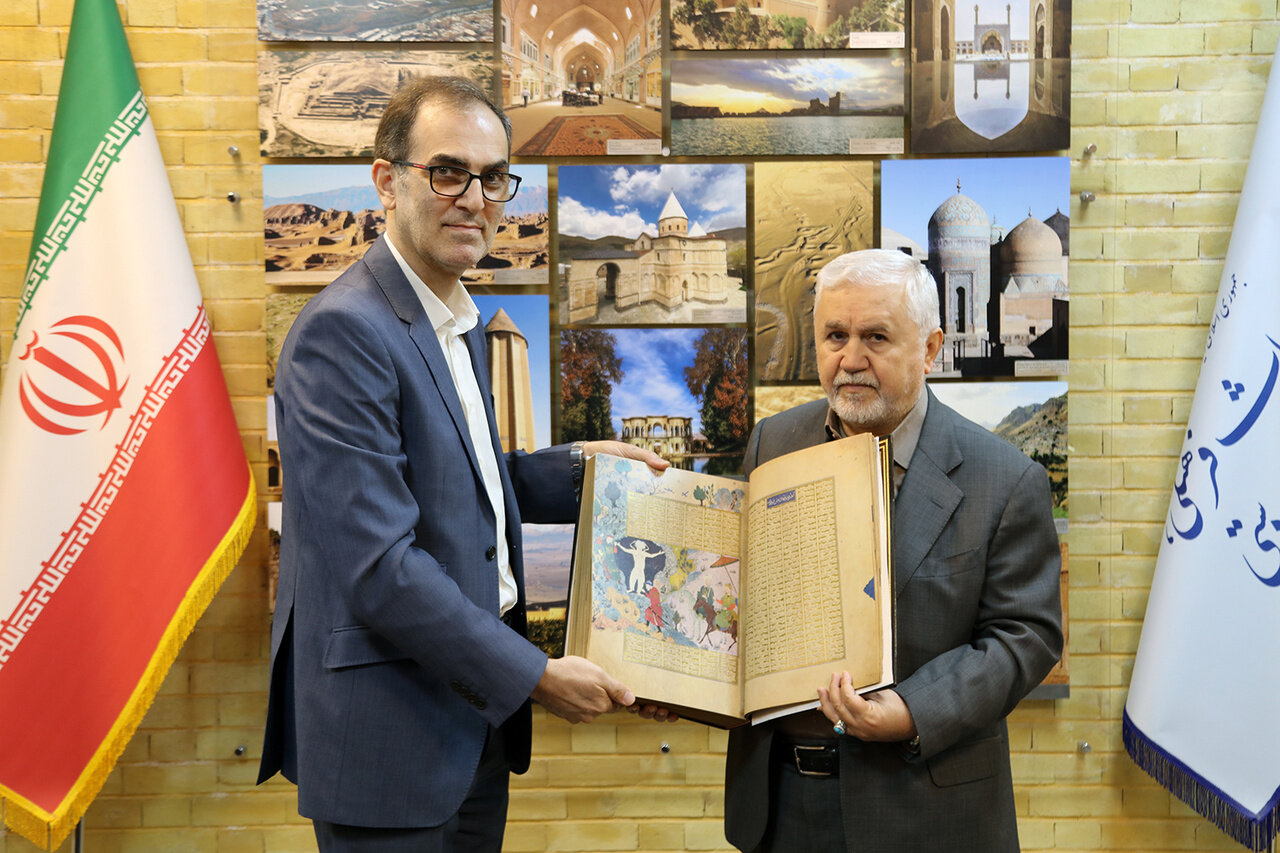
TEHRAN – An Italian-made facsimile of a rare and exceptionally complete copy of Ferdowsi’s Shahnameh has been presented to Iran’s Cultural Heritage Ministry following a joint project involving Italian specialists and Iranian authorities.
Mohammad-Taqi Amini, director general for Europe and the Americas at the Islamic Culture and Relations Organization and Iran’s former cultural attaché in Italy, handed over the lavishly produced volume to Ali Darabi, the deputy minister of Cultural Heritage, Tourism and Handicrafts, during a meeting at the ministry on Sunday.
According to the ministry’s news outlet, Miras Aria, the facsimile was produced in cooperation with a specialized Italian institution, with support from the ministry’s cultural heritage department.
Amini said three specialist teams from the Italian institution had traveled to Tehran to examine the original manuscript, which is preserved at [the UNESCO-registered] Golestan Palace. Their work involved a detailed study of its illustrations, portraits, gilding and other artistic features to ensure the reproduction remained as faithful as possible to the original.
He said Italy had considerable expertise in reproducing and printing valuable historical manuscripts, adding that the project had required substantial time and financial resources and was intended to strengthen cultural cooperation between Iran and Italy.
The original Shahnameh manuscript at Golestan Palace is particularly distinguished for its completeness, Amini said. The 700-page volume contains 22 exceptional miniature paintings and is considered one of the most complete known copies of Ferdowsi’s epic. Other Shahnameh manuscripts are held in museums in Italy, France and the United States, but the Golestan Palace copy has a special standing because of its completeness.
Amini also announced plans to publish a collection of scholarly articles related to the project. Under an agreement with the Italian partners, the facsimile will be formally unveiled in Iran before being presented in Italy.
Darabi, for his part, praised Amini’s efforts during his tenure as Iran’s cultural attaché in Italy, describing the Shahnameh as a lasting masterpiece by the Persian poet Abolqasem Ferdowsi and a cultural and historical record of the Iranian people.
He stressed the epic’s importance in preserving Iranian identity, noting that the words “Iran” and “wisdom” appear more than 1,200 and 650 times, respectively, in the work. Its opening line, “In the name of the Lord of life and wisdom,” also reflects the central place of wisdom in Iranian culture, he said.
Darabi added that historical and cultural works are among the most important foundations of national identity and have played a significant role in the continuity of Iranian cultural heritage.
The newly presented facsimile will be transferred to the World Heritage collection of Golestan Palace and unveiled at a ceremony, he said.
The Shahnameh, or Book of Kings, is an epic poem composed by Ferdowsi between approximately 977 and 1010 CE. With around 50,000 couplets, it is among the longest epic poems in world literature and the longest known epic written by a single poet.
The monumental work recounts the mythical and historical past of Iran, from the creation of the world to the Arab-Muslim conquest in the seventh century. Regarded as a cornerstone of Persian literature, it has played a defining role in preserving the Persian language and shaping the cultural identity of Iran and the wider Persian-speaking world.
AM
Leave a Comment