Restoration of Jameh Mosque of Shah Abdol Azim shrine completed
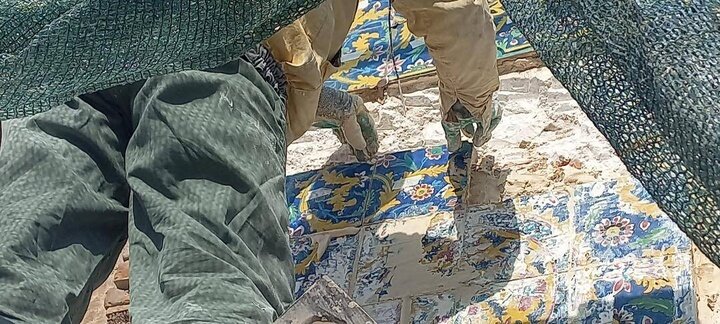
TEHRAN--The project to restore and preserve the tiles on the iwan (porch) of Jameh Mosque of Shah Abdol Azim (AS) shrine in Rey, Tehran province, has been completed, with the aim of preserving the historical decorations of the religious complex.
According to Miras Aria, Mohsen Saadati, head of Rey Cultural Heritage Department, announced that the project began in the first half of this year using pilgrimage funds from last year and has currently been completed.
He explained that the historical studies of the existing situation were first conducted, and then restoration measures began by making the missing tiles.
Saadati added that the remaining tiles, which had been separated from the site due to the hollowness of the plaster under the work, were removed from their place after numbering, and the foundation was made with beta plaster, and the tiles were installed in their original place according to the number.
He said that restoration and protection projects have been implemented at the shrine of Hazrat Abdol Azim (AS) for the second consecutive year using pilgrimage funds.
Rey, in which signs of settlement date from 6000 BC, is often considered Tehran’s predecessor.
Rey was one of the capital cities of the Parthian empire (3rd century BC–3rd century CE) and it was captured by the Muslim Arabs in 641 CE. During the reign of the Muslim caliph al-Mahdi in the 8th century, the city grew in importance until it was rivaled in western Asia only by Damascus and Baghdad.
According to Encyclopedia Britannica, Islamic writers described it as a city of extraordinary beauty, built largely of fired brick and brilliantly ornamented with blue faience (glazed earthenware). It continued to be an important city and was briefly a capital under the rule of the Seljuqs, but in the 12th century, it was weakened by the fierce quarrels of rival religious sects.
In 1220 the city was almost entirely destroyed by the Mongols, and its inhabitants were massacred. Most of the survivors of the massacre moved to nearby Tehran, and the deserted remnants of Rey soon fell into complete ruin.
It became the capital city of the Seljuk Empire in the 11th century but later declined with factional strife between different neighborhoods and the Mongol invasion of 1220.
KD
Leave a Comment