US officials' disagreement over military attack on Iran
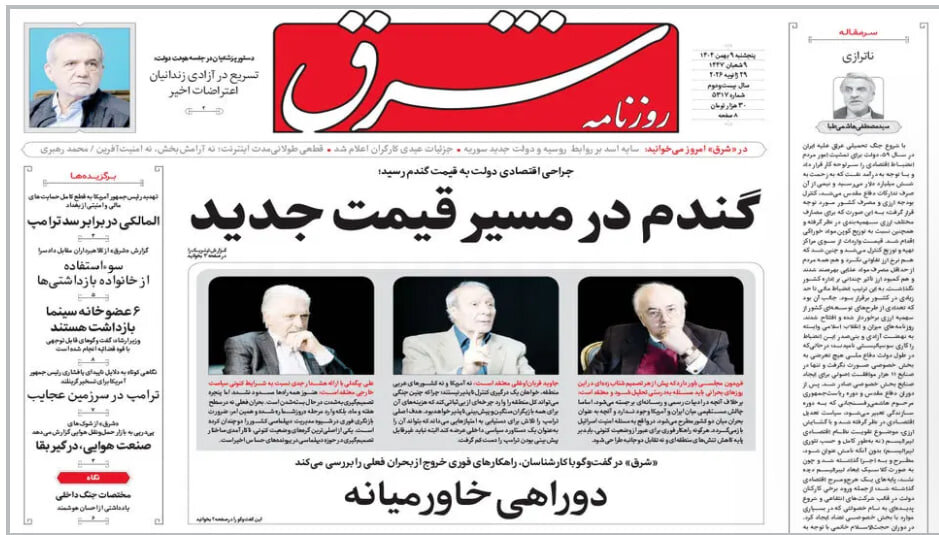
TEHRAN- Shargh wrote: U.S. media are reporting serious disagreements within the Trump administration regarding a military attack on Iran; a disagreement between hardline groups that emphasize the implementation of the red line and a group centered on J.D. Vance and Steve Witkoff, who believe that the costs of the war will not bring any tangible gains for the United States. However, some American officials admit that without further strengthening U.S. combat capabilities, it will be difficult to manage Iran’s possible response.
This concern is also particularly prevalent among U.S. regional allies in the Persian Gulf. On the other hand, Hebrew-language media are referring to an alternative war scenario and believe that Trump will seek a complete naval blockade of Iran, similar to what happened to Venezuela before Maduro’s arrest. However, the country’s military officials, emphasizing full defense readiness, have announced that they have no specific information about an imminent military action, but are closely monitoring U.S. movements. This situation has brought the foreign policy space to a stage where threats and diplomacy are simultaneously contradictory.
Sisat-e-Rooz: Military establishment authority is a tool of deterrent diplomacy
Sisat-e-Rooz, in an analysis, pointed to Iran’s military power that serves as a deterrent against U.S. threats. According to the newspaper, as the U.S. is beefing up its military presence in the region and Trump is once again pursuing deceptive diplomacy under the claim that he is seeking to negotiate, Iran’s military authority and threats by military commanders against aggressors have laid the groundwork for deterrent diplomacy in the region. This is why regional countries have insisted in their consultations with Iranian officials and other countries that they will not allow their soil, airspace, or Western countries’ military bases in these countries to be used against Iran. The region is currently experiencing escalating military tensions and diplomatic moves. However, evidence shows that this diplomacy is not derived from American power, but rather from Tehran's active regional diplomacy and military power, which have led countries to conclude that without Iran, there will be no stability in the region, and that a conflict between Tehran and Washington could lead to the burning of the entire region. They believe that Iran is not Venezuela, which would surrender to American excesses.
Etemad: The future of Middle East geopolitics
Etemad examined the future of Middle East geopolitics. According to the newspaper, the future of Middle East geopolitics is not defined around a single country. Rather based on the competition between two emerging coalitions: the Abraham bloc and the Islamic bloc. On one side of this equation, the Abraham bloc, led by Israel and the United Arab Emirates, is being established. It is an axis that seeks to redesign the regional order by relying on military superiority, advanced technologies, security convergence, and economic integration. The connection of this axis with actors such as Greece and India shows that the goal is not simply to contain Iran, but to build a trans-regional security architecture from the Mediterranean to the Indo-Pacific. On the other side, the Islamic coalition, which is being shaped with the centrality of Saudi Arabia, is accompanied by Turkey, Pakistan, Qatar, and Egypt. It is moving cautiously. This axis introduces itself as a defender of stability and believes that the Israel-UAE axis is pushing the region towards instability by intensifying divisions, interventionism, and a show of power. However, this coalition is not necessarily aligned with Iran's interests, as its goal is to maintain controlled stability and contain any disruptive actor - including Iran - within the framework of its desired order.
Arman-e-Melli: War and diplomacy
After the January events in Iran, the United States has made new statements regarding the country. The Americans have made military threats and offered negotiations. A constant approach that they have usually taken towards Iran. Today, the Americans are trying to force Iran to negotiate, not based on fairness and equality, but to accept their demands, with increasing economic pressure. The arrival of the USS Abraham Lincoln aircraft carrier in the region sends the message that the Americans still believe in putting pressure on Tehran. Although many analysts are talking about the high possibility of war, it seems that, considering the costs of war in the region and the emergence of an international crisis, regional and even extra-regional countries are warning the United States against starting a war with Iran. In his latest position, Trump has claimed he seeks diplomacy but has made threats again. He hopes the two sides can reach an agreement. However, Iran will not accept either an imposed negotiation or an imposed agreement. Everything must be equal and fair.
Leave a Comment