France turns political speech into ‘glorifying terrorism’
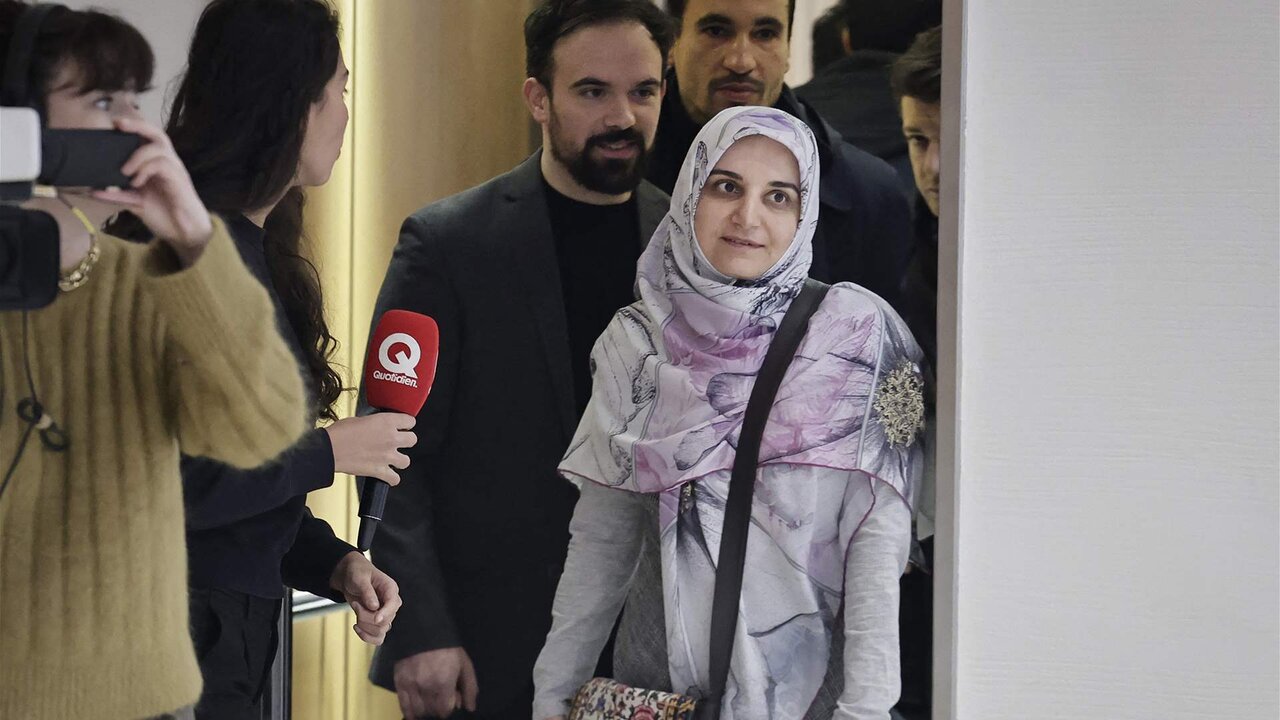
MADRID – In the photographs of Mahdieh Esfandiari that circulated in the media during her judicial process in France, one detail drew disproportionate attention. It was the veil. Not because a woman wearing hijab is an anomaly in contemporary Europe, but because of what that garment condensed in this specific case: an Iranian academic, educated at Lumière Lyon 2 University, facing a criminal court for words published on Telegram.
The image seemed to offer a ready-made narrative. A visible Muslim woman. A terrorism charge. A republic built on laïcité.
Yet the punctum, to borrow Roland Barthes’ term from Camera Lucida, was not the fabric itself. It was the unease the image generated. The discomfort of a figure who did not fit the expected script. A woman trained within French institutions, fluent in their language and codes, who nonetheless articulated a political vocabulary rooted elsewhere. The disturbance lay in the refusal to dissolve into the categories available to her.
On February 26, 2026, the Paris Criminal Court sentenced Esfandiari to four years in prison, with one year to be served in detention and the remaining three suspended. The ruling also included a permanent ban on her entry into French territory. She was charged with “glorifying terrorism” for social media posts published between 2023 and 2024, particularly statements referring to the October 7 operation carried out by Hamas against Israel. According to the prosecution, her description of that attack as an act of resistance constituted criminal endorsement.
The offence of glorifying terrorism was initially designed as a preventive instrument. Its logic is rooted in security. The state seeks to deter speech that could legitimise or encourage violence. The difficulty is now emerging in its application. When the category of terrorism expands beyond operational support or direct incitement to encompass political interpretation, the line between security enforcement and the regulation of dissent becomes less clear.
In Esfandiari’s case, the prosecution framed her statements as endorsement. Her defenders described them as solidarity with Palestinians in the context of a devastating military campaign in Gaza that has been called a genocide by rights groups and experts. The distance between these descriptions is not trivial. It marks the boundary between speech protected as political opinion and speech punishable as criminal advocacy.
This boundary is increasingly unstable across Europe. Counter-terrorism legislation has broadened over the past decade. Exceptional measures introduced in response to genuine threats have entered the ordinary legal framework. In this environment, the language of terrorism acquires elasticity. It begins to function not only as a descriptor of violent acts, but as a civilising discourse.
By labelling certain expressions as terrorist glorification, the state identifies behaviours it deems “unruly”. It delineates the acceptable from the excessive, the legitimate from the suspect. The effect is disciplinary. Entire populations, particularly those already associated with geopolitical tension, are subtly reminded of the limits within which their speech will be tolerated. The accusation carries moral weight as well as legal consequence.
The veil intensified this process. In France, laïcité is more than a constitutional principle. It is a narrative of cohesion forged through the abstraction of the citizen from visible affiliations. “Religious” signs in public space have long been sites of contestation, especially when linked to Islam. Debates over headscarves in schools and public institutions have shaped legislative reforms and electoral campaigns.
The circulation of images showing a veiled Iranian defendant in a terrorism case therefore resonated beyond the courtroom. The garment became entangled with assumptions about integration, loyalty and the place of Islam in Europe. It was read as a symbol, regardless of the intentions of the wearer. The legal evaluation of her words unfolded within that symbolic atmosphere.
Her biography complicates any simplified interpretation. Esfandiari is a linguist and translator who studied in Lyon. She engaged with French academia and navigated its intellectual frameworks. Her trajectory reflects a form of mobility that the republic itself promotes. She was not external to the system that later judged her. She was, in part, formed by it.
This duality unsettles established expectations. The dominant integration narrative presumes that immersion in European institutions produces convergence in cultural and political outlook. In this instance, academic formation did not dissolve Islamic visibility or recalibrate geopolitical sympathies. It produced a subject capable of moving between contexts without relinquishing her own vocabulary.
The perceptual difficulty recalls earlier moments when European observers struggled to categorise Iranian political phenomena. The 1979 revolution, framed at the time through the cover of Time magazine featuring Ayatollah Khomeini, confounded analysts accustomed to interpreting upheaval through class struggle or superpower rivalry. An Islamic revolution did not fit the grammar of the Cold War. It forced a reconsideration of what counted as political language.
Something of that inadequacy persists. In the Esfandiari case, much commentary relied on the inherited lexicon of the global war on terror. Terms such as propaganda, extremism and radicalisation structured the debate. They illuminated certain aspects of the file, but obscured others. They left little space for analysing how political vocabulary travels across contexts and acquires different meanings.
Esfandiari’s use of the word resistance was central to the prosecution’s argument. The term has a layered history. In international law and anti-colonial movements, it has denoted armed opposition to occupation. The court, however, chose to interpret its use in her posts as criminal glorification. That’s while many of her supporters insist it was political positioning within a genocide.
The law is not designed to arbitrate historical semantics. It classifies statements according to statutory definitions. Yet when those definitions expand, they reshape the contours of public discourse. The elasticity of the terrorism charge signals a recalibration of “liberal” tolerance under security pressure.
The Esfandiari case also unfolded against a geopolitical background. Tehran publicly criticised her prosecution and described it as indicative of Europe’s posture towards Iran and towards pro-Palestinian expression more broadly.
This dynamic is not exceptional. Legal cases involving politically sensitive speech often acquire diplomatic resonance. Individuals become sites where broader tensions are negotiated symbolically. The defendant’s body, attire and words are read as extensions of state narratives.
In this context, the veil functions as more than personal attire. It becomes a visual shorthand for unresolved debates about sovereignty, secularism and belonging. It unsettles because it resists reduction. It signals continuity with an Islamic tradition while inhabiting a European public sphere that has struggled to accommodate such continuity without suppression.
Esfandiari’s lawyer has announced an appeal. The photographs that circulated during the proceedings will fade from immediate attention. The structural questions they crystallised will endure. They concern the reach of counter-terrorism legislation, the management of Islamic visibility, and the conditions under which dissent becomes suspect. In that convergence lies the lasting significance of the Esfandiari case.
Her image disturbed because it revealed an unresolved tension at the heart of contemporary Europe. A supposed “liberal” order that defines itself through universalism confronts subjects who refuse to abstract themselves from particular histories. The response, increasingly, is framed in the language of security.
Leave a Comment