Ten Lessons on Peace and Conflict from Iranian Cultural Heritage
In Iranian civilization, peace has never been a mere moral preference; it has been a defining feature of cultural identity, intellectual heritage, and collective self-understanding. From the earliest layers of history, ancient Iranians regarded peace as the hallmark of wisdom and refinement, believing that human flourishing is possible only under the canopy of calm, justice, and human fellowship.
With the advent of Islam, this ancient ethos intertwined with Qur’anic teachings and the prophetic model, giving rise to an even more spiritual and ethically enriched conception of peace. In the Qur’an, God introduces Himself as Al-Salām—the Source of peace; the prophets are described as bearers of reconciliation; and salām is the first word spoken in every encounter between believers. Thus, “Peace is better” became not only a divine command but also a defining principle of Iranian moral and cultural life.
Iran’s poets and thinkers have carried this message forward with exceptional eloquence. From Ferdowsi—whose epic wisdom elevates reason and condemns senseless conflict—to Rumi’s boundless vision of love, and to Saadi’s universal call for compassion in the Gulistan and Bustan, the Iranian imagination has consistently beat with the pulse of peace, tenderness, and humanity. Unlike many nations, Iran has preserved an unbroken linguistic and literary continuity across millennia. This rare continuity has enabled even ordinary Iranians—not only scholars—to read, recite, and interpret centuries-old texts with ease. As a result, generations have inherited a living relationship with a heritage in which poetry, ethics, and peace are inseparable.
A survey of Iranian literature reveals a nation that has never been inclined toward aggression. Though steadfast in defending justice and dignity, Iranians have historically been advocates of dialogue, moderation, and coexistence. Among all the great poets, perhaps none articulated the “logic of peace and conflict” embedded in Iranian wisdom with the clarity and moral depth of Saadi. For centuries, his Bustan and Gulistan were core textbooks in Iranian schools; countless lines became proverbs woven into everyday speech. Through them, Saadi offered a practical and timeless philosophy in which compassion strengthens society, prudence guides action, and war is never glorified.
This essay draws upon Saadi’s teachings in the Gulistan and Bustan to explore this philosophy through ten lessons—a concise reflection on how Iranian wisdom has long understood the moral boundaries of war and the enduring primacy of peace.
Lesson One: Peace Is a Gift to Oneself
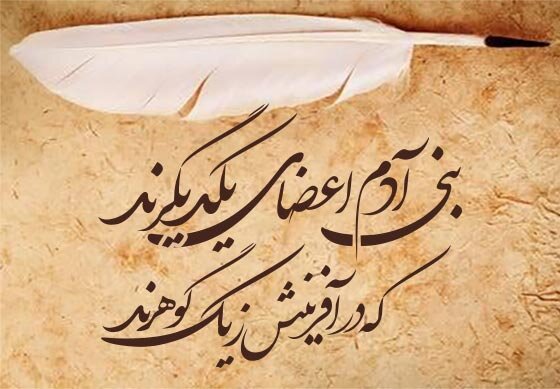
In the Iranian moral imagination, war, hatred, and enmity first wound the spirit of the aggressor long before they harm the opponent. Peace, by contrast, is a source of inner ease, security, and tranquility—an experience that emerges only when human beings relate to one another with kindness and compassion. Saadi views all people, regardless of race, language, religion, or color, not merely as members of a society but as limbs of a single body. In his eyes, the pain of one is the suffering of all, and genuine peace becomes possible only when individuals live together free from injury, humiliation, and injustice.
He conveys this truth through one of the most celebrated passages in Persian literature:
“Human beings are members of a whole,
In creation of one essence they share.
When the calamity of one affects a limb,
The other limbs cannot remain at ease.
You who are indifferent to the suffering of others—
Do not call yourself a human being.”
For Saadi, human dignity is inseparable from empathy. Peace begins with recognizing this shared essence and accepting that harm to another ultimately returns to oneself. Peace, therefore, is not merely a diplomatic posture or a political strategy; it is an inner discipline, a refinement of the soul, and a daily practice of moral responsibility. In the Iranian tradition, one who cultivates such an inner state protects not only society but also the integrity of their own humanity.
Lesson Two: Peace Is Superior to Any Martial Conquest
Within the peace-seeking fabric of Iranian culture, peace is consistently regarded as superior to war. Even when one is powerful before an adversary and able to win a swift and decisive victory, peace remains the nobler triumph. Saadi reminds us that strength, no matter how formidable, cannot compare with the moral stature of reconciliation:
“Even if you possess the strength of an elephant
and the claws of a lion,
in my view, peace is still better than war.”
For true comfort is never found in domination or conquest. No authority, no victory, and no grandeur of ruling over vast lands is worth even a single drop of human blood:
“By the very code of chivalry, I swear:
The dominion of the whole earth is not worth a single drop of blood spilled upon the ground.”
Although triumph in war may display military prowess, it inevitably leaves behind devastation, grief, and bitterness in the hearts of the defeated—sorrow that a cultured Iranian conscience cannot ignore. Peace, by contrast, breathes life into societies; it restores dignity and brings joy to all parties. In Saadi’s moral universe, the highest form of power is the ability to secure tranquility, not to impose subjugation. Lasting honor lies not in overcoming an enemy, but in preventing suffering before it begins.
Lesson Three: Kindness to the Weakest; A Foundation for Peace-Oriented Education in Iranian Culture
The cultivation of peace within a society begins by nurturing a peace-seeking spirit in individuals—teaching them to extend kindness even to the weakest of creatures. In Iranian ethical tradition, respect for human beings, animals, and even the smallest manifestations of life is considered the first step toward building a gentle and violence-free society. Saadi, echoing Ferdowsi, expresses this truth in a simple yet profoundly instructive verse:
“Do not harm an ant that carries a grain,
For it has a life, and life is sweet and precious.”
This couplet functions as an educational principle for forming a peace-seeking human being. A child who learns early in life not to harm even an ant will, in adulthood, neither humiliate nor oppress any human being. Such teaching also instills the awareness that power is temporary: one who is strong today may find themselves vulnerable tomorrow.
“Do not strike the powerless with the hand of force,
For one day you may fall at their feet like an ant.”
This perspective establishes the moral foundations of humility, fairness, and respect for the rights of others. For Iranians, peace begins with a gentle heart and a harmless hand; such a heart and hand can be cultivated only through the discipline of honoring “the smallest and weakest.”
In this tradition, weapons and advanced military strength are not regarded as the true basis of peace. One must never initiate aggression, for the person overpowered today is not erased; they may return as a persistent and hidden enemy. As Saadi reminds us, “the weak keep the stones they receive,” waiting for the moment to restore justice.
Thus, conflict born of brute force is not the work of the wise. Striking with the paw of a lion or the blade of a sword is never the mark of prudence; true wisdom lies in fostering gentleness before strength, and restraint before violence.
Lesson Four: Acquiring Power Guarantees Peace — But Not Fear-Inducing Power
In Iranian ethical and political thought, power is not sought for domination, but for preventing war and safeguarding security. A weak society becomes prey to aggressors; a strong society can defend its dignity, values, and independence, deterring the enemy from even contemplating conflict. Yet this strength must never be of a kind that instills terror—because power that generates fear inevitably breeds hostility, conspiracies, and future violence.
Saadi conveys this lesson through a striking metaphor:
“The snake strikes at the shepherd’s foot
Because it fears its head will be smashed by a stone.”
The snake does not bite out of malice; it attacks because it is terrified. The same logic applies to humans: when an adversary is overwhelmed by fear of our power, he may initiate war in self-defense. Saadi illustrates this further with another vivid image:
“Do you not see that when a cat becomes helpless,
It raises its claws toward the eye of a leopard?”
Even the smallest creature, when cornered, may respond with unexpected ferocity. Thus, the wise understand that true, healthy power inspires respect—not panic. Power coupled with justice, ethics, and dignity becomes a foundation for lasting peace; but power that humiliates or threatens others will, sooner or later, ignite conflict.
Iranian wisdom therefore distinguishes between legitimate strength, which deters aggression, and fear-inducing strength, which provokes it. The former protects tranquility; the latter endangers it. Saadi teaches that a society must be strong enough to defend itself, yet wise enough to prevent its strength from becoming a source of anxiety and thereby a prelude to war.
Lesson Five: Understanding the Power of the Enemy and Avoiding Unequal War
On the path to preserving peace and security, strengthening one’s own capabilities is essential—but so too is a clear understanding of the enemy’s power. Courage without calculation can lead directly to destruction. In Iranian wisdom, entering a war whose outcome is already known to be defeat is not a mark of honor, but of folly. When the adversary possesses overwhelming superiority, one must avoid direct confrontation and instead choose a course that preserves life, dignity, and the homeland.
Saadi expresses this truth plainly:
“When your army numbers one hundred
and your enemy one thousand,
You are delivering yourself to destruction — beware.”
Elsewhere he warns:
“A weak man who shows bravery against the strong
Is an ally of the enemy in his own destruction.”
In other words, when a nation challenges a vastly stronger foe without strategy or preparation, it has effectively assisted its own downfall. Such a war is neither courageous nor noble; it is a form of naïveté that helps the enemy accomplish what he desires. Reason and religion both teach that fighting is justified only when there is a meaningful possibility of victory, or when it is necessary for effective defense.
If the outcome of war is predetermined and catastrophic, another path must be chosen. Saadi cautions that even a skilled warrior must think carefully before entering battle:
“When you engage in war and confront someone,
It should be one from whom you have
‘a means of overcoming’ or
‘a means of escape.’”
Thus, if conflict becomes unavoidable, it must be approached with foresight: either with the prospect of prevailing, or at least with a viable way to withdraw. Iranian wisdom never glorifies reckless combat; it honors the defender who knows when to stand firm, when to negotiate, and when to avoid a battle whose only result would be ruin.
Lesson Six: Revenge Usually Fails to Bring Peace
In Iranian wisdom, war—even when cloaked in the language of revenge—rarely heals a wound; instead, it deepens resentment and perpetuates cycles of hostility. When an enemy commits an act of aggression, retaliation is not the first or most honorable response. Even if the adversary behaves violently, one must reflect carefully on how to correct the wrongdoing and restore order without igniting further conflict. Revenge, in Saadi’s view, is not a path to dignity; it is the beginning of a new injury rather than the end of an old one.
He captures this logic in an evocative warning:
“When you engage in conflict with a stone-thrower,
You have foolishly broken your own head.
When you have shot an arrow at an enemy, beware,
For you are now in its target.”
Entering into confrontation with someone who readily harms others exposes oneself to equal or even greater danger. Every arrow loosed toward an enemy invites another arrow in return. Wisdom teaches that conflict must be the last resort—a step taken only when all avenues of peace have fully closed.
Saadi clarifies this moral stance:
“Two wise men hold neither hatred nor quarrel,
For wisdom does not contend with the frivolous.
If a fool speaks harshly in fear,
The wise responds with a gentle heart.”
The wise understand that choosing peace is not weakness; it is the height of self-control and foresight. One who seeks revenge traps himself in a cycle of pain, insecurity, and retaliation. But the one who responds with patience and forgiveness attains inner tranquility and contributes to the peace of society.
In this tradition, peace is not merely a political arrangement—it is a discipline of the soul. Saadi teaches that dignity lies not in retribution but in rising above the impulse to harm, choosing instead a path that breaks, rather than extends, the chain of hostility.
Lesson Seven: Prudence and Forbearance — The Shield of the Wise Against War
In Iranian ethical thought, wisdom and prudence consistently surpass the sword. The cultured Iranian understands that the greatest victory lies not in triumphing on the battlefield, but in preventing war altogether. Saadi emphasizes that reason, patience, and forbearance are far more potent than bloodshed in extinguishing enmity and averting devastation.
“As long as a task can be managed with prudence,
Forbearance with the enemy is better than battle.”
As long as matters can be settled through intelligence, planning, and strategy, patience and tolerance toward the adversary are preferable to conflict. War becomes inevitable only when the doors of dialogue and deliberation have closed. Whenever possible, war should be postponed, and the enemy should be given a moment of reflection—an opportunity to reconsider hostility. For an adversary who today appears consumed by anger may, through a gesture of patience and a well-timed opening, discover a path away from conflict.
“At times, by delaying the war, one may defeat the enemy;
So treat him with such forbearance as you would a friend.”
Saadi proposes “forgiveness, magnanimity, and kindness” as tools capable of quelling the fires of sedition—acts of moral nobility that can close the gates of enmity where armies cannot. One noble, strategic gesture can extinguish a feud that years of fighting would only inflame.
“When the enemy cannot be defeated by force,
The door of sedition must be closed with bounty.
If you are worried about harm from your adversary,
Bind his tongue with the amulet of ‘benevolence.’”
Pouring generosity in place of blows softens even the sharpest teeth:
“Pour gold instead of blows to the enemy,
For kindness can blunt the sharpest teeth.”
In this tradition, generosity is not naivety; it is strategy. It is a moral intelligence that recognizes how certain conflicts can be resolved through dignity rather than destruction. A person—or a nation—that chooses reason, patience, and benevolence over hasty retaliation protects not only itself but the moral fabric of its society. Such choices prevent needless bloodshed and secure a deeper, more enduring form of honor: the honor of sparing life, calming tempers, and creating space for reconciliation.
Lesson Eight: Sometimes “Defense” Is the Last Resort
Sometimes the enemy persists so fiercely in oppression and aggression that he mistakes every gentle word for weakness, growing only in greed and insolence. As Saʿdī says, he behaves with such entrenched hostility that “he will not be turned into a friend by kindness, but will grow more covetous.” Confronting such an arrogant oppressor—one who, despite repeated demonstrations of goodwill, sees nothing but himself—demands a different approach:
“Speak not with gentleness and grace to one of harsh disposition,
For rusted iron is not cleansed by a soft file.”
If forbearance, benevolence, and every possible prudence to avoid conflict merely embolden and encourage the enemy, then all paths of dialogue, patience, tolerance, and kindness close. When the enemy exceeds the bounds of reason and fairness and casts his greed upon our lives, our honour, and our land, defense—undertaken for dignity and survival—becomes the final remedy:
“When every stratagem is exhausted and fails,
It becomes lawful to lift the sword.”
When the enemy abandons all restraint in his hostility, showing kindness to such a foe becomes its own mistake:
“Match war with war when he seeks vengeance,
For showing kindness to the spiteful is a fault.
If you address a base man with courtesy and sweetness,
His arrogance and stubborn pride will only increase.”
In this matter, there is no difference between a “strong” enemy and a “weak” one. Every arrogant foe must be made aware—whether he is the well-armed adversary intent on eliminating you, or the feeble opponent whose constant harassment seeks to erode your honor. The harm of no arrogant enemy should ever be underestimated. Saadī warns: “He who deems a small enemy insignificant is like one who neglects a small flame.”
Any enemy who observes no bounds, accepts no path of peace, friendship, or calm, and moves solely upon the axis of hostility must not be granted security:
“Strike today, while you can strike;
For once the fire rises high, the world will burn.”
Nevertheless, the endeavor of rulers should always be to ensure that the least possible amount of warfare occurs. One must not raise the cry of battle over the smallest provocations when the enemy—even a weak one—can be admonished through gentler means. Whoever—whether a person or a nation—has more enemies than friends will see his adversaries increase day by day, while his friends will suffer hardship and reproach merely for their loyalty.
“Beware of battling, even with the weak,
For I have seen many a flood born of a single drop.
Do not knit your brow in anger if it can be avoided,
For an enemy, however lowly, is better won as a friend.
His enemies grow numerous, and his friends grow weary,
For the one whose enemies outnumber his friends.”
But when conflict becomes unavoidable, and the decision for defense is made, one must not fear. With trust in the Almighty, a path may always be found to prevail over even the most powerful and arrogant adversaries:
“With strategy, even Rostam can be bound,
he whose noose even Esfandiyār could not evade.”
Yet blind courage is never sufficient; war must be waged with wisdom and planning so that victory is gained—not merely bloodshed and ruin. Military strategy, magnifying one’s power before the enemy, strengthening the spirit of combat and sacrifice, employing the strongest soldiers, camouflage and protection of secrets, caution in choosing companions, guarding against enemy infiltration within the ranks, sowing division among the enemy while preserving unity among one’s own, pitting one foe against another, drawing near to the friend of one’s adversary, avoiding simultaneous confrontation with multiple enemies, striking at the enemy’s points of strength, managing time, and at times a prudent retreat—or even a wise flight, or donning the enemy’s garment to preserve one’s life in dangerous moments—are among the tactics long emphasized in Iranian culture whenever conflict becomes inevitable.
Lesson Nine: The Hidden Pursuit of Reconciliation Amidst War
Even in the midst of battle, peace must never disappear from the commander’s horizon nor from the warrior’s heart. True victory is achieved not merely when an enemy is subdued, but when hostility is ended and order restored without needless bloodshed. Saadī teaches that the path of reconciliation must remain present—even if concealed—within every act of war:
“When you take up the sword of combat,
Keep hidden the path of reconciliation.”
That is, whenever one is forced to raise arms, one must still preserve within the heart a readiness for peace, restraining the fire of vengeance. Saadī explains that even great commanders, at the height of conflict, often maintain an inward gaze toward peace, seeking a way to end the quarrel with wisdom rather than destruction. Though outwardly they display courage and strength, inwardly they search for the door through which discord may be brought to an end:
“…who, though their armies blossomed and their helmets split open in war,
Sought peace in secret and displayed battle in the open.”
The wise leader, therefore, pairs the boldness of the battlefield with the prudence of farsighted diplomacy. He knows that through mediation, patience, or a well-timed gesture, it may be possible to awaken the enemy to his own arrogance and bring an end to strife. For Saadī, such a reconciliation surpasses a hundred outward victories:
“If secretly you win over one heart,
That is better than a hundred night raids.”
Thus, even at the height of confrontation, the wise continue to seek peace quietly, believing that restoring hearts is a greater achievement than conquering lands. Iran’s wisdom tradition regards reconciliation not as a retreat, but as the highest form of triumph—a triumph that preserves dignity while sparing lives.
Lesson Ten: Wise Reconciliation — Accepting Peace with Vigilance and Caution
In the school of Iranian wisdom, just as beginning a war must be the final resort, ending one is a sign of prudence and nobility. Whenever peace is proposed by the enemy, it must be received with the ear of intelligence and assessed with a discerning, far-seeing gaze. As Saadī counsels:
“If the enemy desires peace, Do not turn away your head.”
“When the enemy approaches your door in helplessness,
Cast out from your heart resentment and wrath.”
If an adversary comes forward out of weakness, regret, or recognition of his wrongdoing, one must not lose the opportunity for peace. With magnanimity and dignity, one should step through the door of reconciliation. In such cases, accepting peace is not a sign of vulnerability but a source of greater awe and moral authority:
“For if he closes the door of battle,
Your worth and majesty become a thousand-fold.”
Peace embraced with wisdom enhances both the moral power and the social strength of a nation, bringing calm to hearts and stability to the land. Yet Saʿdī warns that peace must be accepted with vigilance, for some enemies clothe deceit in the garments of reconciliation:
“When he seeks protection, act with generosity;
Forgive, and yet reflect upon his deceit.”
He reminds us that many have recited the verse of peace by day, only to march their armies under cover of night:
“I do not say, fear the malice of the ill-intentioned in war—
Fear him more when he proclaims peace.
Many a one by day recited the verse of peace,
But when night came, drove his army against the sleeping foe.”
Thus, every offer of peace must be examined with care, lest treachery hide behind its veil. If the peace is genuine, one must accept it with a noble heart and replace anger with forgiveness. True reconciliation dissolves bitterness and draws nations closer together.
But if the deceitful enemy once again breaks his covenant and violates the agreement, then the nation becomes united in its resolve; and with a strength multiplied manifold, it restores him to his rightful place:
“If he again comes beating the drum of war,
The people together shall tear him apart and destroy him.”
In Saadī’s vision, wise reconciliation is neither surrender nor naivety. It is the disciplined balancing of generosity and caution, forgiveness and foresight—a moral craft through which peace is restored without falling prey to treachery. It is this blend of magnanimity and vigilance that forms the enduring heart of Iranian ethics on war and peace.
Conclusion
In Iranian thought, peace is not simply the absence of war; it is the beginning of insight, understanding, and moral clarity. Saadī—one of the finest teachers of this civilizational heritage—illumines, in the Bustan and Gulistan, a path where prudence walks alongside kindness, and where anger, haste, and vengeance find no home. He reminds us that a wise person seeks peace not out of fear, but out of awareness—an awareness rooted in dignity, restraint, and a deeper vision of what sustains human life. And even when one is compelled to enter the battlefield, the lamp of reconciliation continues to burn within the heart.
For Saʿdī, the logic of peace is neither a fleeting tactic nor a political convenience; it is a foundational truth—ethical, enduring, and civilizational. Should this truth take root within individuals and society, it has the power to cultivate not only the cessation of conflict but the flourishing of a more humane, compassionate, and peaceful world.
Dr. Mohsen Maarefi is an Iranian cultural scholar, a representative of the Saadi Foundation, and the Head of the Iran Cultural Center in Dar es Salaam, Tanzania.
Leave a Comment