Yemen commemorates historic Feb. 11 victory against U.S. occupation
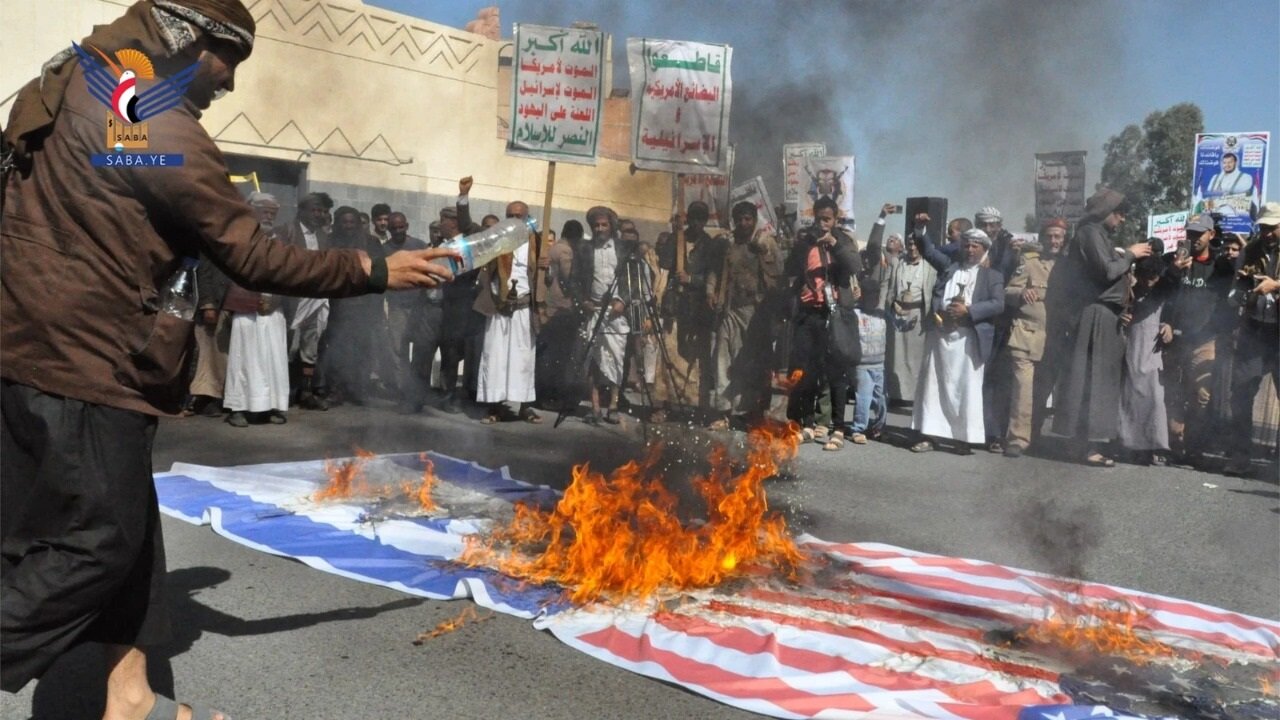
BEIRUT — Every year, Yemenis gather to commemorate February 11, marking one of the most significant turning points in the country’s modern history.
For nearly a decade, citizens have assembled at the former U.S. Embassy in Sana’a to honor the historic withdrawal of U.S. Marines in 2015—a defeat described by Ansarullah leader Sayyed Abdul-Malik Badr al-Din al-Houthi as a “historic victory” granted by God.
In his statement on the anniversary, Sayyed Abdul-Malik affirmed: “The departure of the U.S. Marines and the exit of the American ‘evil gang’ from Sana’a was indeed a great victory from God.”
On that day, then-U.S. Ambassador Matthew Tueller, accompanied by dozens of Marines and CIA operatives, fled the capital in broad daylight.
Remarkably, the evacuation occurred without a single shot being fired, without bloodshed, and without any negotiations or compromises over Yemen’s sovereignty, dignity, or independence. This event symbolized the failure of one of the largest intelligence operations in U.S. history, demonstrating the power of faith, unity, and national awareness.
The context of this victory further underscores its significance. At the time, the United States exerted almost total control over Yemen, influencing politics, the military, and economic sectors.
According to Sayyed al-Houthi, “They exploited it to impose their policies and execute their conspiracies against the Yemeni people from the heart of their capital, subjugating senior officials in power, where the U.S. ambassador in Sana’a held the primary authority and decision-making power over all the country’s officials.”
American officials directly supervised the restructuring of the Yemeni military, confiscated strategic weapons, controlled media and education, and even dictated the content of Friday sermons.
Yet the Yemeni people’s uprising following the 21 September 2014 revolution changed the balance of power.
“This was not achieved through negotiations, concessions, or compromises,” Sayyed Abdul-Malik emphasized, “but rather through the rise of our people, based on their faith-based identity, their blessed revolution, and the failure of the enemies’ conspiracies thereafter.”
The withdrawal of U.S. forces was a decisive outcome, demonstrating that even a global superpower could be humbled by a united and aware populace.
The anniversary of February 11 is also tied to broader struggles for Islamic independence.
Sayyed Abdul-Malik extended congratulations to Iran, recalling its 1979 Islamic Revolution: “This revolution has successfully built an Islamic civilizational renaissance, adhered to its liberation principles, supported the oppressed and marginalized—primarily the Palestinian people—and diligently worked to strengthen Islamic brotherhood.”
Both historic victories serve as important lessons for the Muslim Ummah, showing that liberation is possible even under immense external pressure.
Following February 11, 2015, the U.S.-Saudi coalition launched a decade-long military campaign to reverse Yemen’s revolutionary achievements.
Despite this aggression, Yemenis remain resolute. Sayyed Abdul-Malik highlighted that the Marines’ withdrawal “was the end of their direct control over the political and administrative center of the country,” proving that resistance, awareness, and faith can overcome external domination.
February 11 stands as a symbol of resilience, faith, and national pride. It reminds the world that true liberation is earned not through submission or compromise, but through collective determination and steadfastness. For Yemen, this date offers inspiration to oppressed nations everywhere: with courage, unity, and divine guidance, independence is always achievable.
Leave a Comment