Iran’s geography strikes back in the corridor war
The strategic collapse of Washington’s attempt to bypass the heart of Eurasia
TEHRAN – The global maritime order fractured in early 2026, not through a single explosion, but through a methodical reassertion of geological reality. When the U.S.-Israeli axis launched its kinetic campaign of aggression against Iran on February 28, the strategic assumption in Washington was that the world’s most critical energy artery would remain a mostly passive, obedient channel for Western commerce.
They were catastrophically wrong. Within weeks, daily vessel traffic through the Strait of Hormuz collapsed by more than 95 percent, falling from roughly 130 ships a day to fewer than 10.
The waterway has been transformed from a Western-policed highway into a sovereign space governed by the nation that lives on its shores.
This shift has exposed the West’s long-standing doctrine of freedom of navigation as a selective privilege, one granted to allies but violently denied to the disobedient.
By targeting Iranian infrastructure, the aggressors attempted to enforce a trade map that rewards cooperation with the U.S.-Israeli axis while isolating the sovereign heart of Eurasia, but they forgot a fundamental law of geoeconomics: security is indivisible.
The IMEC mirage
A casualty of this failed strategy is the India-Middle East-Europe Economic Corridor, better known as IMEC. Conceived as a deliberate bypass of Iran, IMEC was a geopolitical design built to reward Israel’s regional role and create a transit architecture that surgically excluded Iran.
Promoters once promised 40 percent faster transit times and a bold new commercial bridge between Asia and Europe. Today, however, IMEC is functionally dead.
Corridors do not survive on PowerPoint slides or summit photo-ops; they require stability, insurance, and the cooperation of geography.
No rational sovereign wealth fund or insurance firm will underwrite a railway running through a war zone ignited by the very powers that pitched the project.
With the port of Haifa heavily damaged and regional “normalization” with the regime in ruins, IMEC has devolved into a paper corridor. The war has exposed it as an Israeli-American mirage, and the desert of regional reality has swallowed it whole.
The sanction-proof spine
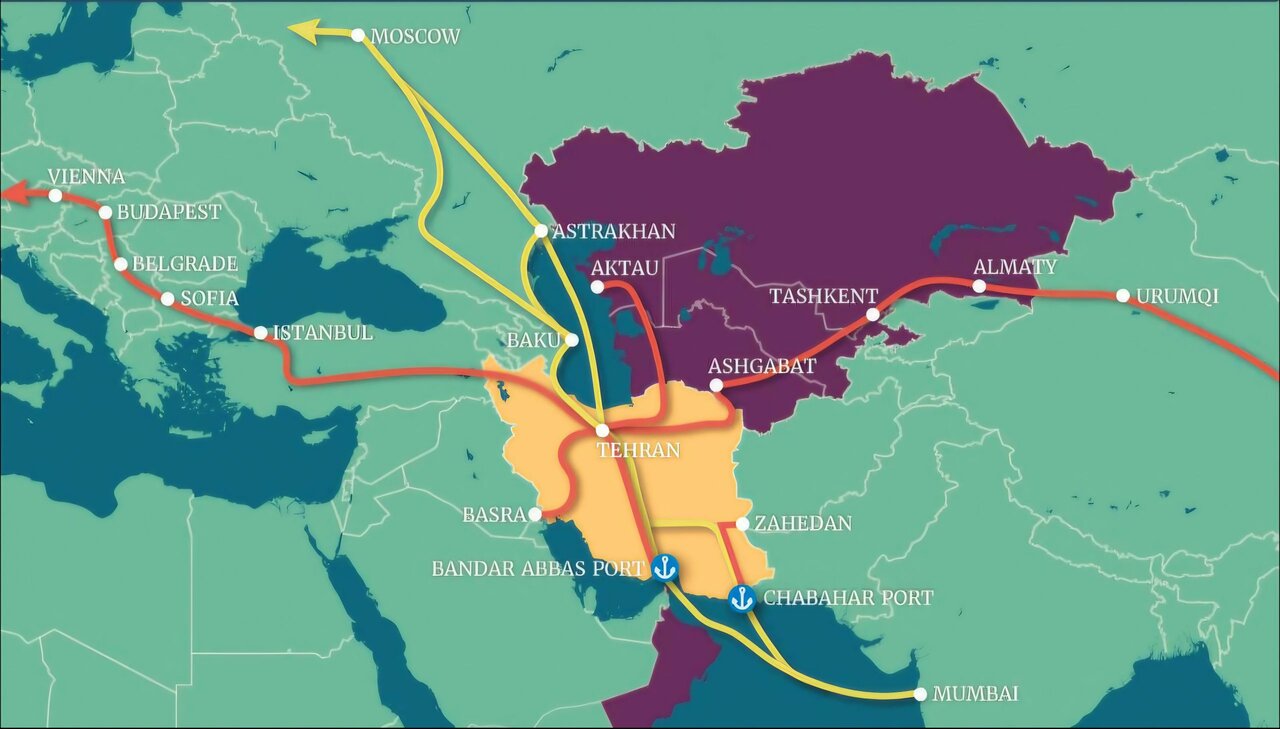
While exclusionary Western projects falter, a different architecture is accelerating on land. The International North-South Transport Corridor, which links India to Russia through Iran, is emerging as the true future of Eurasian trade.
It slashes freight time from Mumbai to St. Petersburg from 40 days via Suez to as little as 10 days, while cutting costs by roughly 30 percent.
Crucially, this corridor is a land-and-sea spine that the U.S. Navy cannot strangle. In a move that signals a deep multipolar shift, Russia and Iran agreed in late April 2026 to begin construction of the 164-kilometer Rasht-Astara railway, the final missing link in this resilient network. Even as bombs fell elsewhere, deals were being signed on the Caspian shore.
Furthermore, Pakistan’s recent authorization of expanded transit routes has opened land crossings that deliver cargo to the Iranian border in hours, rendering naval blockades increasingly irrelevant. These routes are a practical response to a world tired of being governed by naval coercion and financial blackmail.
The global war tax and the pivot of history
The economic blowback on the West has been immediate and merciless. The Hormuz shock has introduced a permanent risk premium into global markets, exposing the fragility of a Western economy that relies on a region it simultaneously destabilizes.
Brent crude has surged toward record highs, and insurance premiums have multiplied sevenfold. Washington’s desperate attempt to reroute trade around the Cape of Good Hope is an admission of defeat, as each detour adds up to 20 days and millions of dollars in fuel costs, driving global inflation.
This hidden tax falls on consumers and farmers far beyond the battlefield, turning the U.S.-Israeli war into a global tax on trade that hits the Global South the hardest.
Ultimately, the war’s strategic lesson is geological. Iran remains the irreplaceable bridge between the Persian Gulf, the Caspian, and the Mediterranean.
The global economy is now bifurcating into two zones: a high-cost, high-risk Western zone and a faster, sanction-proof Eurasian zone with Iran at its center. By attempting to exclude Iran, the U.S.-Israeli axis has only confirmed that the millennia-old civilization is too central to be bypassed by force.
Leave a Comment