Agha Bozorg Mosque: The soul of Kashan’s architectural heritage
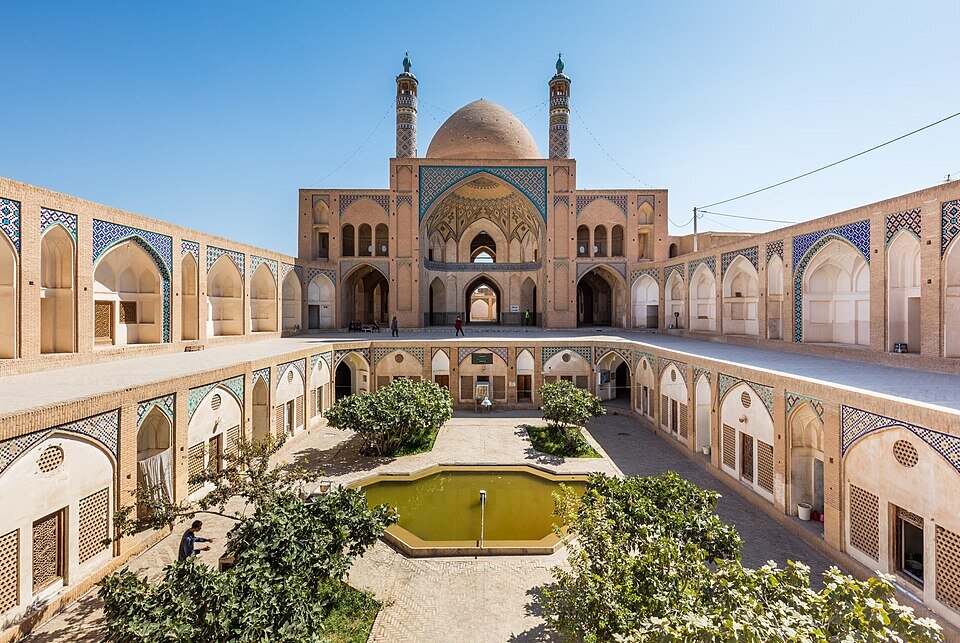
TEHRAN - Rising from the historic fabric of Kashan, the Agha Bozorg Mosque stands as one of the most remarkable architectural ensembles of late Persian design. It is a place where spirituality, scholarship, and artistry converge.
Constructed in the late 18th century and completed in the early 19th century, this mosque-madrasa complex is not merely a monument but an immersive journey into Iran’s intellectual and aesthetic traditions.
Named after the esteemed theologian Mulla Mahdi Naraqi II, the complex reflects both his scholarly legacy and the cultural vibrancy of the era. An inscription dates its completion to 1832–1833, a time when Kashan thrived as a center of trade and learning. Today, it continues to attract visitors from around the world, drawn by its rare architectural synthesis and serene atmosphere.
What immediately distinguishes the Agha Bozorg Mosque is its ingenious integration of a mosque and a madrasa within a single, unified structure. Unlike traditional layouts where these functions are separated, here they coexist seamlessly across five levels and two courtyards, one elevated and one sunken. This innovative design not only maximizes spatial harmony but also represents a departure from conventional Persian architectural principles, making it a true masterpiece.
Approaching the complex, visitors enter through a grand iwan-portal, which is an arched, domed gateway that opens into a spacious vestibule. From this vantage point, the courtyard unfolds in a dramatic, multi-level composition. Stairways, corridors, and terraces interconnect the various sections, guiding visitors through a carefully orchestrated sequence of spaces. The layout, oriented northwest to southeast, reveals a thoughtful balance between openness and enclosure, light and shadow.
At the heart of the complex lies the courtyard, arranged on two levels. The upper level functions as a balcony, framed by rows of deep, blind niches where students once sat and studied. From here, one looks down onto the lower courtyard, where a tranquil pool reflects the surrounding architecture, a quintessential feature of Persian design. This sunken courtyard, surrounded on three sides by madrasa dormitories, creates a sense of intimacy and retreat, ideal for contemplation.
Beneath the entrance pavilion, a subterranean space known as the sardab offers respite from the desert heat. Its broad arches and cool interior are complemented by towering windcatchers (badgirs), which rise above the structure to channel air into the lower levels, which is a brilliant example of traditional climate-responsive architecture.
The mosque itself occupies the southeastern side of the complex, centered around a domed chamber known as the gunbad-khanah. This octagonal space, crowned by a large dome, opens onto an ambulatory that wraps around it on three sides. The interplay of arches and light within this space creates a sense of rhythm and movement, inviting quiet reflection. Adjacent to it lies the shabistan, a hypostyle prayer hall divided by twenty columns into six aisles, each marked by subtle variations in light and shadow. A single mihrab indicates the direction of prayer, anchoring the spiritual focus of the space.
Decoration throughout the complex is both restrained and captivating. The dominant material is a special brickwork, interspersed with delicate geometric tiles in shades of light blue and brown. In certain areas, particularly around the dome and entrance portal, intricate muqarnas, stalactite-like ornamentation, adds depth and texture. The interplay of blue and turquoise tiles forms elegant Persian patterns, demonstrating a refined sense of balance and color.
One of the most memorable aspects of visiting Agha Bozorg is the attention to ceilings. Whether beneath the main dome or within smaller chambers, the ceilings, reveal intricate craftsmanship that rewards those who look up. It is a reminder that in Persian architecture, beauty is often found in the details above.
Beyond the mosque itself, Kashan offers a rich atmosphere of historical attractions. Situated along a major route connecting Tehran to cultural hubs like Isfahan, Shiraz, and Yazd, the city serves as a gateway to Iran’s central plateau. Visitors can explore its famed traditional houses, including the elegant Borujerdi House, Tabatabaei House, Ameri House, and Abbasi House, each showcasing the artistry of Persian residential architecture.
Yet, even among such treasures, Agha Bozorg Mosque holds a special place. It is not just a site to visit, but a space to experience, where architecture tells stories of faith, learning, and innovation.
AM
Leave a Comment