Bloodthirsty Netanyahu scrambling to save political career
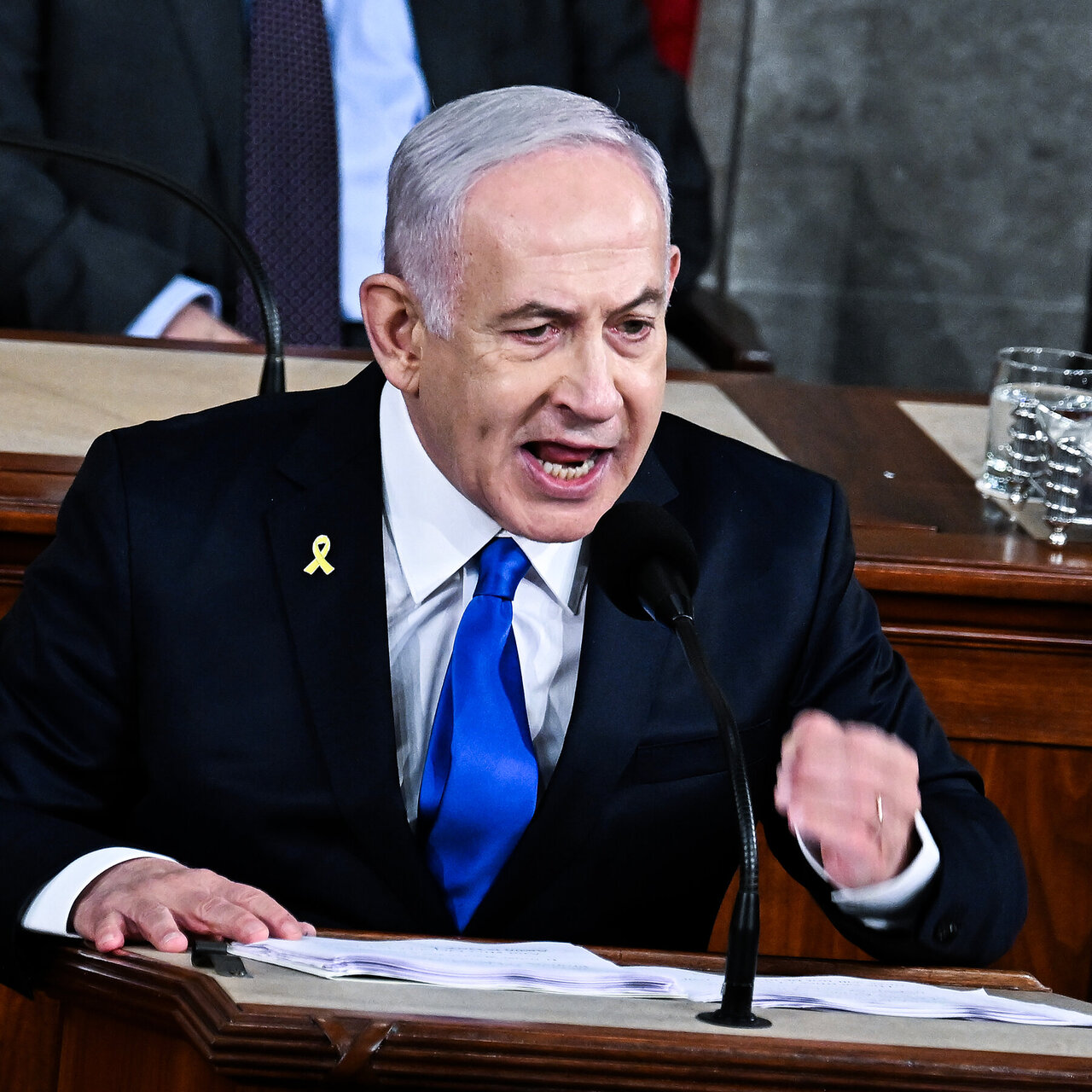
TEHRAN – The chances of Benjamin Netanyahu, who is wanted by the International Criminal Court for war crimes and crimes against humanity in Gaza, remaining in power do not appear promising.
Most opinion polls recently released by various research centers and Hebrew media outlets indicate a clear decline in support for the far-right Likud Party, which, since the end of December 2022, has formed, alongside other right-wing parties, the most fascist government in the history of the Zionist regime.
Although all successive Israeli governments have adopted policies of violence and war crimes, none has reached, over more than seven and a half decades, the level of brutality seen under the Netanyahu’s current government. According to the International Court of Justice and the International Criminal Court, the crimes committed have reached unprecedented levels.
Among the catastrophic consequences of Netanyahu’s rule has been the killing of more than 80,000 innocent civilians in the Gaza Strip, as well as massive destruction of infrastructure and civilian, medical, and relief facilities, exceeding 90 percent.
Netanyahu can be viewed as the most violent and bloodthirsty prime ministers in the history of the Zionist regime, surpassing even David Ben-Gurion, the first prime minister after the establishment of the occupying regime, who formulated its national security doctrine. A doctrine rooted entirely in killing, criminality, and bloodshed in pursuit of the “Greater Israel” dream, for which the rogue regime waged numerous wars.
He also eclipses Menachem Begin, the first Likud prime minister in 1977; Yitzhak Rabin, architect of the “bone-breaking” policy during the first Palestinian intifada in 1987; Ariel Sharon, the butcher of Sabra and Shatila; and many others who relied on violence and murder as a means to achieve the regime’s goals and to deter and terrorize all its neighbors, regardless of nationality, ethnicity, or religion.
After October 7, 2023, Netanyahu faced a wide range of crises, particularly after the major and unprecedented failure suffered by Israeli Occupation Forces (IOF) along the Gaza border.
Israeli investigations classified this as a complete and total failure of the Gaza Division, which had been responsible for securing the Strip’s borders, as well as a major failure at both the political and military levels throughout the Zionist regime.
Other crises also surrounded Netanyahu, including the judicial reform crisis, the issue of recruiting ultra-Orthodox Jews, and the crisis surrounding the dismissal of former Defense Minister Yoav Gallant, the head of the Shin Bet, and the legal adviser. These were accompanied by successive scandals revealed by Hebrew media, including bribery, excessive spending, scandals involving his wife Sara, others involving his son Yair, and many more.
All of the above have clearly affected Netanyahu’s chances of winning another term as prime minister. This pushed him to search by every possible means for an escape route that could save his political future and spare him the dark fate awaiting him if he loses the next elections.
A fate that has drawn increasingly close, especially since the corruption cases against him before courts could lead to butcher of Gaza spending long years behind bars, as happened with former Prime Minister Ehud Olmert.
During recent months, a troubled Netanyahu has attempted to play his final cards to save himself from an approaching fate. He found what he was looking for, according to some Israeli analysts, in the Zionist-American war on Iran, which opened an important window to escape his bleak future and cover up his major defeat in the Gaza Strip.
Although he succeeded in achieving an accomplishment during the first days of the aggression in late February, through the martyrdom of Iran’s Leader, Ayatollah Sayyed Ali Khamenei, along with several senior officials, the decisive Iranian response, which came as a resounding and unexpected shock to the Zionist regime, as well as to its American ally, changed the equation.
It made achieving a major breakthrough, such as overthrowing the Islamic Republic and taking control of its resources and wealth, which would have meant controlling the entire region, virtually impossible.
Another card Netanyahu sought to play came through the Lebanese front. He attempted to use it as a path to escape political downfall and imprisonment by expanding the aggression against Lebanon.
To that end, he deployed several elite and special combat IOF brigades into the Lebanese quagmire, despite repeated warnings from many Zionist military commanders, who understood all too well what it meant to enter terrain of such harsh and difficult geography against a battle-hardened, highly experienced adversary possessing capabilities that can only be described as exceptional.
After months of fierce fighting in the villages and towns of southern Lebanon, and after the IOF suffered heavy losses as a result of Hezbollah’s use of FPV drones and anti-tank missiles, some with ranges of nearly 10 kilometers, the IOF was once again forced to end the aggression.
Netanyahu then sought to achieve a breakthrough through diplomatic channels by engaging in direct negotiations with the Lebanese government under American sponsorship. Although this effort succeeded in producing a “framework” agreement between the two sides, it changed nothing on the ground, where the battlefield and the Lebanese resistance continued to dictate events.
The third and final card that has remained available to Netanyahu is the Gaza Strip, which now appears to have become his last refuge for securing the achievement he has long pursued but has failed to attain over more than 33 months.
In war-ravaged and besieged Gaza, the IOF, acting on direct orders from Netanyahu and his Defense Minister Katz, is working to expand its areas of occupation and seize additional territory within the Strip. During the past week alone, the regime’s occupation has reportedly surpassed 70 percent of Gaza’s territory, exceeding the figure Netanyahu himself announced roughly two weeks earlier.
In this regard specifically, the occupying regime is expanding the territory it controls from east to west. According to all available indications, it is seeking to confine Gaza’s population to the western part of the Strip, areas that lack the infrastructure and essential public services needed to sustain such an enormous number of people.
The population is crowded into worn-out tents and whatever remains of institutions, schools, and universities, most of whose buildings and essential facilities have been destroyed. The result is a catastrophic humanitarian crisis.
Alongside the expansion of regime-controlled areas and the forced displacement of even more residents toward western Gaza, the IOF has intensified its campaign of targeted assassinations against Palestinian activists. It has employed a broad range of intelligence and surveillance tools, gathering information through artificial intelligence systems, which, according to numerous reports, have been behind most of the recent assassination operations carried out in Gaza.
According to many analysts and specialists, there is a clear effort to prepare the ground for a large-scale land operation in the Gaza Strip.
The IOF is attempting to deprive Palestinian resistance forces of as many fighters and members as possible. This is while the IOF is simultaneously targeting any location or facility believed capable of helping the Palestinian resistance restore part of its operational capabilities. As events over the past two months indicate, this campaign has been steadily escalating.
It is reasonable to believe that these operations will continue to increase in both scale and intensity over the coming months, leading up to the Knesset elections. They may even reach their peak in October in a bid to secure what Netanyahu and his advisers believe is the only significant achievement still attainable amid the growing complexities of the other fronts.
The prospects for launching such an operation may appear considerably stronger than other scenarios some believe remain possible, particularly in light of reports that advance elements of a “stabilization force” have begun arriving in certain parts of the Strip, and that a breakthrough may be approaching that would allow the Gaza Administrative Committee to assume its responsibilities for managing civilian affairs and ensuring the population’s basic living and humanitarian needs.
Nevertheless, the reality suggests that numerous obstacles continue to stand in the way of such a hoped-for breakthrough. Foremost among them is the regime’s evasion of the bulk of its obligations under the ceasefire agreement and its abandonment of the understandings reached on October 10 last year.
Even so, such an operation would be far from easy. The enormous population density concentrated within small urban areas, together with the Palestinian resistance’s defense of limited geographical zones, would prevent any anticipated military campaign from being straightforward or easily executed.
Instead, it would become an exceptionally complex and highly dangerous operation, accompanied by widespread international criticism. This makes the prospect of a final decision to launch such an operation uncertain, particularly if the U.S. aggression against Iran expands into another regional war.
In such a scenario, the Zionist regime would not remain unaffected, and any major regional developments could delay, or even entirely prevent, Netanyahu’s plans for Gaza.
Leave a Comment