Inaugural Global Poetry Award for Martyr Leader concluded
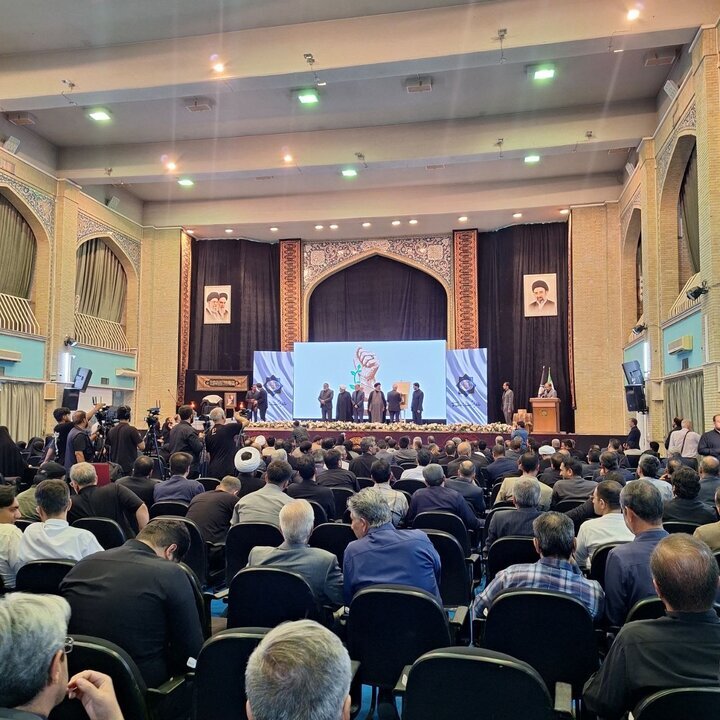
TEHRAN – The closing ceremony of the first Martyr Leader Global Poetry Award, aimed at commemorating the legacy and path of the martyred Leader of the Islamic Revolution, Ayatollah Seyed Ali Khamenei, was held on Monday at the Islamic Culture and Relations Organization in Tehran with the presence of cultural officials, intellectuals, and prominent international poets.
In his address at the ceremony, Minister of Culture and Islamic Guidance, Seyyed Abbas Salehi, emphasized the unique poetic stature of the Martyr Leader and said, “Unlike many leaders in the Arab and Islamic world who are strangers to literature and poetry, our wise leader was nurtured from childhood under the training of his dear mother, possessing a poetic sensibility. Until the end of his life, he memorized poems in three languages—Persian, Arabic, and Turkish—was proficient in literary criticism, and composed poetry himself.”
Highlighting the literary dimensions of the Leader’s character, the Minister added, “He not only read a great deal of poetry and possessed an exceptional memory, but also played an unparalleled role in the post-revolutionary era in poetry criticism, composing, and even the cultivation of poets. The mid-Ramadan poetry sessions were merely one manifestation of his passion, as he consistently encouraged and motivated young poets throughout the year.”
“He always emphasized that a revolution without poetry is incomplete, flawed, and lacking a medium; for the cultural essence and identity of Iranians are intertwined with poetry. From the very beginning of the revolution, he insisted on the link between poetry and the permanence of the revolution—a perspective that remained consistent both before and during his leadership,” ISNA quoted the minister as saying.
Also speaking at the event, Hojjatoleslam Mohammad Mehdi Imanipour, president of the Islamic Culture and Relations Organization, noted the significance of the event, stating: “The first cultural and international program of the Islamic Republic of Iran following the grand funeral of the Martyr Leader has begun with poetry, and we hope this initiative will develop into a lasting cultural movement. Based on our planning, the Global Poetry Award will continue in the coming years, and its scope will be expanded to other countries.”
“The importance of poetry in the Leader’s view was primarily due to this art form’s capacity to convey messages, as he believed that messages are transmitted more durably and effectively through poetry,” he added.
Imanipour reported a widespread response from poets around the world, noting: “Poets from 40 countries have submitted their works to the secretariat. The number of works has now exceeded 3,000 poems—a reception that demonstrates the high capacity of this prize and its global status.”
Subsequently, Alireza Ghazveh, Scientific Secretary of the event, reported an unprecedented reception from domestic and international poets, saying: “The number of submissions is still increasing, and the collection of poems, which has already been compiled into 10 volumes, has the capacity to be published in up to 20 volumes.”
Pointing to the participation of various academic groups in compiling this collection, he added: “The sections for Persian, Arabic, English, Afghan, Subcontinent, and Children’s poetry have been organized with the cooperation of professors and researchers in these fields, and a team of experts has been responsible for editing these works.”
During the ceremony, several volumes containing poems by domestic and foreign poets (along with translations) were unveiled. Additionally, 42 poets from 10 countries were introduced as winners.
The poetry recitation segment of the event, centered on the elegy of the Martyr Leader, hosted renowned poets from Iraq, Pakistan, India, Afghanistan, Yemen, and Lebanon.
SS/
Leave a Comment