'De-dollarization' and 'economic integration' on Iran's agenda at SCO summit
TEHRAN— Iran is seeking to use the Shanghai Cooperation Organization’s 2026 summit in Bishkek to deepen economic integration with Eurasian partners, advance de-dollarization and expand trade and transport links.
Iranian President Masoud Pezeshkian arrived in the Kyrgyz capital on Monday for the two-day summit, accompanied by Foreign Minister Abbas Araghchi. His visit includes participation in the SCO and SCO Plus meetings as well as a series of bilateral talks with leaders of member states.
The 2026 summit, which marks the 25th anniversary of the SCO, brings together leaders from China, Russia, India, Iran, Pakistan, Belarus and the Central Asian member states. Turkey is also participating as a dialogue partner. The organization has expanded significantly since its establishment, with the combined GDP of its members rising from about $1.67 trillion in 2001 to approximately $25 trillion in 2025, according to figures cited in the accompanying reports.
For Tehran, however, the summit is about more than multilateral diplomacy. Iran is seeking to convert its membership in the organization into practical economic mechanisms that can reduce its exposure to sanctions and strengthen its access to regional markets.
De-dollarization on economic agenda
One of Tehran’s central proposals is the establishment of a Shanghai Development Bank, with its capital structure based on the national currencies of member states and supported by independent systems for trade and financial settlement.
The proposal was presented during discussions among finance ministers and central bank chiefs in Bishkek. Under the plan, the proposed institution could help finance infrastructure projects, particularly in the energy and transportation sectors and along major regional corridors.
Iranian officials view the initiative as part of a broader effort to reduce dependence on the US dollar and create alternative channels for trade and finance.
Hassan Qashqavi, spokesman for the Iranian Parliament’s National Security Commission, said continued dominance of the dollar remained a source of economic pressure on Iran but argued that sanctions did not leave Tehran without options.
The proposal is expected to be referred to SCO's interim secretariat for further consideration.
Energy and transit links with central Asia
Pezeshkian’s meeting with Kyrgyz President Sadyr Japarov highlighted Tehran’s effort to translate political ties into concrete economic projects.
The Iranian president welcomed Bishkek’s proposal to establish a joint oil refinery in Kyrgyzstan and said Iran was prepared to supply the crude required by the facility and share the resulting refined products with Kyrgyzstan.
Pezeshkian also proposed establishing a Kyrgyz logistics center at Iran’s Bandar Abbas port. The facility could provide Kyrgyzstan with a route to the Persian Gulf, the Indian subcontinent and East Asian markets while allowing other members of the Eurasian Economic Union to make greater use of Iran’s transport infrastructure and access to international waters.
Japarov welcomed the expansion of economic and energy cooperation and invited Iranian oil exploration companies to contribute their technical expertise to projects in Kyrgyzstan.
The discussions reflect Iran’s broader strategy of positioning itself as a transit and energy gateway between landlocked Central Asian economies and international maritime markets.
India emerges as a key economic partner
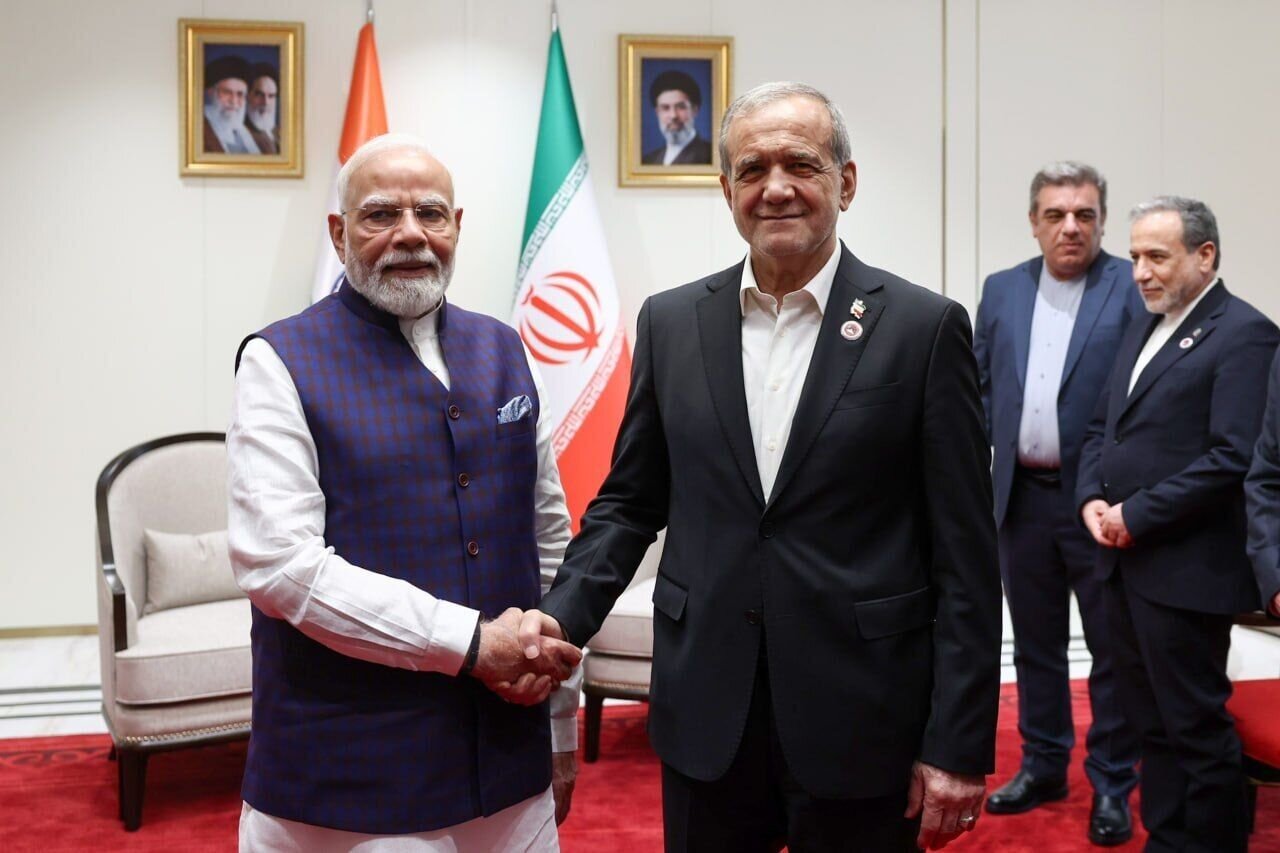
Pezeshkian’s talks with Indian Prime Minister Narendra Modi were particularly significant against the backdrop of sanctions and regional tensions.
The Iranian president emphasized the extensive potential for cooperation between Tehran and New Delhi in economic, political, scientific and cultural fields, arguing that closer bilateral ties could help mitigate the effects of sanctions.
The two leaders also discussed transportation and maritime cooperation, developments surrounding the Strait of Hormuz and progress at Iran’s Chabahar Port, one of the country’s key gateways to the Indian Ocean.
Pezeshkian thanked India for its cooperation with Iran during the recent U.S.-Israeli war and called for stronger diplomatic efforts to restore peace and stability in the region.
He reiterated Tehran’s position that Iran does not seek war and that regional disputes should be addressed through dialogue and negotiations. He also urged India to use its relations with different parties to encourage a shift away from confrontation and toward diplomacy.
Modi reaffirmed India’s commitment to strengthening its long-standing relationship with Iran and expressed readiness to expand and diversify bilateral trade. India’s Foreign Ministry described the meeting as “fruitful” and reiterated New Delhi’s position that outstanding disputes should be resolved through dialogue and diplomacy.
Broader Eurasian diplomacy
Pezeshkian also held talks with Pakistani Prime Minister Shehbaz Sharif and Tajik President Emomali Rahmon, with both meetings focusing on strengthening bilateral cooperation and making greater use of existing economic and political capacities.
The meetings form part of Tehran’s broader diplomatic push across Eurasia, where Iran is seeking to expand trade, energy cooperation, transportation links and strategic partnerships.
Iranian officials have also emphasized that Tehran’s defense cooperation with other countries is intended to strengthen regional security rather than target neighboring states. Pezeshkian has described regional security as a collective responsibility and argued that greater cooperation among regional states is the most sustainable way to prevent external interference.
The SCO summit therefore provides Iran with a platform that combines diplomacy, economics and security at a time of major geopolitical realignment.
The organization now represents a substantial share of the global population and economy, while its members have increasingly sought to strengthen economic cooperation outside Western-dominated financial structures.
For Tehran, the priority is to turn that emerging framework into tangible economic opportunities — from alternative payment mechanisms and infrastructure financing to energy partnerships and transit corridors.
As the SCO marks its 25th anniversary, Iran is positioning itself as an active participant in the organization’s evolving economic architecture, seeking to use multilateral cooperation to reduce the impact of sanctions, diversify trade and strengthen its role as a link between Central Asia, the Persian Gulf and the wider Asian market.
The summit is expected to produce the Bishkek Declaration and a series of agreements covering areas including security, energy, transportation and digital development, further underscoring the organization’s expanding role in the emerging Eurasian order.
Leave a Comment