Iran is not just retaliating; it has seized the initiative
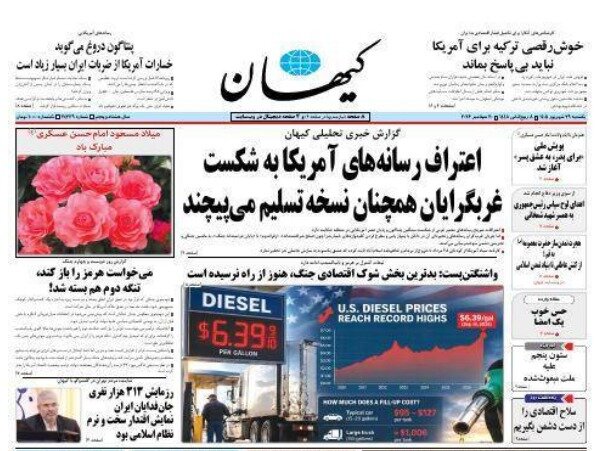
Kayhan analyzed the mounting pressure on the United States after seven months of war with Iran and argued that Iran now holds the initiative. The paper wrote that as the conflict approaches its seventh month, multidimensional pressure on Washington is rapidly intensifying.
The situation has reached a point where the US Secretary of Energy says Iran effectively controls global energy pricing. Meanwhile, the US -drafted anti‑Iran resolution at the UN Security Council was vetoed by China and Russia. According to Kayhan, Trump’s foolish war has produced no gains; instead, the Strait of Hormuz and the Bab al‑Mandab have effectively fallen under Iran and its allies’ control, leaving Washington with little capacity to respond. The era in which Iran merely retaliated against US and Israeli attacks is over. From striking a US aircraft carrier, announcing new restrictions in the Persian Gulf, and enabling Yemeni forces to seize a key chokepoint in the Red Sea, to shutting down the vital East–West pipeline, all developments point to Iran’s operational initiative. Iran is leveraging its peak pressure capacity to convert military disruption into economic and political leverage.
Iran: Supporting the consolidation of legal norms
The Iran newspaper examined Russia and China’s positions at the UN Security Council. According to the paper, Iranian officials welcomed the two countries’ stance against the political misuse of the Council. From Tehran’s perspective, the key issue is preventing the institutionalization of a trend that could turn political disputes over Iran’s nuclear file into binding Security Council mechanisms. This comes at a time when the disputed nuclear dossier has once again become central at the UN. Two parallel tracks are emerging: the IAEA seeks to maintain the scope of its reporting on Iran’s nuclear program, while the Security Council faces deep divisions among its permanent members over the future of sanctions mechanisms. The events of last Thursday revealed a deeper disagreement over the Council’s jurisdiction, the legal validity of the “Snapback” mechanism, and how the international community should approach Iran’s nuclear case. Moscow and Beijing, by using their vetoes, blocked the transformation of a politically motivated interpretation of international law into an enforceable decision.
Etemad: The United States is under pressure
Etemad wrote that the continued closure of the Strait of Hormuz and the fuel crisis in the West have severely disrupted global monetary calculations, energy markets, and international logistics chains. As Washington struggles with severe military attrition and record‑breaking fuel prices at home, Tehran’s move to block the strategic artery of Hormuz has effectively handed Iran control over US inflation dynamics. Iranian officials describe this as imposing the “Hormuz risk premium” on the US Federal Reserve’s decision‑making tools — a point even the Fed Chair has acknowledged, noting the direct impact of crisis centers on tightening policies. The overall trajectory of events shows that the balance of power has moved beyond conventional military confrontation: Iran’s strategic decisions in commercial and energy waterways are now challenging the structural stability of Western macroeconomic variables.
Javan: Global straits in turmoil
The world is in turmoil due to a war the United States triggered with its blind attack on Iran. Two of the world’s strategic straits are now closed or unstable. Saudi Arabia is reportedly pleading with China, Pakistan, and Oman for a two‑week ceasefire. Although the war planners initially envisioned a limited military operation, current indicators suggest the world is entering a fundamentally different phase — one whose consequences extend far beyond the battlefield and may reshape energy markets, regional security, and even US domestic politics. What is unfolding cannot be confined to a military crisis between Iran and the United States. By disrupting energy markets, destabilizing new oil trade routes, increasing economic costs, and generating political pressure in affected countries, the conflict may push the world toward changes far greater than those imagined at the outset. The most important reality, Javan argues, is that wars can be started — but their consequences rarely remain within the boundaries set by those who initiate them.
Khorasan: Elections as the decisive factor
Khorasan analyzed why Trump and Netanyahu have returned to “regime‑change rhetoric,” arguing that both face potential electoral defeat. The continued closure of the Strait of Hormuz has intensified public dissatisfaction in the United States. In Israel, most polls indicate a likely reduction in Likud’s seats in the Knesset, increasing the probability of Netanyahu’s defeat. In this context, Khorasan suggests it is not unlikely that Trump and Netanyahu may resort to any measure in the next two months — including attempts to provoke domestic unrest in Iran combined with simultaneous military action — in hopes of manufacturing a “sellable victory” for their voters. The paper concludes that adversaries remain intent on creating instability and unrest.
Leave a Comment