Minab children’s unfinished dreams live on in paintings
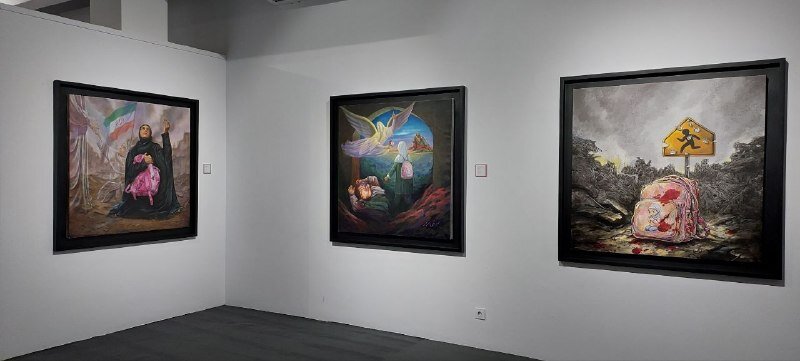
TEHRAN- There are exhibitions that can be visited, and there are exhibitions that stay with you long after you have left. The group painting exhibition dedicated to the martyred children of Minab belongs to the latter.
Walking through the gallery, the first impression is not of an ordinary art show. The walls are filled with paintings that speak of children, schools, dreams and lives that ended before they had the chance to fully begin. The colors, faces and empty spaces in the works carry a sadness that is difficult to separate from the reality behind them.
The paintings do not simply tell the story of a tragedy. They create an atmosphere of absence — the absence of children who should have been preparing for another school day, another lesson and another ordinary morning.
Held at the Art Bureau in Tehran, the group exhibition brings together works by contemporary Iranian artists in memory of the martyred children of Minab School. The exhibition has turned a painful event into a visual narrative, allowing each artist to approach the tragedy through a different image and artistic language. The works recall the attack on the Shajareh Tayyebeh School in Minab, Hormozgan province, where a school building was struck during the Israeli-US aggression against Iran in February, killing and injuring students and school staff.
Walking through the gallery, it is difficult not to think about the approaching new school year in Iran. In just a few days, schools will once again fill with children carrying backpacks, wearing uniforms and meeting their friends after the summer break.
The beginning of a school year is normally associated with new beginnings. At the Minab exhibition, however, the same idea acquires a different meaning. The children portrayed in these paintings will not return to their classrooms. Their school days ended, while their dreams — and the futures their families imagined for them — remained unfinished.
For Iranian families preparing their children for a new school year, the thought of children who will never walk into their classrooms again becomes particularly painful.
One visitor described the exhibition as a reminder of “dreams that were cut down before they could blossom.”
The phrase seems to echo through the gallery. Behind every painting is the question of what these children might have become: what they might have studied, whom they might have met, what professions they might have chosen and what lives they might have built.
Another visitor said the exhibition represents a reminder of the vulnerability of children in war and oppression, and of the suffering of innocent children caught in violence.
For a third visitor the significance of the exhibition goes beyond remembering the victims. He expressed hope that exhibitions of this kind could create greater international empathy, raise sensitivity toward the suffering of children and encourage people around the world to pay closer attention to such tragedies.
In this sense, the paintings are not merely records of grief. They are also attempts to make grief visible to people who did not experience the tragedy themselves.
Perhaps the most striking element of the exhibition, however, is not a painting at all. Among the finished works hangs an empty frame. A note beside it explains that the empty frame represents the continuation of the exhibition and is waiting for another work by an artist.
The blank space is simple, but difficult to ignore. In a gallery filled with images created to remember children who are no longer here, an empty frame becomes another kind of image — one that asks the viewer to imagine what has not yet been painted and what stories still remain to be told.
It also suggests that remembrance is not meant to end with one exhibition or one collection of paintings. The empty frame leaves the story open, waiting for another artist to respond.
As visitors move from one painting to another, the exhibition gradually feels less like a collection of artworks and more like a collective act of remembering. The sadness comes not only from what the paintings show, but from what they cannot show: the years these children might have lived, the classrooms they might have entered, the friendships they might have made and the ordinary futures that will never happen.
The exhibition officially presents paintings. But after walking through the gallery, it becomes difficult to see them only as paintings.
They are memories given color and form.
They are artists' attempts to hold on to a painful moment and prevent it from becoming just another date in history.
And as the new school year approaches, the images seem to speak even more directly. While millions of Iranian children are preparing to return to school, the children of Minab remain in the memories of their families and in the works on the gallery walls.
Their desks may be empty, but their stories continue to occupy a space — in art, in memory and in the collective grief of those who refuse to let them disappear.
SAB/
Leave a Comment