ICCIMA head outlines 6 steps to boost trade with Kazakhstan
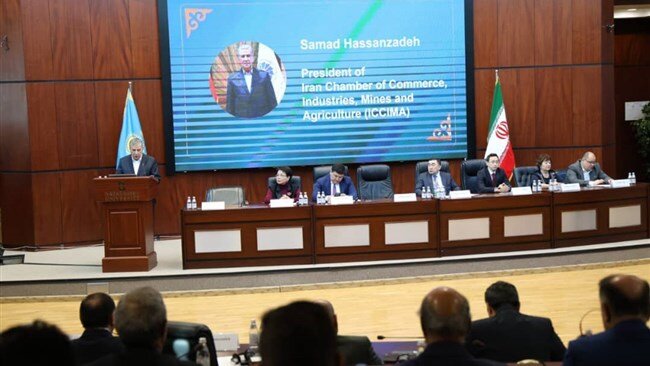
TEHRAN – The head of Iran Chamber of Commerce, Industries, Mines and Agriculture (ICCIMA) said on Wednesday that a set of practical measures, including formalized barter, a joint financial mechanism and long-term involvement in Kazakhstan’s infrastructure projects, could significantly expand bilateral trade.
Speaking at a seminar on Iran–Kazakhstan trade cooperation, Samad Hassanzadeh said the two countries should launch a new strategic program to deepen economic ties.
He described Kazakhstan, with a gross domestic product of more than $288 billion, as a key Eurasian economy and one of Iran’s principal partners in Central Asia.
The official said bilateral trade over the past ten months reached about $360 million, including $243 million in Iranian exports and $115 million in imports from Kazakhstan, adding that while the trade balance is positive for Tehran, the current level of cooperation remains far below the two sides’ potential.
Hassanzadeh said trade could rise to $3.0 billion if key constraints were removed. He added that the free trade agreement between Iran and the Eurasian Economic Union, which eliminates a large share of tariffs for the first time, had reduced transaction costs and created what he called a strategic opportunity for Kazakhstan to link to Persian Gulf, South Asian, African and even European markets via Iranian routes. Iran, he said, could in turn become a distribution hub for Central Asia.
Outlining his first proposal, he called for a joint working group to quickly identify priority goods and agree on stable supply contracts. He described Iran as the most reliable, cost-effective and secure route for Kazakhstan’s access to open waters, saying southern Iranian ports could serve as the final link for Kazakh exports to India, Western markets, Southeast Asia and Africa.
His second proposal focused on creating a Kazakhstan–Iran “green transit corridor” offering customs discounts, faster clearance and long-term transport agreements.
Hassanzadeh also highlighted the need for joint investment rather than simple commodity trade. He identified three potential projects: a joint logistics terminal in southern Iranian ports; shared facilities for processing grain, meat and vegetable oil; and a joint industrial zone in Iran’s free trade areas to serve Eurasian markets.
Noting Kazakhstan’s position as a major supplier of oil, iron concentrate and base metals, and Iran’s strengths in downstream petrochemicals, machinery and technical expertise, he proposed a joint consortium for processing Kazakh minerals in Iran for re-export at higher value.
He also cited challenges facing the relationship, including sanctions, banking restrictions, unreliable companies and strong regional competition. But he said practical solutions exist, including formal and systematic barter, a shared financial platform in a free trade zone, a company credit-rating system and Iran’s participation in long-term Kazakh infrastructure projects.
Iranian president leaves Tehran for Kazakhstan
Iranian president Masoud Pezeshkian left Tehran on Wednesday (December 10) for Kazakhstan and Turkmenistan for a two-day visit focused on expanding trade and transport cooperation.
The president’s chief of staff Mohsen Haji-Mirzaei said on Wednesday that the Kazakhstan leg will be a bilateral trip during which several agreements aimed at developing trade between the two countries are expected to be signed.
He said a number of ministers accompany the president, with negotiations planned across sectors including transport and commerce.
Haji-Mirzaei said a large delegation from the Iran Chamber of Commerce had already travelled to Kazakhstan for discussions with local business groups to explore areas of potential cooperation.
A joint meeting of Iranian and Kazakh traders is planned to take place in the presence of Pezeshkian as part of the visit.
EF/MA
Leave a Comment