Individual crime in Australia and Israeli massacre at Al-Tabi’een school
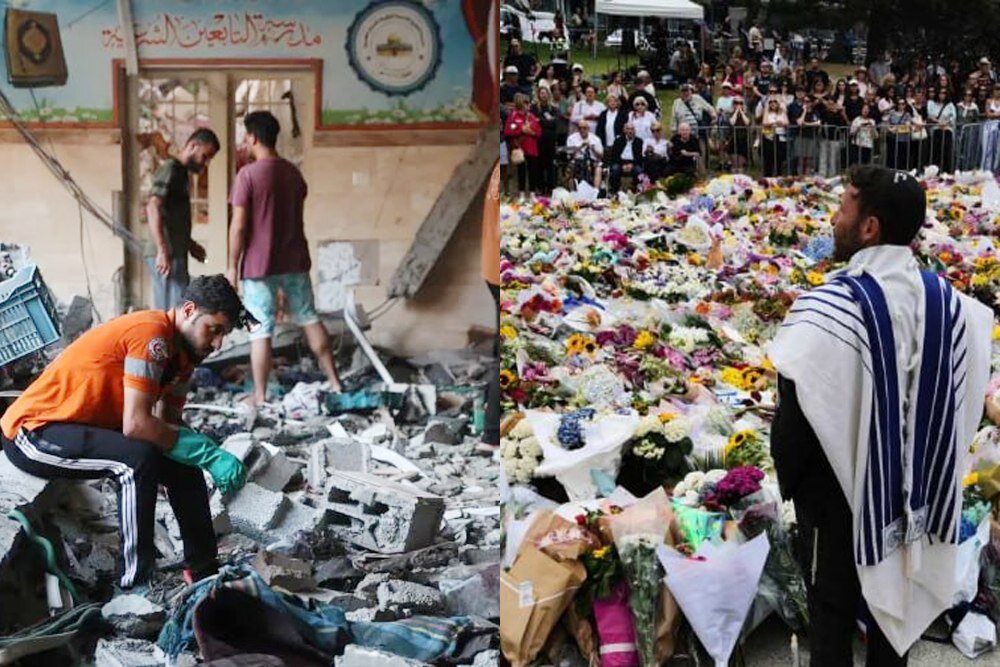
BEIRUT - The comparison between the act of one or two individuals attacking Hanukkah celebrants in Australia, and the crime of targeting civilian worshippers at Al-Tabi’een school in Gaza on August 10, 2024, using precise U.S.-made GBU-39 bombs, lays bare the moral and political degradation embedded in Western-Israeli discourse, as well as the blatant double standards in defining terrorism, sanctifying one kind of blood while dehumanizing another.
This is not a superficial comparison between two unrelated events. It is a direct confrontation between a limited individual act with contained consequences and a fully-fledged state crime, one that carries genocidal intent, is executed with American strategic weaponry, and is politically and media-wise shielded.
Scale of victims: When Palestinian blood becomes a worthless number
In the Australian incident we are dealing with a limited attack carried out by one or two individuals, resulting, according to available information, in a small number of injuries when compared to any armed conflict, falling far short of mass killing. Despite the limited harm, the incident was politically and media-wise inflated, treated as an existential threat, and accompanied by widespread security mobilization and international media coverage.
In contrast, the “State of Israel” bombed Al-Tabi’een school, which was sheltering civilian worshippers and displaced people, using highly precise American GBU-39 bombs. The attack resulted in the martyrdom of more than 100 civilians and injured dozens more. It was massacre documented by sound and image at a location publicly known and declared as a civilian shelter. This was not a mistake; it was a deliberate target, a calculated timing during prayer, and the use of a weapon designed to kill with maximum precision.
The numerical disparity alone exposes the lie: a small amount of blood spilled in the West becomes a global catastrophe, while rivers of blood in Gaza are reduced to the phrase “casualties were reported.”
Scale of reactions: Inflating an incident, justifying a massacre
The Australian attack was met with immediate condemnations by world leaders, extensive media coverage, and a ready-made narrative of “antisemitism,” even before investigations were completed or motives established. Intent was assumed, the interpretive framework was pre-set, and the incident was placed within an ideological context serving the global Israeli narrative.
Meanwhile, the Al-Tabi’een school massacre was met with shameful silence or crude justifications—such as "targeting militants" or "human shields." This was despite the fact that the victims were worshippers inside a school sheltering displaced civilians, and despite the use of smart American weaponry that should not miss, leading to the grim conclusion that mass killing itself was the objective.
No sanctions were imposed, no ambassadors recalled, no effective international investigations launched. The crime was absorbed as casually as a passing weather report.
This is how the equation is managed: an individual incident is elevated to a universal crime, while a state-perpetrated massacre is linguistically and morally laundered.
Here, the verses of poet Adib Is’haq resonate as if written yesterday: The killing of a man in a forest is an unforgivable crime, but the killing of a peaceful people is a matter for debate.
Motives: Manufactured ignorance here, premeditation there
In the Australian case, the real motives remain unknown. One attacker was killed and the other injured amid concerns that the truth may be suppressed, politically or media-wise, to preserve a single dominant narrative: “antisemitism,” regardless of facts or investigation outcomes. The story is written before the truth and imposed as a final reality.
By contrast, the Al-Tabi’een school crime requires no speculation about motives. It fits squarely within an openly declared ideological framework, grounded in religious rhetoric explicitly adopted by Netanyahu himself and used in official messages to soldiers, invoking the annihilation of the “Amalekites” (The Amalekites are a significant and complex entity in the Hebrew Bible - Old Testament -, depicted as the perpetual arch-enemy of the Israelites.) This is a blatant resurrection of biblical texts from the Book of Samuel, which legitimize total extermination without exception: women, children, and the elderly.
Here, we are facing an announced intent, mobilizing discourse, and military action fully aligned with that discourse. This is genocide by prior design, not individual impulse or random violence.
Collapse of moral order
The core of international humanitarian law rests on a single, non-negotiable principle: the absolute prohibition of targeting civilians and the unconditional protection of non-combatants—whether they are worshippers, displaced people, or civilians in schools and shelters. This principle is not selective, nor does it depend on the identity of the victim or the religion of the perpetrator.
What the comparison between Australia and Gaza reveals is not differing incidents, but the collapse of a unified moral standard. When a limited individual act is condemned while a documented, genocidal state crime is justified. It means the international system no longer protects human beings. It protects weapons, political patrons, and the dominant narrative.
The silence over the Al-Tabi’een school massacre, contrasted with the global outcry over the Australian incident, condemns not Israel alone, but an entire international order that has decided some humans are born without the right to life—or even the right to be mourned.
Using the Sydney incident as a pretext for broader aggression
The Sydney incident cannot be separated from the broader geopolitical context in which Israel seeks to expand the confrontation with Iran, shifting it from covert warfare to open conflict under the banner of “self-defense.” Israeli history is replete with examples of exploiting security incidents, even ambiguous ones, as political and military leverage to justify pre-planned aggression.
In this context, Yedioth Ahronoth makes a striking assertion: “The Sydney operation was caused by the wave of antisemitism sweeping the world, and in Israel they are examining Iranian involvement in the operation.”
This statement is not neutral journalism; it is a classic narrative prelude—linking an incomplete, unresolved incident to Iran, then embedding it within a global antisemitism discourse, thereby enabling the expansion of blame from unknown individual actors to an adversarial state.
The danger lies not only in the absence of evidence, but in the methodology itself: an event occurring at the far edge of the world, with perpetrators killed or silenced and motives unresolved, is suddenly transformed into a node in the so-called Iranian “axis of evil.” Thus, pretexts are manufactured, and past scenarios replayed, where ambiguous or fabricated incidents were used to justify devastating wars.
If Iranian involvement is “established”—or even merely promoted without conclusive proof—it opens the door to a joint Israeli-American aggression presented to the world as legitimate preemptive defense, rather than unlawful escalation.
Here, the picture becomes complete: a limited incident in Australia is inflated, ideologized, and tied to Iran, while documented massacres in Gaza, such as Al-Tabi’een school, are buried because they expose, rather than serve, the coming war project.
In this sense, the comparison between Sydney and Gaza is not only moral, but predictive: the former may be weaponized as a pretext for a major regional war, while the latter is erased because it stands as living proof that the real problem is not “antisemitism,” but a state practicing genocide and perpetually seeking new wars to conceal old crimes.
And tomorrow is not far away for those who wait.
(Adnan Allameh is a member of the International Association of Political Experts and Analysts)
Leave a Comment