WSJ’s balkanization fantasy and the hyenas at Iran’s gate
Why Iran’s civilizational depth defies neocon fantasies

TEHRAN – The Wall Street Journal published a provocatively unhinged opinion piece by Melik Kaylan on January 16, serving as a naked blueprint for the fantasies of Iran’s enemies who dream of the nation’s destruction.
Titled “A Fractured Iran Might Not Be So Bad,” the article moves past the usual platitudes of “democracy promotion” to advocate for “geographical fragmentation.”
Kaylan ridiculously portrays Iran’s borders as “artificial” and “drawn rather arbitrarily,” suggesting that the West should “help secession happen” to “take a downsized Iran... off the geopolitical chessboard entirely.”
This is a confession. After years of orchestrating economic warfare and terror — and especially in the wake of recent foreign-directed riots and coordinated terror attacks that claimed the lives of hundreds of innocent Iranians — the mouthpiece of the ultra-Zionist Murdoch media has finally said the quiet part out loud.
The goal is not to “stand with the Iranian people,” as Western politicians have repeatedly said, but to facilitate a bloody balkanization scheme that would leave the plateau in ruins to serve foreign interests.
The most revealing sentence in the entire piece admits that “a pared-down Iran would pose a diminished risk to Israel.”
This is the core of the neocon fantasy. For those still gullible enough to believe that Western intervention is motivated by “human rights,” Kaylan provides a necessary wake-up call.
The intent is to split Iran into warring ethnic factions that can be played against one another, effectively repeating the tragedies seen in Libya and Syria.
It is the height of hypocrisy for the West to claim concern for Iranian lives as they funded and armed a live-streamed genocide in Gaza.
The mask has fallen, revealing that the true objective is the total removal of Iran as a regional power.
Kaylan’s arguments are rooted in a profound ignorance of history and a transparent ethnic bias. As a fringe journalist known for belittling the Armenian genocide, Kaylan’s pan-Turkic leanings are on full display when he claims that “The Azeris of Iran eye their flourishing Turkic brethren in Azerbaijan with a degree of envy.”
He openly suggests that a “united Azerbaijan” would serve the interests of Turkey and Israel, revealing a NATO-backed plan to carve up Iranian territory to “reopen the old Silk Road” for Ankara.
For over two millennia, Persian statecraft shaped the political order of the region. Even when Turkic dynasties rose to power, they governed through Persian administrators, Persian institutions, and Persian culture — a testament to Iran’s unmatched civilizational depth.
His claim that Iran’s borders are “arbitrary” is a historical absurdity. Unlike the colonial mandates of the Levant or certain small, Western-backed states that claim ancient indigeneity while being modern creations, Iran is one of the world’s oldest civilizations.
Hegel, one of the most influential German philosophers, famously treated ancient Iran (Persia) as the first truly world-historical empire, where a universal principle enters history and unites many peoples under a single imperial order—an early, formative moment in the story of what would later become the modern nation-state.
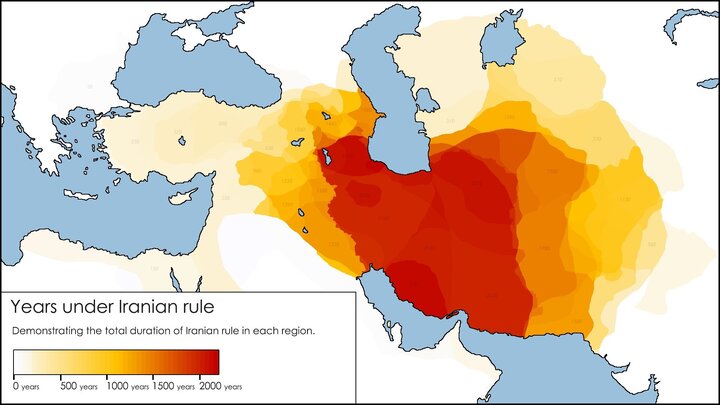
A map of the Iranian plateau illustrating over 2,000 years of continuous rule and territorial stability, “debunking the artificial borders” myth with deep civilizational continuity
Furthermore, recent scientific evidence utterly dismantles the claim that Iran is a collection of fragile, artificial groupings.
A landmark study published in PLOS Genetics, together with additional regional genomic analyses reported in 2025, shows that although Iranians display high internal genetic diversity, the core ancestry of Persians, Kurds, Lurs, Azeris, Gilaks, Mazanderanis, Arabs, Qashqais, and other groups has remained remarkably stable on the Iranian plateau for many millennia.
This genetic continuity in the Northern Iranian Plateau, spanning from the Copper Age to the Sassanid Empire and into the modern era, proves that the Iranian identity is biological and historical, not a recent colonial construct.
In perspective, modern Iranians have retained their genetic constitution far more successfully than modern Germans or Britons have over the same period.
The hyenas are indeed circling, but they underestimate the depth of the Iranian roots.
The WSJ piece is an admission of failure; unable to topple the state through “maximum pressure,” terror attacks, and attempted velvet revolutions, the architects of chaos are now pivoting to total disintegration.
For any Iranian still shouting for “intervention,” this article exposes the endgame: not reform, but the end of their 3,000-year-old home.
Our beloved Iran is facing a coordinated effort to be taken “off the geopolitical chessboard,” as Kaylan wrote, and the only response must be an ironclad commitment to the unity that has defined this plateau since the dawn of history.
Leave a Comment