A warning to America, resistance forces placed on alert
Ayatollah Khamenei says any US attack on Iran will trigger an all-out regional war
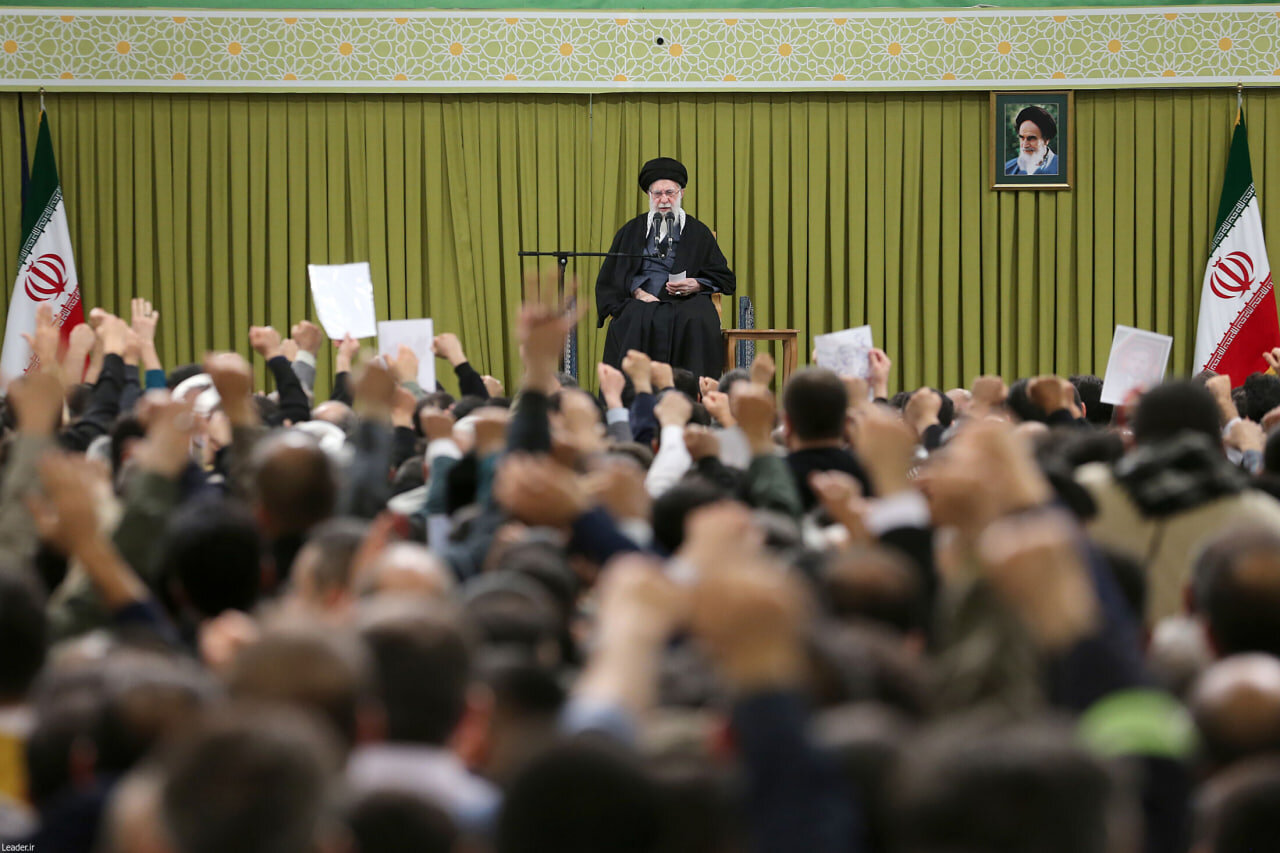
TEHRAN – As the United States continues to threaten possible war against Iran while expanding its naval military buildup in the Persian Gulf, Leader of the Islamic Revolution Ayatollah Seyyed Ali Khamenei has said that Tehran will not initiate a conflict but will respond decisively, and will also ensure that any future war with the United States becomes a regional one.
Iran previously forced the United States and Israel to seek a ceasefire after the two regimes launched an illegal war against the country in June 2025, a campaign that collapsed after only 12 days when Iranian missiles left widespread destruction across Israeli cities and damaged the largest U.S. military base in West Asia. Tehran did not seek the help of its allies back in summer, who have said in recent weeks that they would target American and Israeli personnel and assets from Lebanon, Iraq, and Yemen if Iran is attacked again.
The Leader addressed the prospects of war on Sunday, as he celebrated the 47th anniversary of the victory of the Islamic Revolution with thousands of people in Tehran.
During the meeting, the Leader addressed the reason for the decades-long hostility of the U.S. toward Iran, saying: “The U.S. wants to devour Iran, but the Iranian nation and the Islamic Republic stand in its way. In reality, the ‘offense’ of the Iranian nation is that it told the U.S., ‘You are mistaken if you think you can devour my country.’”
Ayatollah Khamenei described Iran’s numerous endowments, including its oil, gas, rich mines, and strategic geographic position, as the reason for the greed of an aggressive and expansionist power such as the U.S. He emphasized: “They seek to occupy Iran and restore their dominance over its resources, oil, politics, security, and international relations, just as during the Pahlavi era. This is the main reason for their hostility, and the rest of their claims, such as human rights, are just empty talk.”
The Leader of the Islamic Revolution stressed: “The Iranian nation has firmly stood against the U.S.’s ambitions, continues to stand, and will remain steadfast, frustrating them in their schemes and hostile acts.”
Referring to the U.S.'s threats regarding war and the use of aircrafts, he said: “These statements are not new. In the past, they repeatedly threatened that ‘all options are on the table.’ Now, this individual [the U.S. President] continually makes claims of the same nature, saying that we have brought an aircraft carrier.”
Ayatollah Khamenei added: “The Iranian nation must not be intimidated by such things; it will not be influenced by these statements. Of course, we are not the initiators of war. We do not seek to oppress anyone. We do not seek to attack any country. However, anyone who seeks to attack or cause harm will face a decisive blow from the Iranian nation.”
The Leader of the Islamic Revolution emphasized: “The Americans should also know that if they start a war, this time it will be a regional war.”
In continuation of his remarks, emphasizing the American and Zionist nature of the recent unrest, the Leader described the rioters as consisting of “ringleaders” and “foot soldiers.” He added: “The ringleaders, many of whom have been arrested, confessed that they were paid for their actions and trained in how to attack centers and mobilize and direct young people. However, some of the other rioters were impulsive youths, and we do not have significant problems with them.”
Ayatollah Khamenei called the statements of the U.S. President a clear sign of the American and Zionist nature of the recent sedition, saying: “He explicitly told the rioters, whom he referred to as the ‘Iranian nation,’ ‘Go ahead, I’m coming [to help]!’ According to their view, these few thousand rioters were ‘the Iranian nation,’ but the millions who rallied across the country on January 12 were not considered part of the Iranian nation.”
The Leader of the Islamic Revolution pointed to the new path and ideology of the Islamic Republic and its clash with the interests of Global Arrogance as the reason for the continuation of their hostility. He stated: “For this reason, the recent sedition, just as it was not the first in Tehran, will not be the last, and such incidents may occur again in the future.”
He added: “These hostilities will continue until the Iranian nation, with stability, resilience, and full awareness of the affairs, brings despair to the enemy—and we will reach that point.”
The Leader of the Islamic Revolution emphasized that officials truly must appreciate the Iranian people, saying: “Of course, this sedition occurred, whether by chance or design, at a time when the government and officials were designing economic plans and packages to advance the country’s situation.”
The final characteristic of the recent sedition highlighted by the Leader was its ISIS-like violence.
Referring to the admission of the current U.S. President during his first election campaign about America’s involvement in creating ISIS, he said: “In the recent sedition, the Americans created a group resembling ISIS in its actions. ISIS violently murdered individuals by accusing them of unbelief, and these rioters also killed people with the same brutality but because of their [religious] beliefs, burning some alive and beheading others with shocking cruelty and ruthlessness.”
In conclusion of his remarks, Ayatollah Khamenei described February 1 as an exceptional and historic day. Referring to the unprecedented and unified reception of Imam Khomeini (ra) on February 1, 1979, he stated: “Amid all threats, Imam [Khomeini (ra)] entered Tehran with courage and power, and the grand reception of the people became the catalyst for establishing a new system, and on that very day, the overthrow of the monarchy was declared.”
The Leader of the Islamic Revolution identified two defining characteristics of the system born from the struggles of Imam Khomeini (ra) and the Iranian nation: the transformation of an autocratic government into one in which the people hold full authority, and the conversion of the anti-religious process intended by the Pahlavi regime into an Islamic process.
He also considered the return of the country to its rightful owners—the Iranian people—and the elimination of American influence from Iran as another defining characteristic of the Islamic Republic, stating that this caused anger and hostility from the U.S. toward the system and the nation.
Ayatollah Khamenei, in explaining the popular dimension of the government, referred to the creation of a spirit of self-reliance among the people, saying: “The wise Imam [Khomeini (ra)] made the nation aware of its great capabilities and values, transforming the mindset of ‘we cannot’ into the vital belief of ‘we can.’”
Recalling the country’s progress across various fields, the Leader added: “Who would have believed that one day the Iranian nation would reach a point where Americans would copy a weapon (drone) made by it? All of this is the result of the confidence, hope, and ambition that Imam Khomeini (ra), as the ‘embodiment of hope and self-reliance,’ instilled in the nation, motivating the people to strive and take action.”
Leave a Comment