The Strait of Hormuz as the US president’s political thermometer
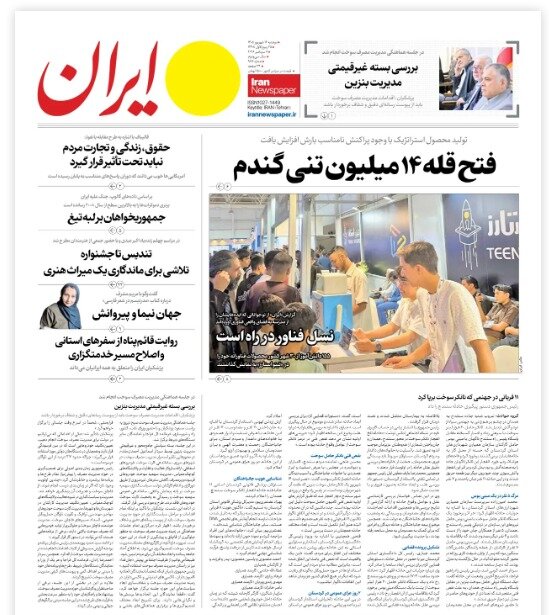
The Iran newspaper analyzed the management of the Strait of Hormuz and the control of tensions in the region: The current situation in the Strait of Hormuz must be understood within the conceptual framework of “erosive peace.
”In such a condition, the aim of confrontation is not full‑scale war but the management of circumstances. Washington has turned the Strait of Hormuz into a “political thermometer,” adjusting the temperature of tensions with millimetric precision—both to show domestic public opinion that it has the situation under control and to prevent a price explosion. This tension‑management is inseparable from the dynamics of the November 2026 US elections. On the eve of the election, any uncontrolled escalation in the Strait directly ties into fuel prices and inflation inside the United States. Given Trump’s declining approval ratings, Washington is compelled to use tension as a kind of electoral painkiller to prevent further collapse in popularity—even though this erosive peace is by no means a sustainable strategy.
Kayhan: British and American employers of Iran’s West‑leaning camp
Kayhan, in an article, criticized Iran’s West‑leaning political faction. It wrote: When you see, scattered through recent years’ news, remarks downplaying Iran’s defensive and missile capabilities, portraying the nuclear industry as a costly burden, or depicting the management of the Strait of Hormuz as troublesome, you should not be surprised. According to the familiar pattern of the unclean hands of global powers, they are—directly or indirectly—busy belittling Iran’s assets and achievements to pave the way for their eventual surrender. Today, Iran’s missile power has become so evident and globally recognized that domestic West‑leaning figures no longer dare to cast doubt on it. Instead, they have once again turned to the Strait of Hormuz and even the nuclear program, trying to portray these strategic industries as insignificant. Their agenda is the same as always: to depict management of the Strait of Hormuz as problematic and unimportant in public opinion so that abandoning it becomes easier. This method belongs to their British and American employers—who, unfortunately, have used Iranian agents to advance their goals.
Sobh‑e‑No: A war that trapped Trump
Sobh‑e‑No analyzed the trap Trump has fallen into. The Iran war has now become one of the biggest domestic challenges of Trump’s presidency. The US economy, which had only recently emerged from the COVID crisis, is once again stuck in the swamp of inflation and rising costs, and the slogan “ending endless wars” has given way to a painful reality. American Senator Bernie Sanders argues that continuing this war is not only inhumane but foolish and against US national interests. The central question now is: Will Trump swallow his pride and end the war, or will he push America further down the dangerous path of inflation and public dissatisfaction until the midterm elections? What is clear is that the time to end the war has come—not for Iran, but for America itself.
Siasat‑e‑Rooz: Trump’s new game; renaming the war
In its editorial, Siasat‑e‑Rooz examined Trump’s decision to rename “Epic Fury Operation” as a “military engagement.” A new Reuters–Ipsos poll shows that only about one‑quarter of Americans consider the Iran war worthwhile. Trump faces a dilemma. If he ends the war now, he must return to the Islamabad Agreement—something he considers a defeat against Iran. But if he escalates the war, the costs will haunt him in the election. In this situation, Trump appears to have launched a war of narratives, centered on renaming the operation from Epic Fury to an overseas operation under CENTCOM’s area of responsibility. This allows him, on the one hand, to claim victory, and on the other, to insist that continued strikes are necessary to finalize Iran’s submission. He hopes that by breaking Iran’s economic and military resilience—and, in his view, trapping Iran in domestic unrest—he can secure at least some electoral gain.
Ham‑Mihan: Russia’s strange policy
Ham‑Mihan commented on Russia’s lack of objection to Article 4 of the G20 joint statement. Article 4 refers to free, safe, and predictable navigation in the Strait of Hormuz. Russia’s silence is notable because, compared to China, it is considered politically and militarily closer to Iran. Russia also needs the Strait far less than China—and even benefits from disruptions there. Yet Moscow chose not to oppose Article 4. The likely reason, Ham‑Mihan argues, is Russia’s desire not to irritate the Trump administration. Trump’s encouragement of Russia to attend the Nashville summit in person—contrary to the Biden administration’s approach—and the value of maintaining Trump–Putin relations amid the Ukraine crisis are among the factors shaping Russia’s behavior. Russia may also calculate that Iran ultimately has no alternative and must tolerate Moscow’s conduct.
Leave a Comment